wikiHow is a “wiki,” similar to Wikipedia, which means that many of our articles are co-written by multiple authors. To create this article, 22 people, some anonymous, worked to edit and improve it over time.
wikiHow marks an article as reader-approved once it receives enough positive feedback. In this case, 100% of readers who voted found the article helpful, earning it our reader-approved status.
This article has been viewed 199,052 times.
Learn more...
Cats are wonderful pets and great to have around, but they—like people—have a wide variety of personalities. Some cats are outgoing and friendly whereas others may behave aggressively or fearfully toward new people or stressful situations.[1] Whether your existing cat is reacting fearfully to a stressor or you’re trying to help a new cat adjust to you, you can take several steps to show the cat that you’re not a threat.

Steps
Method 1
Method 1 of 2:Calming Your Fearful Cat
-
1Recognize signs of a fearful cat. Cats are certainly adept at communicating when they’re angry—hissing, growling, flattening their ears, and fur standing on end is hard to miss.[2] However, general aggression is just one of many behaviors associated with a frightened cat. Other behaviors to look for include:[3]
- Hiding or running away
- Freezing in place
- Releasing anal glands, urine, or stool
- Not using the litter box
-
2Isolate the cat’s fear triggers. Your cat may have a consistent set of triggers—such as sounds, people, etc.—that cause the fearful reaction. In many cases, you may be able to help the cat adjust by simply reducing the cat’s exposure to the trigger of the fear or aggression. Common examples include:[4]
- Loud sounds or quick, unexpected movements
- Strange or new environments
- Unfamiliar people or animals
- Active, unpredictable children
- Stressful events (moving and trips to the vet, especially)
Advertisement -
3Give your cat space. For many stimuli that trigger a fearful response in your cat, the answer is simply to give your cat some time and space alone.[5] If the stressful occurrence caused your cat to hide in her carrier or another favorite hiding spot, then leave her be.[6] She’ll get over it accordingly.
- Note that while a sound might make her hide for a few minutes, something like moving to a new home might make her scarce for days. Make sure she has access to food, water, and her litter box to use nearby.[7]
- Trying to force your cat out of a hiding spot before she’s ready will only stress her out more and amplify the fearful response.[8] Don’t take it personally as though she’s afraid of you.
- When helping an aggressive or fearful cat after a move, you may want to introduce her to the new home one room at a time. Start with a calm secluded room where you can put her carrier, toys, food/water, and litter box (on the other side of the room from the food/water).
-
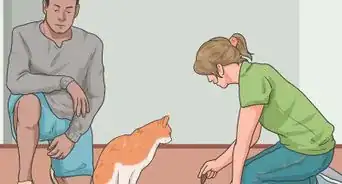
4Use food to motivate your cat. Cats respond to few things as well as food. If your cat has a fearful response to a friend or a new roommate who you’d really like the cat to bond with, then put that person on food and treat duty.[9] Start by having the person fill the cat’s food dish and then simply sit on the other side of the room without making eye contact or otherwise paying any attention to the cat. Have the person move slightly closer over the course of several repetitions.
- Have the person give her treats as well. Set the treat out where your cat can see it and then move away to a similar distance, moving closer over time. Your cat will begin to associate this person with good things instead of treating the person as a fear trigger.
- Remember to let your cat set her own pace. Luring her out is not the same as forcing her. Ultimately, she needs to choose to come toward the person.[10]
-
5Provide a high perch. Cats love to be up above the action where they can look down and survey in safety. If the fearful response stems from an overactive toddler or a new animal in the house, then a cat tower where your cat can retreat is a great option.
- Even the option of a cat tower can help calm your cat. Your cat is much more likely to respond fearfully to a situation if she feels cornered. If she always knows that she has her tower to escape to, then she’s less likely to respond aggressively when she can just run away to her safe spot.
Advertisement


Method 2
Method 2 of 2:Bonding with an Unfamiliar Cat
-
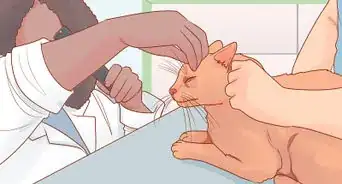
1Take the cat to a vet. Make sure any new cat you want to bring home is up to date on her shots and veterinary exams. If you’re adopting a cat from a rescue, then you’ll likely receive this documentation with the cat. If you’re taking in a stray, then you should absolutely take her to the vet before bringing her into your house. Sick cats can potentially transmit diseases to you or your loved ones, and they’re more likely to be aggressive, which can result in injury.
-
2Let the cat adjust to one room at a time. New owners, a new environment, and a disruption to the cat’s previous routine are all triggers for a fearful response from a cat. In an effort not to overwhelm the cat, isolate her to one room as she adjusts to her new home. Place her food, water, toys, and litter box all in the same area, as well as her carrier where she can hide.[11]
- Leave the door open, so she can explore at her own pace, but don’t try to force her away from this space.
-
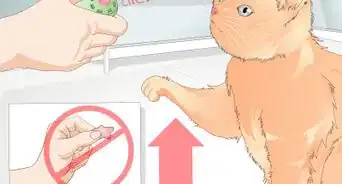
3Provide food and treats. Bonding over food is always a safe bet with cats. You want her to begin associating you with delicious food and treats.[12] Don’t try to feed her by hand though. Make noise with the food bag or bag of treats so she knows you have something good for her, and then place the dish down and sit close by. Over the course of many repetitions, move closer to the dish without looking at the cat or trying to pet her. Simply help her acclimate to you being in the same space.
-
4Play with the cat. Playing with a cat is another great way to bond.[13] Don’t attempt to touch the cat. Instead, buy wand toys with dangling feathers or catnip toys attached. These will allow you to play with your cat at a distance that is more comfortable for her.
- If she won’t come out of her carrier at first, try dangling the toy near the entrance and making it jiggle for several minutes to see if you can entice her out. If not, try again later.
-
5Let the cat come to you. As you start trying to make actual contact with your cat, ensure that you allow her to approach you above all.[14] As she gets curious and begins getting closer to you and sniffing in your general direction, you can slowly put your hand out and see if she’ll get close enough to sniff you directly. Always wait for her to rub up against you first initially, and don’t get frustrated if she backs away when you pet her.
-
6Do not try to pick up the cat. Even cats that have bonded with their owners for years often do not like being picked up.[17] You can find out if your cat minds you picking her up in due time, but never test it while you’re still in the process of acclimating her to you and your home.
-
7End training sessions on a positive note. Rather than pushing your luck with your cat and risking her running away, let her set the pace and end each training session on a positive note with a treat. Just as you let her approach you and brush up against you, let her decide when to walk away as well. Don’t try to force the bonding session to last longer than your cat wants.
-
8Be patient. Remember that your cat will adjust on her schedule, not yours. Having the patience to continuously show her that you are calm and safe goes a long way. Some cats may warm to you in days whereas others may take months. Cats enjoy routine, so stay consistent with providing her food, treats, and playtime, and she will eventually bond with you enough to approach you and sit on your lap.
-
9See a cat behavior specialist if necessary. If your new cat continues to hiss, growl, or even bite and scratch at you despite your best efforts to bond with her, then call a local cat behavior specialist.[18] A specialist may be capable of helping to determine anything wrong with your approach, as well as offering additional advice on how to proceed.
- If your cat shows aggressive behavior that you fear might be a danger to you or others in your household, then isolate her to one room until you can contact the specialist.[19]
- If she actually manages to bite or scratch you, then wash the area well and apply an antibiotic ointment. Also, ensure that you see a doctor at the first sign of a possible infection.[20]
Advertisement


Expert Q&A
-
QuestionHow do you bond with a skittish cat?
 Jennifer Van de KieftJennifer Van de Kieft is a Certified Advanced Feline Training & Behavior Professional, Fear Free Certified Animal Trainer, and the Owner of Cat Advocate LLC based in New York City. With four years of experience, she specializes in helping cat guardians address cat behavioral issues through positive reinforcement methods. Her specialties include inappropriate elimination, food insecurity and food aggression, and inter-cat aggression. In addition to Certifications in Feline Training and Behavior from the Animal Behavior Institute, Jennifer holds a BA from St. Francis College in Psychology and a JD from Cardozo School of Law.
Certified Advanced Feline Training & Behavior ProfessionalGive the scared cat the power of control, which is a high-value reinforcer. Don't force them to engage, but give them the choice to. -
QuestionHow can I help my scared cat adjust?Jennifer Van de KieftJennifer Van de Kieft is a Certified Advanced Feline Training & Behavior Professional, Fear Free Certified Animal Trainer, and the Owner of Cat Advocate LLC based in New York City. With four years of experience, she specializes in helping cat guardians address cat behavioral issues through positive reinforcement methods. Her specialties include inappropriate elimination, food insecurity and food aggression, and inter-cat aggression. In addition to Certifications in Feline Training and Behavior from the Animal Behavior Institute, Jennifer holds a BA from St. Francis College in Psychology and a JD from Cardozo School of Law.
Certified Advanced Feline Training & Behavior ProfessionalProvide everything your cat may need in a quiet space that's close by—this way, your kitty won't be afraid to access their resources. You can also play calming cat music to help them relax. -
QuestionHow do you get a cat to trust you?Jennifer Van de KieftJennifer Van de Kieft is a Certified Advanced Feline Training & Behavior Professional, Fear Free Certified Animal Trainer, and the Owner of Cat Advocate LLC based in New York City. With four years of experience, she specializes in helping cat guardians address cat behavioral issues through positive reinforcement methods. Her specialties include inappropriate elimination, food insecurity and food aggression, and inter-cat aggression. In addition to Certifications in Feline Training and Behavior from the Animal Behavior Institute, Jennifer holds a BA from St. Francis College in Psychology and a JD from Cardozo School of Law.
Certified Advanced Feline Training & Behavior ProfessionalPair yourself with good things, like food and play. Marker or clicker training is a great way to build trust by creating opportunities for the cat to be rewarded, which helps decrease fear and increase confidence.
Warnings
- Never yell or punish your cat when he hisses. Hissing is just his way of saying how frightened he is, and if you punish him for his fear he'll just be more frightened.Thanks!
- Remember that a cat is very different from a dog. While you need to establish your authority with a dog, trying to prove to a cat that you're the alpha is not going to work.Thanks!
- Don't jump the gun and expect too much too soon. You have to give the cat time. One thing any cat trainer will tell you is if a cat doesn't want to do something, nothing is going to change her mind.Thanks!
Things You'll Need
- Cat toys
- Cat treats
- Pet carrier
- Cat tower/perch

-Step-19.webp)






References
- ↑ Jennifer Van de Kieft. Certified Advanced Feline Training & Behavior Professional. Expert Interview. 1 December 2021.
- ↑ http://www.humanesociety.org/animals/cats/tips/fearful_cats.html
- ↑ http://www.humanesociety.org/animals/cats/tips/fearful_cats.html
- ↑ http://www.humanesociety.org/animals/cats/tips/fearful_cats.html
- ↑ http://www.humanesociety.org/animals/cats/tips/fearful_cats.html
- ↑ Jennifer Van de Kieft. Certified Advanced Feline Training & Behavior Professional. Expert Interview. 1 December 2021.
- ↑ http://www.humanesociety.org/animals/cats/tips/fearful_cats.html
- ↑ http://www.humanesociety.org/animals/cats/tips/fearful_cats.html
- ↑ http://www.humanesociety.org/animals/cats/tips/fearful_cats.html
- ↑ Jennifer Van de Kieft. Certified Advanced Feline Training & Behavior Professional. Expert Interview. 1 December 2021.
- ↑ http://www.humanesociety.org/animals/cats/cat_problem_solver/stress.html
- ↑ http://www.humanesociety.org/animals/cats/cat_problem_solver/stress.html
- ↑ http://www.humanesociety.org/animals/cats/cat_problem_solver/stress.html
- ↑ http://www.humanesociety.org/animals/cats/cat_problem_solver/stress.html
- ↑ http://www.humanesociety.org/animals/cats/cat_problem_solver/stress.html
- ↑ http://www.humanesociety.org/animals/cats/cat_problem_solver/stress.html
- ↑ http://www.humanesociety.org/animals/cats/cat_problem_solver/stress.html
- ↑ http://www.humanesociety.org/animals/cats/tips/fearful_cats.html
- ↑ http://www.humanesociety.org/animals/cats/tips/fearful_cats.html
- ↑ http://www.humanesociety.org/animals/cats/tips/fearful_cats.html
About This Article
To form a bond with an angry, scared cat, start by figuring out what's scaring it, like loud sounds, unexpected movements, or unfamiliar people, so you can minimize the triggers. Next, try giving the cat special food or treats, since food is a major motivator for cats. Always place the food down and sit close by rather than trying to feed the cat by hand. It's important to avoid crowding the cat or forcing it to interact. Instead, give it time and space to adjust and let it come to you. For tips on using toys to bond with your kitty, read on!