wikiHow is a “wiki,” similar to Wikipedia, which means that many of our articles are co-written by multiple authors. To create this article, volunteer authors worked to edit and improve it over time.
There are 19 references cited in this article, which can be found at the bottom of the page.
This article has been viewed 3,464 times.
Learn more...
There are many reasons you might want to know sign language. Perhaps you are deaf or know someone who is deaf an want to communicate, or maybe you are interested in being a sign language interpreter. An easy place to start with learning British Sign Language (BSL) is the alphabet. This opens doors to more ways to communicate in BSL. This wikiHow has you covered.
Steps
Part 1
Part 1 of 3:Understanding the Basics
-
1Understand what the alphabet is used for. Most words have a sign in British Sign Language, so you would typically sign the word rather than the individual letters, but the alphabet has its uses:
- Use the alphabet to spell out names. There are no signs for names, so you have to fingerspell them. Learning to fingerspell your name in BSL can be a fun introduction to the sign language, especially for children.
- Many BSL users have a sign name that they are known as to acquaintances. This is a sign that they are referred to as a nickname, rather than spelling individual letters. [1] For example, if the person is known for being a happy person, their sign name might be the sign for "happy". .
- Spell out acronyms. The British Sign Language alphabet can be useful for spelling out acronyms such as "BSL" (British Sign Language).
- Spell out words which don't have a sign. Most words have a sign, however if you come across a word which doesn't have a sign, you can fingerspell the word. This can be especially useful for newer words to the English language.
- Fingerspell words you are unsure of the sign for. If you don't know the sign for a certain word, it can be helpful to fingerspell the word. This can be especially useful if you are having a conversation with someone who is fluent in BSL as they can show you the sign you are spelling, so you come out of it knowing a new sign.
- Use the alphabet to help you understand other words in BSL. Many words in British Sign Language use letters of the alphabet in them such as "purple"[2] , "colour"[3] , or "year"[4] . An example is "excuse me", which is signed "E X me"[5] (the sign for E and X, then point to yourself for "me"), or Monday, which is signed "M day" (or M M)[6] .
Note: Sign names are only given to someone by a deaf person, and those who are hearing should not assign their own.
- Use the alphabet to spell out names. There are no signs for names, so you have to fingerspell them. Learning to fingerspell your name in BSL can be a fun introduction to the sign language, especially for children.
-
2Understand that there are no capital or lowercase letter in BSL. Regardless of whether the word you are spelling has capital letters or not, the sign is the same. The sign for some letters such as D and Q represent capital letters, while others like R represent lowercase letters, but they are used for both capital letters and lowercase letters.
-
3Use your dominant hand. This is the hand you write with. It doesn't matter which hand you use for sign language, as long as you keep it consistent. It can be quite confusing for the person you are signing to if you swap hands while signing. A lot of signs require both hands, but usually your dominant hand and non-dominant hand play different roles.
- If you are ambidextrous, you can choose whichever hand you want, preferably the one you are most confident with, though some people report finding it harder to understand a left-handed signer at first.[7]
- Avoid switching your leading (dominant) hand when signing, as this can be confusing to the person you are conversing with.[8]
- Your non-dominant hand is known as your "base hand".[9] If you are left-handed, your right hand is your base hand, if you are right-handed, your left hand is your base hand.
-
4Take it bit by bit. Like any language, sign language takes time to learn, consistency is key. It can take a few years to be fluent in BSL, although it is different for everyone. If you already know a sign language such as Australian Sign Language (Auslan), it can be easier to learn another.
- British Sign Language is split into different levels, from Level 1 to Level 6[10] . The alphabet is a Level 1 skill.
- It can help to take classes, or watch YouTube tutorials.
- Once you learn a sign, write the letter or word down so you know what you have covered and what you have to work on.
- Try to learn in chunks. For example, starting with learning the vowels.


Part 2
Part 2 of 3:Signing Letters A to M
-
1
-
2Put all your fingers on both hands together an make your hands "kiss" to form B.[13] The sign for B can look like the letter B, or the number eight, rotated 90 degrees.
- An easy way to remember the sign for B is that it looks like binoculars, which starts with B.
-
3Curl your index finger and thumb whilst keeping your other your fingers in to sign the letter C. The sign for C should look like the letter C, even if it is in mirror.
- Sign this letter with your dominant hand.
- Don't worry if the sign appears backwards, either to you or the person you are signing to, it just depends on what hand you are using.
- If you are signing with your right hand, the letter should appear backwards to you, but the right way around to the person you are signing to (assuming they are in front of you).
- If you are signing with your left hand, the sign should appear the right way around to you, but backwards to the person you are signing to.
-
4Point upwards with your non-dominant hand with your index finger and make the sign of C with your left hand touching your finger to sign D.[14] The tips of both your index fingers should be touching and the thumb of your dominant should touch the bottom of the index finger of your non-dominant hand. The sign should look like a capital D.
- If you are left-handed, the letter should appear backwards in your perspective, but the right way around to the person you are signing to. The opposite applies if you are right-handed.
-
5
-
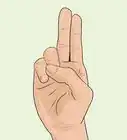
6Extend your middle and index fingers of both your hands and put the two fingers of your dominant hand on top of the two fingers of your base hand to sign F.[18] It should look like a closed hashtag.
- Make sure your fingers are not spread apart when signing F.
-
7Make both of your hands into fists with your thumbs tucked in and place your dominant fist on top of your base fist to sign G.[19]
- Some people remember the sign for G because it looks like you are grinding pepper.
-
8Lay your base hand flat with the palm up and with your dominant hand, swipe up with your fingers from your wrist to your fingertips to sign H.[20]
- Imagine you are trying to swipe a bug off your hand when signing H.
-
9Hold out your non-dominant palm and place your dominant index finger on the middle finger of your other hand to sign I.[21] Lean your middle finger forward slightly to make it clear what you are signing.[22]
- The sign for the letter I is different to the sign for the word "I" (referring to yourself). To sign the word "I", simply point to yourself.[23]
-
10Spell the letter J on the palm of your base hand to sign the letter J.[24] For J, you should start with your index finger on your middle finger, much like for the letter I. From there, move your index finger down to your palm and round to the end of your thumb.
- An easy way to think of it is drawing the letter J on your hand.
-
11Point upwards with your base hand, make a hook with your index finger on your dominant hand and place the joint of your dominant index finger on your other hand to sign K.[25] The sign should look like the capital letter K.
- If you are right-handed, it should like the right way round for you, but backwards for the person you are signing to and vice versa if you are left-handed.
-
12Hold your non-dominant hand out and put the index finger of your dominant hand in the middle of your hand to sign L.[26]
- Don't confuse the sign for L for the sign for T. For L, your index finger is in the centre of your palm. For T, your index finger is on the bottom side of your hand.
-
13Hold your palm out and place your three middle fingers (ring, middle and index) on the palm of your hand to sign M.[27]


Part 3
Part 3 of 3:Signing Letters N to Z
-
1Hold your palm out and place your index and middle finger of your base hand in the middle of your palm to sign N.[30]
- Some people confuse the sign for V and the sign for N. With the sign for N, you keep your index and middle finger together, unlike for V, where you spread them apart.
-
2
-
3Sign P.[33] Point your index finger upwards on your base hand and on your dominant hand make your thumb and index finger touch to make a circle. Make the index finger and thumb of your dominant hand touch the tip of your base index finger so make the letter P. The sign for P should look like the letter.
- If you are right handed, the P should appear the right way round for you, but back-to-front to the person you are signing to. If you are left-handed, the sign should appear backwards to you, but the right way around to the person you are signing to.
-
4Put your thumb and finger on your base hand together to make a circle, then hook the top of your other index finger to your thumb to sign Q.[34] The sign should look like a capital Q.
-
5Make the index finger of your dominant hand into a hook and place it on the palm of your base hand to sign R.[35] If you are right handed, it should look like a back-to-front lowercase R, and if you are left-handed, it should appear as a lowercase R the correct way around.
-
6Hold out your base hand with the palm facing up, and with the pinky finger on your dominant hand, hook it with your pinky on your other hand when signing S.[36]
-
7Hold your base hand with its palm facing upward and put your index finger of your dominant hand on the bottom of your palm, near your wrist, on the inner side of your hand (the side with your pinky) to sigh T.[37]
- Don't confuse the sign for T with the sign for L. The sign for L is with your index finger in the middle of your palm.
- For left-handers, you should place your left index finger on the left side of your right hand. For right-handers, you should place your right index finger on the right side of your left hand.
-
8
-
9Make a V shape on the palm of your hand to sign V.[40] With your dominant hand, make a V shape by extending and spreading your index and middle finger apart. Place the V shape on the palm of your base hand.
- Unlike the sign for N, the sign for V is with your index and middle finger apart on your thumb.
-
10Interlock your fingers of both hands so that both palms are facing each other and your fingers are pointing diagonally up to sign W.[41]
- Keep your wrists separate when signing W, it should look like a little tent.
-
11Cross your index fingers by having both fingers extended and pointing diagonally upwards overlapping each other to sign the letter X.[42] The sign for X should look like an X.
-
12Extend your thumb and index finger on your non-dominant hand and place your dominant index finger between them to sign the letter Y.[43] It should look a little bit like a capital Y.
-
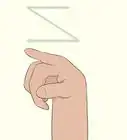
13Do the sign for Z.[44] Hold your base hand in front of you facing the side as if you are about to start clapping. Put your dominant hand in a right angle so your palm is facing your other plan but your fingertips are touching your base hand.


Warnings
- Ensure you are learning BSL (if that's the one you are wanting to learn). It can be a common mistake for people starting of on British Sign Language to accidentally do American Sign Language (ASL) instead as some tutorials don't specify what sign language is being used. It is estimated there are anything between 138 and 300 different sign languages around the world[53] , each with very different signs.Thanks!
- Be careful signing that your signs aren't misinterpreted as something offensive.[54]Thanks!

References
- ↑ https://www.british-sign.co.uk/fingerspelling-alphabet-charts/
- ↑ https://www.signbsl.com/sign/purple
- ↑ https://www.signbsl.com/sign/colour
- ↑ https://www.signbsl.com/sign/year
- ↑ https://www.signbsl.com/sign/excuse-me
- ↑ https://www.signbsl.com/sign/monday
- ↑ https://www.british-sign.co.uk/left-handed-signing/
- ↑ http://www.bslqed.com/2_Right_or_Left_Hand-i-381.html
- ↑ https://www.wikihow.com/Do-Vowels-in-Sign-Language
- ↑ https://www.dotsignlanguage.co.uk/how-long-does-it-take-to-learn-british-sign-language/
- ↑ https://www.british-sign.co.uk/fingerspelling-alphabet-charts/
- ↑ https://www.wikihow.com/Do-Vowels-in-Sign-Language
- ↑ https://www.british-sign.co.uk/fingerspelling-alphabet-charts/
- ↑ https://www.british-sign.co.uk/fingerspelling-alphabet-charts/
- ↑ https://www.british-sign.co.uk/fingerspelling-alphabet-charts/
- ↑ https://www.wikihow.com/Do-Vowels-in-Sign-Language
- ↑ https://www.wikihow.com/Do-Vowels-in-Sign-Language
- ↑ https://www.british-sign.co.uk/fingerspelling-alphabet-charts/
- ↑ https://www.british-sign.co.uk/fingerspelling-alphabet-charts/
- ↑ https://www.british-sign.co.uk/fingerspelling-alphabet-charts/
- ↑ https://www.british-sign.co.uk/fingerspelling-alphabet-charts/
- ↑ https://www.wikihow.com/Do-Vowels-in-Sign-Language
- ↑ https://www.signbsl.com/sign/me
- ↑ https://www.british-sign.co.uk/fingerspelling-alphabet-charts/
- ↑ https://www.british-sign.co.uk/fingerspelling-alphabet-charts/
- ↑ https://www.british-sign.co.uk/fingerspelling-alphabet-charts/
- ↑ https://www.british-sign.co.uk/fingerspelling-alphabet-charts/
- ↑ https://www.british-sign.co.uk/fingerspelling-alphabet-charts/
- ↑ https://www.signbsl.com/sign/mother
- ↑ https://www.british-sign.co.uk/fingerspelling-alphabet-charts/
- ↑ https://www.british-sign.co.uk/fingerspelling-alphabet-charts/
- ↑ https://www.wikihow.com/Do-Vowels-in-Sign-Language
- ↑ https://www.british-sign.co.uk/fingerspelling-alphabet-charts/
- ↑ https://www.british-sign.co.uk/fingerspelling-alphabet-charts/
- ↑ https://www.british-sign.co.uk/fingerspelling-alphabet-charts/
- ↑ https://www.british-sign.co.uk/fingerspelling-alphabet-charts/
- ↑ https://www.british-sign.co.uk/fingerspelling-alphabet-charts/
- ↑ https://www.british-sign.co.uk/fingerspelling-alphabet-charts/
- ↑ https://www.wikihow.com/Do-Vowels-in-Sign-Language
- ↑ https://www.british-sign.co.uk/fingerspelling-alphabet-charts/
- ↑ https://www.british-sign.co.uk/fingerspelling-alphabet-charts/
- ↑ https://www.british-sign.co.uk/fingerspelling-alphabet-charts/
- ↑ https://www.british-sign.co.uk/fingerspelling-alphabet-charts/
- ↑ https://www.british-sign.co.uk/fingerspelling-alphabet-charts/
- ↑ https://www.wikihow.com/Do-Vowels-in-Sign-Language
- ↑ https://hearmeoutcc.com/sign-supported-english/
- ↑ https://www.wikihow.com/Do-Vowels-in-Sign-Language
- ↑ https://blog.ai-media.tv/blog/sign-language-alphabets-from-around-the-world
- ↑ https://www.deafblindinformation.org.au/about-deafblindness/deafblind-communication/deafblind-manual-alphabet/
- ↑ https://metro.co.uk/2017/09/06/what-is-the-british-sign-language-alphabet-learn-it-with-googles-video-6906549/
- ↑ https://www.wikihow.com/Sign-Simple-Phrases-in-British-Sign-Language
- ↑ https://www.wikihow.com/Fingerspell-the-Alphabet-in-American-Sign-Language
- ↑ https://k-international.com/blog/different-types-of-sign-language-around-the-world/
- ↑ https://www.wikihow.com/Do-Vowels-in-Sign-Language