This article was co-authored by Darron Kendrick, CPA, MA. Darron Kendrick is an Adjunct Professor of Accounting and Law at the University of North Georgia. He received his Masters degree in tax law from the Thomas Jefferson School of Law in 2012, and his CPA from the Alabama State Board of Public Accountancy in 1984.
There are 8 references cited in this article, which can be found at the bottom of the page.
This article has been viewed 36,161 times.
When dealing with the loss of a spouse, the last thing you want to think about is filing your taxes. However, the IRS offers a way for widows or widowers to reduce their tax burden by filing as a qualified widow(er) for up to two years after the death of their spouse. You can select this status, if you qualify, instead of choosing your regular tax status, such as "married filing jointly" or "head of household." From there, you would simply fill out your taxes as you normally do. But first, you'll have find out if you qualify.
Steps
Part 1
Part 1 of 2:Determining Eligibility
-
1Determine your previous filing status. You must have qualified to file jointly before your spouse died, even if you chose to file separately. Anyone claiming the qualified widow(er) status must have also been able to file taxes jointly in the year of the spouse's death.[1]
- It doesn't matter if you actually did file jointly before the death of your spouse, just that you qualified to.
- The only requirement for filing a joint return is that you are legally married.[2]
-
2Figure out how many tax years have passed since the death of the spouse. You can file as a qualified widower for two tax years after the tax year in which the spouse died. So, if your spouse died in 2013, you could file as a qualified widow(er) in 2014 and 2015 (assuming you met the rest of the standards). If more than two years have passed, you will have to file using a different status (single, head of household, or another status depending on your situation).
- If your spouse died in the current tax year, you should still file as married filing jointly.
- You cannot file as qualified widower if you remarry in the tax year you are filing for.
- Your marital status on the last day of the year determines your filing status for the entire year.[3]
Advertisement -
3Assess whether your dependent child qualifies you for the widow or widower filing status. In order to qualify for qualified widow(er) status, you must have a qualified dependent. The dependent must be your child (biologically or through adoption) or a stepchild. A half sister, half brother, niece, nephew, foster child or other dependent doesn't qualify you as a widow or widower.
- The child must be under the age of 19 or a full-time student under the age of 24. A son, daughter or stepchild who is permanently disabled can be of any age to qualify as a dependent.
- The child or stepchild lived in your home for the entire year. Temporary absences are acceptable.
- You may also be qualified to file using this status if the dependent in questions was born or died during the tax year. This depends whether or not you paid for half of the cost of keeping up the house in which the dependent lived during the tax year.[4]
-
4Make sure that you meet household upkeep standard. You must have paid at least half of the costs to maintain the home in which you and your dependent(s) lived during the year. Calculate the total amount spent on keeping up the home over the year and the portion of these costs that you paid. If your portion is at or above 50 percent of the total amount spent, you qualify for widow(er) status. Upkeep costs include:
- Property taxes.
- Rent.
- Utility charges.
- Repairs/maintenance.
- Property insurance.
- Food eaten in the home.
- Other household expenses.[5]
Advertisement


Part 2
Part 2 of 2:Filing Your Taxes
-
1File taxes in the year of the spouse's death. For the tax year of the spouse's death, you can file a joint return. This will likely allow you to be taxed at a lower rate than if you filed as single or head of household for that year. In addition, you will be able to take the standard deduction that goes along with married filing jointly status.
- This status can be claimed in this tax year regardless of whether or not the surviving spouse qualifies for qualified widow(er) status.
- For the year in which a spouse dies, the surviving spouse can claim an exemption for the deceased spouse. No further exemptions are allowed in the years following the year of death.
- The surviving spouse has the ability, but not the obligation, to file their taxes using this status.[6]
-
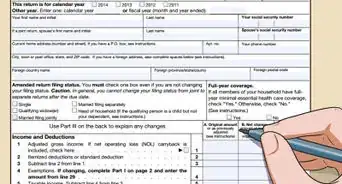
2Mark your filing status as qualified widow(er). Complete Form 1040 or Form 1040A to file your income taxes. Under the "Filing Status" section of the form, mark box 5 labeled "Qualifying widow(er) with dependent child." Under "Exemptions," list the names of all dependents, their Social Security number and relationship to you. Check the box if the child is under 17 years old and qualifies for a tax credit.[7]
- You cannot file using qualified widow(er) status if you file with a Form 1040EZ.[8]
-
3Determine your tax liability. Use the "Married filing jointly" column of the tax table for the applicable year to determine your tax liability. Beginning at a taxable income of about $8,000, your tax liability will be less than if you filed with a single status. Starting at a taxable income of about 12,000, your tax liability will also be lower than if you filed as a head of household.[9]
- Filing your taxes in this way does not mean that you are still technically filing a joint return, just that you are using the same tax brackets, and their associated standard deduction amounts, to figure your own tax burden.
- This generally results in a lower overall tax burden.[10]
-
4Understand how to file in subsequent years. In the third year after your spouse's death, you will be considered "single" again for tax purposes. That is, if your spouse died in 2013, you would be a qualified widow(er) in 2014 and 2015 (assuming you qualified), but in 2016 you would have to file as "single" or "head of household" (if you qualify).
- If you have remarried in this time, you would then file as "married filing jointly" or "married filing separately," depending on how you and your new spouse decide to file.[11]
- To file as "head of household," you must be an unmarried person who pays at least one half of the expenses of maintaining a home for you and a qualified dependent.[12]
Advertisement


Expert Q&A
-
QuestionMy state recognizes common-law marriage. My common-law husband died at the end of this year and I have the paperwork stating we were legally married. Can I file jointly?
 Darron Kendrick, CPA, MADarron Kendrick is an Adjunct Professor of Accounting and Law at the University of North Georgia. He received his Masters degree in tax law from the Thomas Jefferson School of Law in 2012, and his CPA from the Alabama State Board of Public Accountancy in 1984.
Financial AdvisorYes. You are considered married if your state recognizes common-law marriages. The joint filing rule therefore applies to you. -
QuestionMy husband died in May 2016. Can I still file a return with an ITIN number for the tax year 2016 as "Married Filing Jointly"?Darron Kendrick, CPA, MADarron Kendrick is an Adjunct Professor of Accounting and Law at the University of North Georgia. He received his Masters degree in tax law from the Thomas Jefferson School of Law in 2012, and his CPA from the Alabama State Board of Public Accountancy in 1984.
Financial AdvisorYes. In the year of your spouse's death, you may still file a joint return with your deceased spouse.










References
- ↑ http://www.investinganswers.com/financial-dictionary/tax-center/qualified-widow-3412
- ↑ https://www.irs.gov/publications/p17/ch02.html#en_US_2015_publink1000170756
- ↑ http://www.efile.com/qualifying-widow-widower-tax-filing-status/
- ↑ https://www.irs.gov/publications/p17/ch02.html#en_US_2015_publink1000170756
- ↑ https://www.irs.gov/publications/p17/ch02.html#en_US_2015_publink1000170809
- ↑ http://www.investopedia.com/terms/q/qualifying-widow.asp
- ↑ https://www.irs.gov/publications/p17/ch02.html#en_US_2015_publink1000170809
- ↑ http://www.efile.com/qualifying-widow-widower-tax-filing-status/
- ↑ https://www.irs.gov/publications/p17/ch02.html#en_US_2015_publink1000170809
- ↑ http://www.forbes.com/sites/kellyphillipserb/2015/03/29/taxes-from-a-to-z-2015-q-is-for-qualifying-widower-with-dependent-child/#6675b2765c45
- ↑ http://www.efile.com/qualifying-widow-widower-tax-filing-status/
- ↑ https://www.irs.com/articles/determining-your-filing-status
- ↑ http://www.360financialliteracy.org/Topics/Budgeting-Spending/Budgeting-and-Saving/My-spouse-passed-away-this-year.-When-I-file-my-taxes-what-filing-status-should-I-claim
About This Article