This article was co-authored by wikiHow staff writer, Janice Tieperman. Janice is a professional and creative writer who has worked at wikiHow since 2019. With both a B.A. and M.A. in English from East Stroudsburg University, she has a passion for writing a wide variety of content for anyone and everyone. In her free time, you can find her working on a new crochet pattern, listening to true crime podcasts, or tackling a new creative writing project.
There are 7 references cited in this article, which can be found at the bottom of the page.
This article has been viewed 8,116 times.
Learn more...
Do you want to grow your own dragon fruit? If you live in a warm, humid area, you might be in luck.[1] These plants aren’t hard to care for, but they do require a specific fertilizer regimen. Not to worry—we’ve answered all your frequently asked questions, so you can grow healthy, delicious dragon fruits from the comfort of your home.
Steps
Question 1
Question 1 of 6:What kind of fertilizer do you need?
-
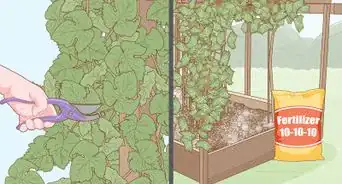
1Choose a fertilizer with a balanced NPK ratio. An NPK ratio is a series of 3 hyphenated numbers that represents the specific percentage of nitrogen, phosphate, and potash in any given fertilizer.[2] A “balanced” fertilizer means that these 3 numbers are the same, like 10-10-10.[3]
- There isn’t a consistent, one-size-fits-all recommendation for fertilizer. However, most experts agree that some type of balanced fertilizer, like 16-16-16 or 13-13-13, is a good choice for your dragon fruit.[4]
- You can use fertilizer granules, or spread fertilizer through your irrigation system.[5] Slow-release fertilizer is also an option.[6]
Advertisement

Question 2
Question 2 of 6:How often do you fertilize dragon fruit?
-
1Fertilize young, 1-to-3-year old plants once every 2 months. Apply both traditional fertilizer and manure or compost to your plant at the same time. Between March and September, apply the the chelated iron or ferrous sulfate 4-6 times total.[7]
-
2Nourish older plants with traditional fertilizer 3-4 times a year. Scale back the manure or compost, applying it twice a year. Between March and September, continue to fertilize your plants with chelated iron or ferrous sulfate 4-6 times each year.[8]Advertisement

Question 3
Question 3 of 6:How much fertilizer do you need?
-
1Use ¼ lb (118 g) of fertilizer and 4 lb (1.2 kg) of manure for a new plant. Dragon fruit plants don’t need that much fertilizer and manure, especially when first starting out. If you’re growing multiple fruit plants, you’ll need ¼ lb (118 g) of fertilizer and 4 lb (1.2 kg) of manure or compost for each one.[9]
-
2Apply extra fertilizer and manure as your plant matures. When your plant is 2-3 years old, add an extra 0.3-0.4 lb (136-182 g) of fertilizer. Similarly, nourish each dragon fruit plant with 6 lb (2.7 kg) of manure or compost during this timeframe.[10] Once your dragon fruit is at least 4 years old, regularly apply ½ to ¾ lb (227-341 g) of fertilizer and 5 lb (2.2 kg) of manure.[11]Advertisement

Question 4
Question 4 of 6:What other nutrients can you use in addition to fertilizer?
-
1Some gardeners use chelated iron or ferrous sulfate to adjust the soil’s pH.[12] Dragon fruits thrive in soil that’s slightly less than 7 pH.[13] To help your plant grow as healthy and strong as it can, experts recommend treating acidic soil with ferrous sulfate, and nourishing basic soil with chelated iron.[14]
- Use a small amount of chelated iron or ferrous sulfate on 1-year old plants. Spray 0.25 to 0.5 oz (7-15 g) of chelated iron over any basic soil, or scatter a small handful of ferrous sulfate over acidic soil.[15]
- Apply extra chelated iron to plants that are 2 years or older. As your dragon fruit matures, treat the soil with 0.75-1 oz (22-29 g) of chelated iron, if needed. If your soil is more acidic, continue treating it with a small amount of ferrous sulfate.[16]
-
2Organic fertilizer, like manure or compost, is a good nutrient source. Pick up decomposed manure at your local home improvement store, or make your own compost at home. Along with traditional fertilizer, both manure and compost are a great source of nutrients for your dragon fruit.[17]Advertisement

Question 5
Question 5 of 6:How do you apply the fertilizer?
-
1Apply traditional fertilizer with granules or an irrigation system. If you only have a few plants, you might have an easier time applying the fertilizer around your plants. Depending on your set-up, you might have an easier time applying the fertilizer through your irrigation system.[18]
-
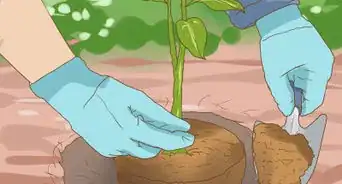
2Spread manure along the base of the plant. If your plant is only a year old, don’t apply the manure around the stem. Once your dragon fruit is at least 2 years old, apply the manure around the base of the stem and plant.[19]
-
3Spray chelated iron and spread ferrous sulfate. Experts recommend spraying around your plant with chelated iron, and spreading ferrous sulfate along the bottom of the plant.[20]Advertisement

Question 6
Question 6 of 6:How do I get my dragon fruit to flower?
-
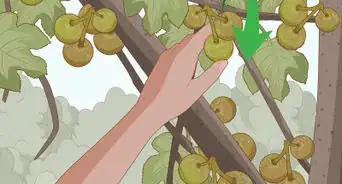
1Wait up to 7 years for your plant to produce fruit. Your dragon fruit plant may seem barren, even after months and months of regular TLC. Don’t worry—this is perfectly normal. If grown from a seed, dragon fruit can take up to 7 years to bear delicious fruit.[21]
- If you planted your dragon fruit from a cutting, it may take up to 3 years.







References
- ↑ https://www.bhg.com.au/growing-dragon-fruit
- ↑ https://extension.psu.edu/how-to-calculate-a-fertilizer-ratio
- ↑ https://dpir.nt.gov.au/__data/assets/pdf_file/0004/232933/778.pdf/
- ↑ http://apps.worldagroforestry.org/downloads/Publications/PDFS/BC07324.pdf
- ↑ https://dpir.nt.gov.au/__data/assets/pdf_file/0004/232933/778.pdf
- ↑ https://www.urbanharvest.org/wp-content/uploads/2020/02/Dragon-Fruit-2020.pdf
- ↑ https://edis.ifas.ufl.edu/pdffiles/hs/hs30300.pdf
- ↑ https://edis.ifas.ufl.edu/pdffiles/hs/hs30300.pdf
- ↑ https://edis.ifas.ufl.edu/pdffiles/hs/hs30300.pdf
- ↑ https://edis.ifas.ufl.edu/pdffiles/hs/hs30300.pdf
- ↑ https://edis.ifas.ufl.edu/pdffiles/hs/hs30300.pdf
- ↑ https://edis.ifas.ufl.edu/pdffiles/hs/hs30300.pdf
- ↑ https://www.bhg.com.au/growing-dragon-fruit
- ↑ https://edis.ifas.ufl.edu/pdffiles/hs/hs30300.pdf
- ↑ https://edis.ifas.ufl.edu/pdffiles/hs/hs30300.pdf
- ↑ https://edis.ifas.ufl.edu/pdffiles/hs/hs30300.pdf
- ↑ https://edis.ifas.ufl.edu/pdffiles/hs/hs30300.pdf
- ↑ https://dpir.nt.gov.au/__data/assets/pdf_file/0004/232933/778.pdf
- ↑ https://edis.ifas.ufl.edu/pdffiles/hs/hs30300.pdf
- ↑ https://edis.ifas.ufl.edu/pdffiles/hs/hs30300.pdf
- ↑ https://www.bhg.com.au/growing-dragon-fruit
About This Article