This article was co-authored by Lyssandra Guerra and by wikiHow staff writer, Janice Tieperman. Lyssandra Guerra is a Certified Nutrition & Wellness Consultant and the Founder of Native Palms Nutrition based in Oakland, California. She has over five years of nutrition coaching experience and specializes in providing support to overcome digestive issues, food sensitivities, sugar cravings, and other related dilemmas. She received her holistic nutrition certification from the Bauman College: Holistic Nutrition and Culinary Arts in 2014.
There are 25 references cited in this article, which can be found at the bottom of the page.
wikiHow marks an article as reader-approved once it receives enough positive feedback. In this case, 100% of readers who voted found the article helpful, earning it our reader-approved status.
This article has been viewed 170,138 times.
When your stomach starts growling, it can be super tempting to pile your plate high with all your favorite foods. Unfortunately, really large portions can be a bit of a roadblock between you and your health and weight goals. Harvard Medical School even notes that larger meals can increase your risk factor for a variety of medical conditions.[1] Not to worry! Eating smaller portions, or portion control, is easy to master with a little bit of practice. We’ve put together some tips, tricks, and suggestions to help you get started.
Steps
Method 1
Method 1 of 14:Drink water before you dig into your meal.
-
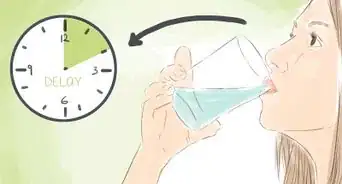
1Sipping water before a meal might help you feel full. Try drinking a 500 mL (17 fl oz) glass of water before digging into your meal. According to some studies, people actually ate smaller portions of food after drinking water.[2] It’s no magic trick—water fills up your tummy, so you don’t feel as hungry while you eat.[3]
- Generally speaking, experts suggest women drink 11½ cups (2.7 L) of water each day and men drink 15½ cups (3.7 L).[4]
Advertisement

Method 2
Method 2 of 14:Snack on a soup or salad first.
-
1People who eat salad as a first course may eat smaller portions at lunch.[5] Similarly, people who sip on some soup before lunch may eat fewer calories during their main meal.[6] Ultimately, a small appetizer like a salad or broth-based soup can help fight off any big hunger pangs, so you don’t eat as much in the long run.[7]
Method 3
Method 3 of 14:Grab a smaller dish and serving spoon.
-
1Smaller dishes and cutlery instantly shrink your serving size. During a party, researchers gave the party-goers a big or small dish, as well as a big or small ice cream scooper. Overall, people who had bigger bowls and scoops ate more ice cream than the people with smaller dishes and scoops. This is because smaller dishes and serving utensils make it way easier to enjoy food in moderation.[10]
- For instance, you could grab the smallest dish available at a buffet, or eat dinner on smaller plates at home.
Advertisement
Method 4
Method 4 of 14:Avoid eating out of a package or container.
-
1Check the food label to see what the recommended portion size is. When you eat directly out of the bag, it’s all too easy to lose track of how much you’ve actually eaten. Portioning your food helps you enjoy your favorite snacks without eating really big portions.[11]
- For example, you might pour some potato chips into a small dish instead of snacking directly from the bag.
- You might pour out a handful of your favorite candy instead of eating the whole package at once.
Method 5
Method 5 of 14:Split restaurant entrees in half.
-
1Restaurant servings are notoriously big. Before digging into your dish, take a second to cut your entree into 2 portions. You could share your meal with a loved one, or ask your server for a doggie bag or to-go box so you can enjoy your leftovers later.[12]
- Try to steer clear of larger portion options if the restaurant offers them.[13]
Advertisement
Method 6
Method 6 of 14:Add a little spice to your meals.
-
1Red pepper can lower your appetite for future meals. In 1 study, researchers asked some participants to eat a non-spicy breakfast, and others to eat a breakfast made with red pepper. Believe it or not, people who ate the spicy breakfast had less of an appetite and didn’t eat as much during lunch.[14]
- You might add a dash of red pepper to your scrambled eggs, or sprinkle a little bit of pepper on your toast.
Method 7
Method 7 of 14:Wait 10-20 minutes before going back for seconds.
-
1You might not feel full right after you finish eating. Before getting another helping, take a breather for at least 10 minutes and see if you feel full afterward. It takes about 15 minutes for your body to tell your brain that you’re full, so you might not be as hungry as you originally thought![15]Advertisement

Method 8
Method 8 of 14:Practice eating mindfully.
-
1Mindful eating helps you make careful, intentional decisions about your food portions. Choose to eat when you’re hungry, but not starving—this way, you can appreciate your food instead of eating it really quickly. Then, dish out a small portion for yourself. Take a couple of minutes to think about the time and effort that went into making the meal. As you start eating, enjoy your food in small bites, taking time to chew carefully.[16]
- For instance, if you’re about to eat some spaghetti, think about the time it took to buy the spaghetti, cook the noodles, and prepare the sauce. Then, give a silent thanks for the chance to enjoy this delicious meal.

Method 9
Method 9 of 14:Serve up small sports ball-sized portions of fruits and veggies.
-
1Try to eat 5 servings of veggies and 4 servings of fruit each day. A single serving of veggies is about 1 cup (36 g) of leafy greens, ½ cup (74.5 g) of chopped-up veggies, ½ cup (65 g) of cooked peas or beans, or 1⁄4 c (59 mL) of pure vegetable juice. One serving of fruit could be 1 medium-sized piece of fruit, 1⁄4 c (59 mL) of pure fruit juice, ¼ cup (40 g) of dried fruit, or ½ cup (59 g) of chopped-up fruit.[17]
- For reference, a serving of veggies is about the size of a baseball, while a fruit serving is about the size of a tennis ball.[18]
- Veggies are chock full of water and fiber, so they help you feel full and satisfied after a meal.[19]
- You could toss some chopped-up veggies in your morning omelet or slurp down a bowl of vegetable soup at lunch. You might even snack on carrots, bell peppers, green beans, and other tasty veggies when you get hungry.[20]
- You could whip up a fruit salad with your lunch and dinner, or snack on some dried fruit throughout the day.
Advertisement
Method 10
Method 10 of 14:Add a card-deck-sized serving of lean protein.
-
1Protein helps you feel more satisfied and full after you eat.[21] Try to eat about 1-2 servings of meat and poultry every day. Experts also recommend eating about 1 serving of nuts, beans, seeds, and legumes each day, and enjoying a serving of fish and seafood every other day.[22]
- A serving of lean protein resembles a deck of playing cards.[23] A serving of nut-based protein could be 1 US tbsp (15 mL) of peanut butter, 2 tbsp (17 g) of seeds or nuts, or ¼ cup (15 g) of cooked peas or beans.[24]
- Peanut butter, tuna fish, black beans, and salmon are all great sources of protein.[25]

Method 11
Method 11 of 14:Include a hockey puck-sized portion of whole grains.
-
1Whole grains are way more filling than refined grains. Look for quick, easy replacements you can make in your favorite meals, like switching white rice with brown, or using whole-grain spaghetti instead of the regular kind. Since whole grains are more satisfying overall, you won’t have to eat as much.[26]
- A single serving of grains is the same size as a hockey puck.[27] Health experts recommend eating around 6 servings of grain each day.[28]
- You might enjoy a slice of whole-grain toast for breakfast, or snack on a handful of whole-wheat crackers.
- If you like to bake, try using a little bit of whole-wheat flour instead of all-purpose flour.
Advertisement
Method 12
Method 12 of 14:Enjoy a cup of dairy with your meal.
-
1Dairy products help you feel less hungry and more satisfied.[29] Try aiming for around 3 servings a day. About 1 cup (236.5 mL) of dairy is considered a serving—this might be 1 cup (236.5 mL) of skim milk, 1½ oz (28 g) of cheese, or 1 cup (236.5 mL) of low-fat yogurt. Stock up on your favorite dairy products for a delicious, satisfying snack.[30]
- You might enjoy some yogurt with your breakfast, or sip on a glass of milk at dinnertime.
Method 13
Method 13 of 14:Limit your fats and oils to a serving the size of a pair of dice.
-
1Try to limit yourself to around 3 servings each day. A serving of oils and fats could be 1 US tbsp (15 mL) of vegetable oil, 1 US tbsp (15 mL) of margarine, 1 US tbsp (15 mL) of low-fat salad dressing, or 1 US tbsp (15 mL) of low-fat mayonnaise.[31] A single serving will be around the same size as 2 playing dice put together.[32]
- Opt for unsaturated fats, like olive and canola oil.
Advertisement

Method 14
Method 14 of 14:Fill up on 21-38 grams of fiber each day.
-
1Dietary fiber helps you feel full after you eat. Choose plenty of high-fiber foods for your meals and snacks, like whole grains, nuts, seeds, beans, fruits, and veggies. By eating more fiber, you can feel full more quickly, so your portions don’t have to be as big.[33] Experts recommend that women up to age 50 eat 25 grams of fiber each day, while men up to age 50 eat 38 grams. Women over 50 should consume 21 grams, while men over 50 should consume 30.[34]
- You might eat a handful of sunflower seeds or mixed nuts as a snack, or enjoy nachos topped with beans for lunch.

Expert Q&A
-
QuestionHow do you portion a meal size?
 Lyssandra GuerraLyssandra Guerra is a Certified Nutrition & Wellness Consultant and the Founder of Native Palms Nutrition based in Oakland, California. She has over five years of nutrition coaching experience and specializes in providing support to overcome digestive issues, food sensitivities, sugar cravings, and other related dilemmas. She received her holistic nutrition certification from the Bauman College: Holistic Nutrition and Culinary Arts in 2014.
Certified Nutrition & Wellness ConsultantIdeally, include some lean protein and a fruit or vegetable for a more complete meal. For example, you might have scrambled eggs with vegetables, whole grain oatmeal with fruit or greek yogurt with fruit. -
QuestionIs it better to eat small portions?Lyssandra GuerraLyssandra Guerra is a Certified Nutrition & Wellness Consultant and the Founder of Native Palms Nutrition based in Oakland, California. She has over five years of nutrition coaching experience and specializes in providing support to overcome digestive issues, food sensitivities, sugar cravings, and other related dilemmas. She received her holistic nutrition certification from the Bauman College: Holistic Nutrition and Culinary Arts in 2014.
Certified Nutrition & Wellness ConsultantYes. If you have a choice between two large meals and three smaller meals, the smaller meals are almost always going to be better for you. Always eat breakfast and then eat a small meal every 3-4 hours. Have a small, healthy snack in between meals if you start getting hungry. This makes it a lot easier for your body to maintain a consistent blood sugar and energy level throughout the day.




References
- ↑ https://www.health.harvard.edu/heart-health/eating-can-cause-low-blood-pressure
- ↑ https://pubmed.ncbi.nlm.nih.gov/18589036/
- ↑ https://www.bbc.com/news/health-11057891
- ↑ https://www.mayoclinic.org/healthy-lifestyle/nutrition-and-healthy-eating/in-depth/water/art-20044256
- ↑ https://pubmed.ncbi.nlm.nih.gov/15389416/
- ↑ https://www.ncbi.nlm.nih.gov/pmc/articles/PMC2128765/
- ↑ https://www.eatright.org/health/wellness/fad-diets/7-tips-for-healthy-dining-out
- ↑ https://www.halfyourplate.ca/fruits-and-veggies/what-is-a-serving/
- ↑ https://www.ncbi.nlm.nih.gov/pmc/articles/PMC2128765/
- ↑ https://sparq.stanford.edu/solutions/use-smaller-plates-smaller-waist
- ↑ https://www.heart.org/en/healthy-living/healthy-eating/eat-smart/nutrition-basics/portion-size-versus-serving-size
- ↑ https://www.cdc.gov/healthyweight/healthy_eating/portion_size.html
- ↑ https://www.bhf.org.uk/informationsupport/heart-matters-magazine/nutrition/weight/perfect-portions/top-tips-for-portion-control
- ↑ https://pubmed.ncbi.nlm.nih.gov/10743483/
- ↑ https://njaes.rutgers.edu/sshw/message/message.php?p=Health&m=150
- ↑ https://www.health.harvard.edu/staying-healthy/8-steps-to-mindful-eating
- ↑ https://www.heart.org/en/healthy-living/healthy-eating/eat-smart/nutrition-basics/suggested-servings-from-each-food-group
- ↑ https://www.mayoclinic.org/healthy-lifestyle/weight-loss/multimedia/portion-control/sls-20076148
- ↑ https://pubmed.ncbi.nlm.nih.gov/14995052/
- ↑ https://www.heart.org/en/healthy-living/healthy-eating/add-color/how-to-eat-more-fruits-and-vegetables
- ↑ https://pubmed.ncbi.nlm.nih.gov/18469287/
- ↑ https://www.heart.org/en/healthy-living/healthy-eating/eat-smart/nutrition-basics/suggested-servings-from-each-food-group
- ↑ https://www.mayoclinic.org/healthy-lifestyle/weight-loss/multimedia/portion-control/sls-20076148
- ↑ https://www.heart.org/en/healthy-living/healthy-eating/eat-smart/nutrition-basics/suggested-servings-from-each-food-group
- ↑ https://www.eatright.org/health/wellness/healthy-habits/5-tips-to-curb-your-late-night-snacking
- ↑ https://medlineplus.gov/ency/article/002093.htm
- ↑ https://www.mayoclinic.org/healthy-lifestyle/weight-loss/multimedia/portion-control/sls-20076148
- ↑ https://www.heart.org/en/healthy-living/healthy-eating/eat-smart/nutrition-basics/suggested-servings-from-each-food-group
- ↑ https://pubmed.ncbi.nlm.nih.gov/21335996/
- ↑ https://www.heart.org/en/healthy-living/healthy-eating/eat-smart/nutrition-basics/suggested-servings-from-each-food-group
- ↑ https://www.heart.org/en/healthy-living/healthy-eating/eat-smart/nutrition-basics/suggested-servings-from-each-food-group
- ↑ https://www.mayoclinic.org/healthy-lifestyle/nutrition-and-healthy-eating/in-depth/fiber/art-20043983?p=1
- ↑ https://www.mayoclinic.org/healthy-lifestyle/nutrition-and-healthy-eating/in-depth/fiber/art-20043983?p=1
- ↑ https://www.health.harvard.edu/blog/should-i-be-eating-more-fiber-2019022115927
About This Article

To eat smaller portions during meals, portion out your food on small-sized plates to reduce the amount of food you’ll eat. During meals you can set a timer for 20 minutes to help you eat more slowly, which will give your body time to become full, reducing the urge to overeat. A good way to space out your meal is to put down your fork between bites and to take sips of water. Finally, remember to stop eating when you’re satisfied, not full, as this will ensure you don’t overeat. To learn how to incorporate more fruits and vegetables into your meals, read more from our Dietician co-author.