This article was co-authored by wikiHow staff writer, Amy Bobinger. Amy Bobinger has been a writer and editor at wikiHow since 2017. She especially enjoys writing articles that help people overcome interpersonal hurdles but frequently covers a variety of subjects, including health and wellness, spirituality, gardening, and more. Amy graduated with a B.A. in English Lit from Mississippi College in 2011 and now lives in her hometown with her husband and two young sons.
There are 14 references cited in this article, which can be found at the bottom of the page.
This article has been viewed 79,443 times.
Learn more...
When you think of Russian folk dancing, you probably picture someone squatting low to the ground, arms folded, kicking their legs in front of them. This dance—which actually originated in Ukraine—is also known as the Cossack dance, Ukrainian Hopak stage dance, or Prisyadka.[1] Mastering it takes a bit of practice, but it's probably not as hard as you think. We're here to break it down for you, so give it a shot!
Steps
Method 1
Method 1 of 7:Crouch down in a low squat.
-
1Balance your weight on the balls of your feet. The prisyadka is performed from a squat, so the first thing you have to do is get comfortable balancing in this position. Bend your knees and squat down until your rear touches your feet, keeping your heels off the ground. It might help to keep your knees apart as you do this. Practice squatting like this until you can easily hold the position for several minutes.[2]
- Your heels, butt, and shoulders should all form a straight line when you're in the squat.
- If it's hard to balance in this position, you can put one hand on the ground until you get used to squatting.
- You can also put your feet flat on the ground at first if you need to. However, you'll need to stay on the balls of your feet for the actual dance—that will help you bounce more easily from one foot to the other.

Method 2
Method 2 of 7:Push one foot out in front of you.
-
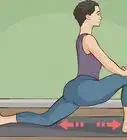
1Keep your heel on the ground to make it easier. Don't worry about kicking up just yet. Just straighten one of your legs so your foot is in front of you with your toes in the air.[3] It might be easiest to start by kicking out your non-dominant leg so you can balance on your dominant leg at first.

Method 3
Method 3 of 7:Practice alternating your kicks.
-
1Bring in the leg you straightened, then kick out the other one. This can be a little challenging—it takes a lot of leg strength. It's okay to start slowly if you need to. You can even put one or both hands on the ground beside you to help you stay balanced. Just don't lean forward or backward, since your back needs to be straight for the dance.[6]
- Work on this until you can kick out one leg and bring in the other in one fairly smooth motion.[7]
- Remember to take breaks when you need to—depending on how strong your calves are, you might need days or even weeks to build up enough strength to do the dance completely!

Method 4
Method 4 of 7:Add a bounce as you alternate legs.
-
1Now it's time to put some energy into the dance. Start by holding one leg out in front of you. As you go to bring it back in, push up slightly with the other leg before you push it out. That little bit of a bounce will make it easier to shift from leg to leg quickly, so you'll be able to add some speed as you alternate your kicks.[8]
- This can be tiring on your legs—start by trying to do it 6 times in a row, then gradually work up from there until you can keep a steady rhythm.[9]

Method 5
Method 5 of 7:Increase the speed of your kicks.
-
1At full speed, you should almost be running in place. Try to hold yourself up at a steady height so your hips don't bounce up and down as you kick. That can make it easier to kick back and forth in a smooth, steady motion.[10]
- As you get stronger, try lifting your foot so it's straight in front of you, rather than leaving your heel on the ground.[11]

Method 6
Method 6 of 7:Fold your arms in front of you.
-
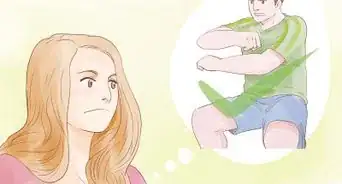
1This is the finishing touch of the dance. Hold your arms so one is folded on top of the other at about shoulder height.[12] However, since you might need your arms to help you balance at first, wait to add this in until you're completely comfortable holding your body straight up and down as you alternate your kicks.[13]

Method 7
Method 7 of 7:Add in some freestyle to take it to the next level.
-
1Don't be afraid to improvise. In a traditional prisyadka, dancers would often hop on one leg, spin, clap, throw their hands into the air, or even do the jump-splits. There's no right or wrong, so just have fun with it![14]
- One popular variation of this dance is to lean back on your arms and kick one foot up in the air before pushing back up to the original position.[15]
- To really get into the spirit, try ending your dance with a hearty shout of "Hey!"

Community Q&A
-
QuestionWhat if my thighs squish my calves and I can't fully extend my legs?
 wikiHow Staff EditorThis answer was written by one of our trained team of researchers who validated it for accuracy and comprehensiveness.
Staff AnswerwikiHow Staff EditorStaff AnswerAs you build up strength, practice a hovering crouch, rather than sitting directly on your feet. It can take some time to work up to this, but it will get easier as your legs get stronger. -
QuestionHow do I stay upright and not fall backwards?wikiHow Staff EditorThis answer was written by one of our trained team of researchers who validated it for accuracy and comprehensiveness.
Staff AnswerwikiHow Staff EditorStaff AnswerYou can use your hands to help you balance as you're learning, but as you slowly build up the strength to do this dance, it will become easier to balance using your core and legs. -
QuestionWhat if it really hurts my knees rather than thigh or calveswikiHow Staff EditorThis answer was written by one of our trained team of researchers who validated it for accuracy and comprehensiveness.
Staff AnswerwikiHow Staff EditorStaff AnswerWhen you're learning any new dance or exercise, take it slowly—you might need to build up your leg muscles so they can better support your knees. If it's painful, take a break. If you have persistent, severe knee pain, see your doctor to make sure you're healthy enough for a dance like this. -
QuestionIs it hard to do the squat kick if it’s my first time?
 Community AnswerYes, but practice makes perfect, and it doesn't take long to get it down.
 -
QuestionWhat if my hips and legs start hurting? Should I continue to do this daily, even if I’m a minor?
 Community AnswerNo. Take a break for a couple of days. Your muscles need time to rest and rebuild. Then when you're ready to start practicing again, try to keep it to every other day.
 -
QuestionDoes core strength matter?Community AnswerYes, very much, but you also need leg strength to do this.
-
QuestionWhy do most dances have their arms crossed on their chest?
 Community AnswerIt looks better than if your arms are hanging at your sides while moving and it also makes you focus on what your legs are doing, as the arms aren't in the way or needing to be moved.
 -
QuestionWhat if I can't balance either way?Community AnswerMany people find it hard to balance when they're not used to it at first. However, it is possible to develop this skill by practicing it over and over again. Practice balancing on one foot while standing every day. Eventually the skill will feel normal and be easy to execute.
-
QuestionI can’t fully extend my leg though, so what do I do?
 Pr0cxtCommunity AnswerIt can be difficult for beginners. Try stretching your legs every day and doing the exercises as shown.
 -
QuestionIs it bad if your legs don't hurt at all after 15 minutes?
 BrookeCommunity AnswerIt isn't technically bad, but it proves that you haven't done your best. Keep trying your hardest. If it doesn't continue to work, it probably just means that you're very strong.

References
- ↑ https://www.visitrussia.org.uk/blog/a%20brief%20tour%20of%20russia%20%E2%80%93%20through%20dance!/
- ↑ https://youtu.be/ead-l5xp1yU?t=62
- ↑ https://youtu.be/ead-l5xp1yU?t=128
- ↑ https://www.latimes.com/health/la-he-try-this-dixon-lean-20120901-story.html
- ↑ https://youtu.be/3r6y78or1Lw?t=9
- ↑ https://youtu.be/0diog3r9EZo?t=72
- ↑ https://www.latimes.com/health/la-he-try-this-dixon-lean-20120901-story.html
- ↑ https://youtu.be/ead-l5xp1yU?t=160
- ↑ https://youtu.be/ead-l5xp1yU?t=189
About This Article