This article was co-authored by Virginia Kelley, MA, a trusted member of wikiHow's volunteer community. Virginia Kelley is an artist and art teacher from New York with over 30 years of experience. She has both a Bachelor's and a Master's degree in Art Education from SUNY-Buffalo State and has taught art at the K-12 and college levels. For the last 20 years, she has focused her work and teaching on watercolor.
This article has been viewed 19,305 times.
Learn more...
At the end of October, as Halloween draws near, evenings take on a special aura of anticipation and mystery. Dried weeds, leaves and other vegetation crunch underfoot, and even the least superstitious person might try to avoid a black cat on the path. Luckily, by painting a cat, you decide how ferocious, mischievous---or loving he will be. Add pumpkins and display your finished painting proudly to chase away any Halloween fears and forebodings that might be in the air.
Steps
Part 1
Part 1 of 3:Sketch the Scene
-
1Draw the cat first. Use a piece of 8 ½ x 11 inch tracing paper from a pad. With a pencil, in the center of the page, draw a large oval for the body, a smaller circle for the head and join the two with a flattened oval for a neck.
-
2Finish your cat. Add two front legs and paws. Draw the suggestion of hind legs on either side and a tail coming off to the side and curving in front.Advertisement
-
3Do the cat's face. Section the face with curved lines to make guidelines for the features. Draw the eyes, nose and mouth and place the ears.
-
4Think of fat circles for pumpkins. Their shapes are easy and fun to draw, so put one under the kitty as if he is sitting on it. Add two more smaller pumpkins, one on either side. Add growth lines and a curly stems to give the pumpkins a fresh from the garden look. Or, with a few strokes of your pencil, turn it into a Jack o' lantern. Just as our facial expression says what we are feeling, the expression on the pumpkin, happy, angry or frightening, can convey a lot about mood. Again, the possibilities are endless.
-
5Add a moon. Above the cat, draw a moon, a circle for a full moon, and if you want a partial moon, draw a crescent shape.Advertisement


Part 2
Part 2 of 3:Transfer Your Drawing
-
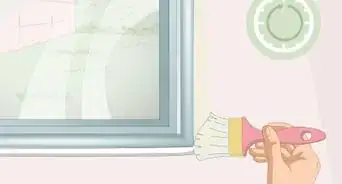
1Go over your drawing with a black marker. Draw just the main shapes at this point and plan to refine it later. Transfer it to an 9 1/2 x 11 inch piece of 140 pound, cold pressed, watercolor paper taken from a pad. Hold the sketch behind the good paper and tack it with tape onto a window.
-
2Transfer the drawing to good paper. Use a pencil to copy the lines, now clearly visible from the light coming through the window, for the cat, pumpkins and moon. Be sure to add the cat's ears and tail.
-
3With the sketch transferred, add details. Think about and, if you wish, try out on scrap paper, different patterns the fur; variegated, tiger-striped, spots like a leopard, or a solid color, head to toe. Pay attention to the cat's eyes because they will tell a lot about his mood. Ears, as well, up and perky means happy and at ease, while down and against the head means he is on guard and ready to take on the world.Advertisement


Part 3
Part 3 of 3:Paint Your Picture
-
1Think about color. Color is what grabs attention and gives the piece drama. How will you arrange it on the page? Most likely, the pumpkins will be shades of orange, although white pumpkins, striped and even ones with green spatters are not unheard of today.
-
2Set up your paints, brushes, water and tissues. Plan to have a full range of colors. On a scrap of watercolor paper, practice color combinations.
-
3Think about how by applying the watercolor, your choice of paint strokes can set a mood. Will the colors be bold and the strokes of the brush be strong and dynamic? Or, will you employ a feather-light touch?
-
4Consider whether your will add live props. Flowers, fruits and vegetables, other living creatures found in the garden might be fun to include, or bats, frogs, lizards, bugs, grasshoppers, birds, even an unsuspecting mouse or two.
-
5Paint your pumpkins and the cat. There is no particular place to begin or any special order of working. Generally, a watercolor can be started by applying a light, over-all application to get the colors down. These light handed strokes, using well diluted paint, will help you to establish your composition. Since the colors are transparent, it is easy to make changes, once the under layer is completely dry. Remember, watercolor dries thirty percent lighter than when it is wet. Allow the first layer to dry thoroughly.
-
6Stand the piece up away from yourself and study it. Now is the time to sketch, using pencil, the details. Start with the cat's face.
-
7Paint the sky. Give the whole piece a second layer. This should go quickly and confidently and it will show in the results. Again, let it dry thoroughly.
-
8Study it from a distance. Sometimes, it is good to wait until the next day to gain distance. Make final changes, additions and repeat the drying, stepping back and studying it. When it is complete stop! It is easy to overwork a watercolor, so remember to use restraint.
-
9Mat and frame it and hang it prominently for all to enjoy. While this picture will have a short lifespan before Thanksgiving bears down and grabs attention, it will add tremendous vitality to the room. Who knows, it might even ward off evil spirits…..heh, heh, heh.Advertisement


Community Q&A
-
QuestionHow long does the whole process take?
 Community AnswerThe whole process would probably take about two to three hours, depending on your level of artistic skill.


About This Article