This article was co-authored by Clinton M. Sandvick, JD, PhD. Clinton M. Sandvick worked as a civil litigator in California for over 7 years. He received his JD from the University of Wisconsin-Madison in 1998 and his PhD in American History from the University of Oregon in 2013.
There are 13 references cited in this article, which can be found at the bottom of the page.
This article has been viewed 63,180 times.
Hawaii is a “no-fault” divorce state, which means that if one person or the other wishes to get the divorce, it will go through. If both the husband and wife are in agreement, this is an “uncontested divorce” and the process is easier. If there are issues that are in dispute, such as child custody or property ownership, then it is called a “contested divorce,” and the process can take longer and become more involved. Even in the simplest divorces, it is always a good idea for both parties to be represented by separate attorneys.
Steps
Method 1
Method 1 of 3:Starting Divorce Proceedings in Hawaii
-
1Know which court to use. In Hawaii, divorces are all handled by the Family Court, but each island has its own “circuit” of the Family Court. You should contact the court in your area.
- Oahu is the First Circuit.[1] The Family Court for the First Circuit is located at Family Court Service Center, Ronald T. Y. Moon Judiciary Courthouse, 4675 Kapolei Parkway, Kapolei, Hawai`i 96707-3272. Its phone number is (808) 954-8290.
- The islands of Maui, Molokai and Lanai make up the Second Circuit.[2] The Family Court for the Second Circuit is located at Wailuku Circuit Court, 2145 Main Street, Room 106, Wailuku, Hawai`i 96793. Its phone number is (808) 244-2969.
- The island of Hawaii makes up the Third Circuit. The Family Court for the Third Circuit has two locations. The first is Circuit Court, Hilo, Hale Kaulike, 777 Kilauea Avenue, Hilo, Hawai`i 96720-4212, and its phone number is (808) 961-7400. The second court is at Circuit Court, Kona, 79-1020 Haukapila Street, Kealakekua, Hawai`i 96750, and its phone number is (808) 322-8750.
- The island of Kauai is the Fifth Circuit.[3] The Family Court for the Fifth Circuit is located at Pu’uhonua Kaulike, Judiciary Complex, 3970 Ka’ana Street, Lihue, Hawaii 96766. Its phone number is (808)482-2330.
- Notice that there is no Fourth Circuit.
-
2Get the paperwork you need. Whether you are filing an uncontested divorce, which is one in which both parties are able to agree on everything, or a contested divorce, which has certain issues that the judge will have to decide, there are basic forms that are common to both. Each circuit, however, has slightly different sets of forms. You may get copies of the forms by going to the court address, by calling the court to ask for the forms to be mailed to you, or by using the court’s web address:
- First Circuit Forms: http://www.courts.state.hi.us/self-help/courts/forms/oahu/family_court_forms
- Second Circuit Forms: http://www.courts.state.hi.us/self-help/courts/forms/maui/family_court_forms
- Third Circuit Forms: http://www.courts.state.hi.us/self-help/courts/forms/hawaii/family_court_forms
- Fifth Circuit Forms: http://www.courts.state.hi.us/self-help/courts/forms/kauai/family_court_forms
-
3Use the Forms Checklist. Not every form will apply to every family situation. The packet of forms, either online or that you will get from the courthouse, will contain a Forms Checklist. Read this carefully. It will tell you which forms are required, which apply only to special circumstances, the numbers of copies that you will need, and the order of completing them.
-
4Get assistance with the forms. The court clerk may be able to assist you in some cases about the meanings of forms, but they will not answer legal questions. For legal questions about completing the paperwork, you will need to consult with a family law attorney.[4]
-
5Begin with the Divorce Complaint. Whether you are filing a contested divorce or an uncontested divorce, the paper that starts the whole proceeding is the divorce complaint. The person initiating the divorce, called the “plaintiff,” completes and files the Complaint for Divorce. This needs to be completed and filed with the court for the correct circuit. It must be filed with the clerk, along with the filing fee. The filing fee is $215, with an additional surcharge of $50 if there are children involved in the divorce.[5]
-
6State the grounds for divorce. As part of the Complaint, the plaintiff will have to state the reason for the divorce. In Hawaii, it does not matter if the two parties agree on the grounds for the divorce. If one person wants the divorce, it will be granted, but it begins with this statement. The complaint form contains three selections for the grounds for divorce:[6]
- The marriage is irretrievably broken.
- The parties have lived separate and apart for 2 or more years under a separation agreement.
- The parties have lived separate and apart for 2 or more years, and there is no expectation that they will get back together.
-
7Serve the complaint and summons. The plaintiff must serve (deliver) the complaint and summons to the other spouse, known as the defendant. The plaintiff must complete a Proof of Service form that declares how the complaint and summons were delivered.[7] The complaint contains the plaintiff’s statements about:
- the grounds for the divorce
- the number and ages of the children
- custody and visitation of children
- alimony and support payments.
-
8Meet to discuss the terms of the divorce. This is where the two parties will determine whether this is going to be an uncontested or a contested divorce. If there is total agreement, the parties will work together to complete the remaining paperwork and file the forms as a contested divorce. If there are differences, then they will proceed as a contested divorce.
-
9Attend “Kids First.” Whether the divorce is contested or uncontested, this step is required if there are children in the marriage. The court will require both parents and any children ages 6-17 to attend an informational program known as “Kids First.” This is a program designed to help parents and children understand the effects of separation and divorce. Facilitators work with the children to help them express their feelings or questions.[8]


Method 2
Method 2 of 3:Proceeding With an Uncontested Divorce
-
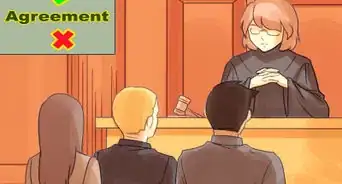
1Decide if you are eligible. An uncontested divorce means that you and your spouse agree on all the issues of the divorce. If you are both in agreement, then you will work on completing the forms together and sign the various paperwork together to indicate your agreement. There is a checklist to see if you are eligible:[9]
- Residence – you must have been living in Hawaii for at least 6 continuous months before filing for divorce
- Children – you must agree on all matters related to child custody and visitation
- Support – you must agree on all matters related to child support, medical and dental insurance
- Taxes – you must agree regarding all tax filings and deduction claims
- Property – you must agree on division of all marital property and debts
- Alimony – you must agree on the amount and timing of any alimony payments
- Cause – you must agree on the reason (“grounds”) for the divorce
- Some of the circuits have an office of a Family Court Service Center. You may be able to get some assistance there, or by calling (808) 954-8290.
-
2Complete the paperwork carefully. Complete all the forms carefully, neatly and completely. In an uncontested divorce, you are not required to appear before the judge. But if the judge cannot understand something in your paperwork, he may require you to attend a hearing or meeting, and this can delay your final outcome.[10] [11]
-
3Submit all the papers to the court with the filing fee. The filing fee varies from one circuit to another, but it is approximately $200-$300 for an uncontested divorce. When you submit paperwork to the court, you will often need multiple copies (the forms will tell you), and you will need to get a copy stamped by the clerk to keep for your records.[12] If you have questions about needing copies, ask the clerk.
-
4Wait for the final divorce order. The final items that you submit to the court are self-addressed, stamped envelopes, one to each spouse. When the judge signs the final divorce decree, the court will mail that decree to each spouse. This should come in about 4-6 weeks. If the judge denies the divorce for some reason, you will receive instructions about further steps you need to take.[13]
- You may be able to track the status of your case online at www.courts.state.hi.us.


Method 3
Method 3 of 3:Proceeding With a Contested Divorce
-
1Serve and file an answer. The defendant must file an answer to the complaint within 20 days. An “answer” is a legal response to each of the allegations that the plaintiff has made in the complaint. The courts do not have a specific form for this. The defendant will need to create it, either alone or with help of an attorney. If the answer is not filed within 20 days, then the plaintiff may automatically receive judgments that he/she requested in the complaint.
- For example, if the plaintiff stated in the complaint that the children should live with the plaintiff alone and that the defendant should have no visitation, this could become the order if the defendant does not file an answer.
- Also, any statements the plaintiff made about alimony or child support payments could be granted automatically if the defendant does not file an answer on time.
-
2Meet to agree on what you can. Even in a contested divorce, there may be several items that the parties can agree on. For example, if they cannot decide on child custody, they may still be able to agree on property division. It is important for the parties to meet and settle as many issues as possible. The primary issues that arise and need to be decided are:[14]
- child custody and visitation
- division of personal property
- division of the marital debts and obligations
- child support payments.
-
3File motions for judicial decisions. Any matters that the two parents cannot decide will have to be decided by the judge. The way to get an issue to the judge’s attention is to file a motion. Any motion must be written (there are no specific forms), filed in the clerk’s office, and then served (delivered) on the other party.
-
4File an answer to any motion. For most issues, when one party files a motion, the court will hold the papers for a period of time, usually 15-20 days, for the other party to file an answer. The answer is your response, with any legal reasoning or argument to support your side of the issue. If you do not file an answer, the court may decide the motion in favor of the first party, without considering your side.[15]
-
5Attend all hearings. After a motion and answer are filed, the court will schedule a time and date for a hearing. Both parties will need to attend and present their arguments. After hearing both sides, the judge will issue a decision. Sometimes the decision will be made right there on the spot, and sometimes you will leave and receive a written decision in the mail.
-
6Consider using mediation. Mediation is a process that involves a neutral third party. You and your spouse will meet with this person, individually and together, to try to resolve your differences. A good mediator may be expensive but can often help you reach a final resolution that you can both agree on.[16]
-
7Settle, if possible. It is generally better for the parties involved in any divorce to reach decisions on their own. If you can reach agreements, then you can report to the court that the divorce has been settled and is ready for a final divorce decree. You will present your settlement to the judge. The judge will review it, and if it appears to address all the disputed issues, the judge will sign it and finalize the divorce.
-
8Receive the final decree. The court will mail you the final divorce decree soon after the final decision is made. When the divorce decree is signed by the judge, it becomes a binding order that dissolves the marriage. It also serves as a lasting order regarding any of the disputed issues, such as child support, alimony, visitation, etc.


Warnings
- Divorce is a serious legal procedure. Even an apparently simple, uncontested divorce can raise issues you may not have anticipated. Consulting with an attorney is always a good idea.Thanks!
- The citation references throughout this article give examples of forms for the various circuit courts in Hawaii. You will need to check your specific circuit court to make sure you are using the correct forms and procedures. The clerk should be able to help with this.Thanks!








References
- ↑ http://www.courts.state.hi.us/self-help/divorce/forms/oahu
- ↑ http://www.courts.state.hi.us/self-help/divorce/forms/maui_molokai_and_lanai
- ↑ http://www.courts.state.hi.us/self-help/divorce/forms/kauai
- ↑ http://www.divorcenet.com/resources/uncontested-divorce-hawaii.html
- ↑ http://www.courts.state.hi.us/docs/courts_docs/Family_Court_Fees.pdf
- ↑ http://www.courts.state.hi.us/docs/form/hawaii/3FP266.pdf
- ↑ http://www.courts.state.hi.us/self-help/courts/forms/maui/family_court_forms
- ↑ http://www.courts.state.hi.us/courts/family/family_court_volunteer_opportunities
- ↑ http://www.divorcenet.com/resources/uncontested-divorce-hawaii.html
- ↑ http://www.divorcenet.com/resources/uncontested-divorce-hawaii.html
- ↑ http://www.courts.state.hi.us/docs/court_rules/rules/hcrr.pdf
- ↑ http://www.courts.state.hi.us/docs/1FP/uncontestWOChildren_instr.pdf
- ↑ http://www.courts.state.hi.us/docs/1FP/uncontestWOChildren_instr.pdf
- ↑ http://www.courts.state.hi.us/self-help/divorce/how_to_proceed
- ↑ http://www.lawhelp.org/files/EAD80A2B-BF27-AE00-DEE5-0D4ED48A9D0F/attachments/8C2580CB-91AF-4FF7-8FDA-644CD8AF052E/f16.divorce-law-in-hawaii.pdf
- ↑ http://www.lawhelp.org/files/EAD80A2B-BF27-AE00-DEE5-0D4ED48A9D0F/attachments/8C2580CB-91AF-4FF7-8FDA-644CD8AF052E/f16.divorce-law-in-hawaii.pdf
- ↑ http://www.courts.state.hi.us/self-help/divorce/divorce_facts
About This Article