This article was co-authored by Pippa Elliott, MRCVS. Dr. Elliott, BVMS, MRCVS is a veterinarian with over 30 years of experience in veterinary surgery and companion animal practice. She graduated from the University of Glasgow in 1987 with a degree in veterinary medicine and surgery. She has worked at the same animal clinic in her hometown for over 20 years.
There are 8 references cited in this article, which can be found at the bottom of the page.
This article has been viewed 5,769 times.
Wry neck, also known as head tilt or torticollis, is a common disease in rabbits that causes a sideways head tilt.[1] Among the many causes of wry neck, a common one is inner ear disease due to infection.[2] Although drastic looking, wry neck is treatable, as long as it is diagnosed promptly.[3] If your rabbit’s head positioning looks like a little strange, observe him at home and take him to your veterinarian for diagnosis and treatment.
Steps
Part 1
Part 1 of 3:Watching Your Rabbit’s Movements
-
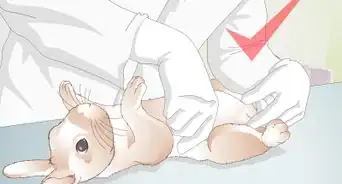
1Determine if your rabbit can walk. For some rabbits, wry neck’s head tilt makes them so disoriented they cannot walk. Instead, they will lie on one side looking paralyzed. While attempting to get up and balance themselves, they may end up simply rolling around on the ground.[4]
- Wry neck can cause weakness or paralysis in the back legs, making it difficult or impossible for a rabbit to walk.[5]
-
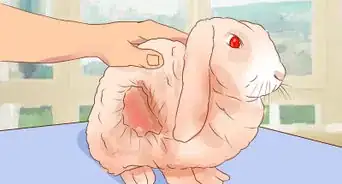
2Observe your rabbit’s head position when he walks. The most telltale sign of wry neck is a sideways-tilting head.[6] If your rabbit’s head is tilting sideways as he walks, you can be confident he has wry neck. Wry neck has other symptoms, though, so you should look out of for those as well.
- The side of the head tilt indicates which side is affected. The head will be tilted down on that side.[7]
Advertisement -
3Detect a lack of coordination when your rabbit walks. Your rabbit, like humans and other animals, has a vestibular system within his central nervous system that controls balance, coordinates body movements, and helps keep body parts in their proper positions.[8] Inner ear disease, if severe enough, could affect your rabbit’s vestibular system and cause him to walk abnormally.[9] For example, your rabbit may begin to walk in circles.[10]
- Wry neck can also cause dizziness, so your rabbit may look wobbly or fall over when walking.[11]
Advertisement


Part 2
Part 2 of 3:Observing Your Rabbit’s Face and Eating Habits
-
1Look at your rabbit’s eye movements. Occasionally, rabbits with wry neck have nystagmus, an eye condition during which the eye uncontrollably moves horizontally or vertically.[12] Sometimes, the nature of the nystagmus (e.g., direction, speed) can provide clues about the cause of wry neck.[13]
- The nystagmus will be present whether or not your rabbit is walking.
-
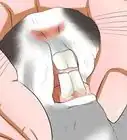
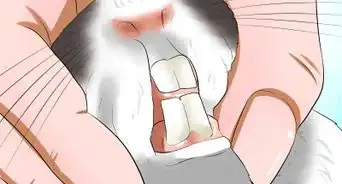
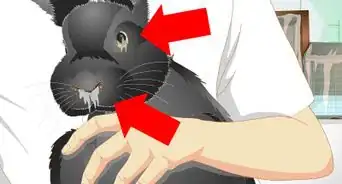
2Examine your rabbit’s face for signs of facial paralysis. Wry neck can affect nerves controlling facial movements. Signs of facial paralysis include a drooping lip, drooling, and an inability to close the eyelids. In addition, you may be able to see the third eyelid, a protective covering that is normally visible only when the eye needs to be protected.[14]
-
3Observe any changes in appetite. If your rabbit has wry neck, he may feel nauseated, causing him to eat less and possibly develop anorexia. The nausea could also cause your rabbit to drool more and grind his teeth.[15]
- A head tilt would make it difficult for your rabbit to get food into his mouth.
Advertisement


Part 3
Part 3 of 3:Seeking a Veterinary Diagnosis
-
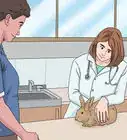
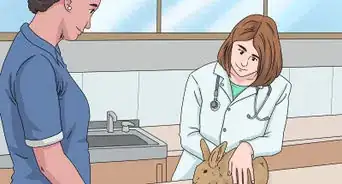
1Take your rabbit to your veterinarian. Wry neck requires veterinary care. If your rabbit has a head tilt, regardless of whether you see any other symptoms of wry neck, take him to your veterinarian for diagnosis and treatment. If your veterinarian does not have a lot of rabbit experience, ask him or her for recommendations on local veterinarians with rabbit expertise. You could also visit the website http://rabbit.org/vet-listings/ to find a veterinarian.[16]
- Wry neck can get progressively worse. Take your rabbit to your veterinarian as soon as possible.[17]
-
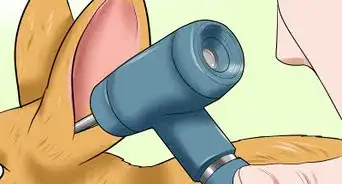
2Allow your veterinarian to examine your rabbit. Wry neck is commonly diagnosed on clinical signs, namely the head tilt.[18] However, since wry neck can have many causes (e.g., middle/inner ear infection, trauma, stroke, parasites), your veterinarian will need to identify the exact cause in order to develop an effective treatment plan. Identifying the exact cause will involve ruling out as many causes as possible.[19]
- Your veterinarian will first do a thorough physical examination of your rabbit. From there, he or she will decide which other diagnostic tests to run.[20]
-
3Have your veterinarian perform additional diagnostic testing. Several other diagnostic tests can help your veterinarian determine the cause of your rabbit’s wry neck. For example, skull x-rays could show an inner ear infection, indicated by a thickened tympanic bulla (bony structure in the ear). However, these x-rays may be non-diagnostic, meaning they wouldn’t be helpful in diagnosing the wry neck.[21]
- If an infection is the suspected cause, your veterinarian would conduct various tests. For bacteria, an analysis of pus inside the ear (if present) would help. For E. cuniculi, a parasite that can cause wry neck, diagnostic tests include blood tests and an analysis of the urine.[22]
- Blood tests for E. cuniculi look for antibodies that form in response to the parasite entering the body.[23]
- Diagnostic testing could be expensive, depending on how long it takes your veterinarian to identify the cause of your rabbit’s wry neck.
Advertisement


Warnings
- Wry neck can look very distressing to you, but do not assume your rabbit needs to be euthanized. Euthanasia should only be a last resort—when your rabbit can no longer eat, walk, or do normal rabbit activities.[28]Thanks!
References
- ↑ http://www.peteducation.com/article.cfm?c=18+1803&aid=2371
- ↑ http://articles.extension.org/pages/33031/head-tilt-wry-neck-in-rabbits
- ↑ http://www.bio.miami.edu/hare/tilt.html
- ↑ http://www.bio.miami.edu/hare/tilt.html
- ↑ http://www.disabledrabbits.com/head-tilt.html
- ↑ http://www.disabledrabbits.com/head-tilt.html
- ↑ http://www.peteducation.com/article.cfm?c=18+1803&aid=2371
- ↑ http://www.petmd.com/rabbit/conditions/ears/c_rb_head_tilt
- ↑ http://articles.extension.org/pages/33031/head-tilt-wry-neck-in-rabbits
- ↑ http://www.peteducation.com/article.cfm?c=18+1803&aid=2371
- ↑ http://www.disabledrabbits.com/head-tilt.html
- ↑ http://www.peteducation.com/article.cfm?c=18+1803&aid=2371
- ↑ http://www.bio.miami.edu/hare/tilt.html
- ↑ http://www.peteducation.com/article.cfm?c=18+1803&aid=2371
- ↑ http://www.peteducation.com/article.cfm?c=18+1803&aid=2371
- ↑ http://www.bio.miami.edu/hare/tilt.html
- ↑ http://www.disabledrabbits.com/head-tilt.html
- ↑ https://www.vetstream.com/lapis/Content/Freeform/fre00020
- ↑ http://www.rabbit.org/journal/3-8/head-tilt.html
- ↑ http://www.disabledrabbits.com/head-tilt.html
- ↑ https://www.mspca.org/angell_services/management-of-head-tilt-in-rabbits/
- ↑ http://www.disabledrabbits.com/head-tilt.html
- ↑ http://www.rabbit.org/journal/3-8/head-tilt.html
- ↑ https://www.mspca.org/angell_services/management-of-head-tilt-in-rabbits/
- ↑ http://www.bio.miami.edu/hare/tilt.html
- ↑ http://www.peteducation.com/article.cfm?c=18+1803&aid=2371
- ↑ http://www.disabledrabbits.com/head-tilt.html
- ↑ http://www.bio.miami.edu/hare/tilt.html
About This Article

To diagnose wry neck in your rabbit, determine whether it can walk, since wry neck can cause disorientation or weakness in its back legs, making walking impossible. If your rabbit can walk, look to see whether its head tilts sideways as this is telltale sign of wry neck. Since inner ear disease is a common cause of wry neck, look to see whether your rabbit is wobbly or walking in circles. Another symptom to look out for in your rabbit is signs of facial paralysis including a drooping lip, drooling, and an inability to close its eyelids, since wry neck can affect the nerves controlling facial movement. If you notice signs of wry neck in your rabbit, take it to a vet to prevent the condition worsening. For more advice from our Veterinary co-author, including how to tell if wry neck is affecting your rabbit’s eyes, keep reading!