This article was co-authored by wikiHow staff writer, Hunter Rising. Hunter Rising is a wikiHow Staff Writer based in Los Angeles. He has more than three years of experience writing for and working with wikiHow. Hunter holds a BFA in Entertainment Design from the University of Wisconsin - Stout and a Minor in English Writing.
wikiHow marks an article as reader-approved once it receives enough positive feedback. In this case, 87% of readers who voted found the article helpful, earning it our reader-approved status.
This article has been viewed 108,578 times.
Learn more...
Understanding the sex of a grasshopper is important if you’re performing research or a dissection. Even though grasshoppers don’t look physically different at a glance, you can still easily identify whether you have a male or female insect. By checking their abdomen and watching their behavior, you can figure out what grasshopper you have!
Steps
Method 1
Method 1 of 2:Checking the Abdomen
-
1Hold the grasshopper in the middle of its body between your fingers. Pick up the grasshopper gently so you have a firm grip. The grasshopper may try to get away while you pick it up. Don’t squeeze too hard or else you may hurt the grasshopper.[1]
- Grasshoppers may bite, but it’s very uncommon. It also may regurgitate its stomach as a defense mechanism, but it isn’t harmful to humans.[2]
-
2Squeeze softly on the grasshopper’s abdomen. Grab the rear of the grasshopper between your thumb and forefinger. Slightly pinch the abdomen so the grasshopper’s sexual organs are revealed.[3]
- Squeezing too hard will hurt the grasshopper.
Advertisement -
3Identify a male grasshopper by a rounded abdomen. Looking at the grasshopper's abdomen is the most definitive way to determine its sex. A rounded, upturned abdomen indicates the grasshopper is a male.[4]
-
4Note that a female grasshopper has a tapered abdomen. A female grasshopper's abdomen looks like a tube. This tube is known as the ovipositor, which the female uses to lay its eggs.[5]Advertisement


Method 2
Method 2 of 2:Assessing the Grasshopper Visually
-
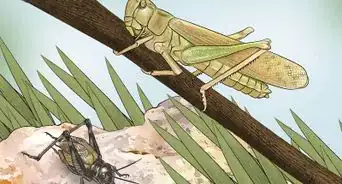
1Recognize that female grasshoppers are larger than males. If you are looking at a particular grasshopper in a large group, look at how large it is compared to others of its species. If your grasshopper is larger than the others, it’s most likely a female. If not, then it’s likely that you have a male.[6]
- Don’t judge the sex of the grasshopper solely on its appearance since it will not be the most accurate.
-
2Identify male grasshoppers by their aggressive behavior. Look to see if the grasshopper is kicking or biting others of its species. When grasshoppers prepare to mate, the males will become more aggressive with one another while they search for females.[7]
- Behavior and temperament depends on the grasshopper species. Some may be more aggressive while others will not.
-
3Look for males mounting females when they mate. When grasshoppers mate, they will climb on top of the females to deposit their sperm so the females can lay eggs. If you see a smaller grasshopper on top of a larger grasshopper, the smaller one is likely a male.[8]
- Sometimes, males will mount other males if they are fighting.
-
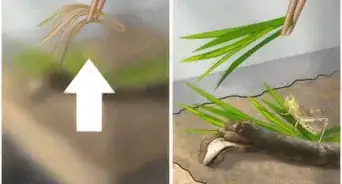
4Spot a female grasshopper if you notice it laying eggs. Check if the grasshopper is sticking its abdomen, or lower body, into the ground. Females lay their eggs underground, so look for grasshoppers digging in the ground or staying still when you approach them.[9]
- Female grasshoppers lay eggs throughout the summer and autumn.
Advertisement


Community Q&A
Did you know you can get answers researched by wikiHow Staff?
Unlock staff-researched answers by supporting wikiHow
-
QuestionDo grasshoppers have a season that they mate I want to breed them?
 wikiHow Staff EditorThis answer was written by one of our trained team of researchers who validated it for accuracy and comprehensiveness.
Staff AnswerwikiHow Staff EditorStaff AnswerGrasshoppers tend to mate throughout the summer months and into early autumn.
Support wikiHow by unlocking this staff-researched answer.
-
QuestionMy grasshopper has a black stinger-looking thing. What could this be?wikiHow Staff EditorThis answer was written by one of our trained team of researchers who validated it for accuracy and comprehensiveness.
Staff AnswerwikiHow Staff EditorStaff AnswerThese may be the tips of the ovipositor on a female grasshopper. These are used to help the female dig in the ground to lay her eggs.Support wikiHow by unlocking this staff-researched answer.
-
QuestionHow long do grasshoppers live?
 Community AnswerGrasshoppers will generally live about one year.
 -
QuestionHow do grasshoppers dig holes to lay their eggs?
 Community AnswerAfter breeding, female grasshoppers dig a hole in the ground in which to lay their eggs by using a special tube in their abdomen known as an ovipositor. The ovipositor is first used to dig the hole, and then to deposit the eggs one by one into the hole.
 -
QuestionHow do I remove baby grasshoppers from the mother and still keep them alive? I do not have enough space to hold the babies, but I wish for them to survive while still keeping the mother.
 Community AnswerTake the mother grasshopper out of its cage and gently put it into a temporary holding area. Then take the cage outside and place it in an area that would be beneficial for the babies. Remove the lid from the cage and let the babies come out on their own. They will jump out and be on their way. Once all the babies have left the cage, bring it back inside and carefully put your mommy back inside of it.
 -
QuestionHow do I determine if the grasshopper is a baby or an adult?Community AnswerBabies are very small, like smaller than your pinkie fingernail. The babies also don't have wings yet.
-
QuestionHow do grasshoppers lay eggs?
 Community AnswerGrasshoppers lay eggs by using their ovipositor to dig into the ground and then laying their eggs in the hole. The mothers do not stay and care for their young, obviously.
 -
QuestionI have a boy and girl grasshopper. I found them both missing one of their jumper legs. Will they still be able to have babies?Community AnswerYes, no problems will occur in the babies, just make sure they have 2 - 3" of soil, dried oats, coconut fiber, or sand.
-
QuestionIs the size of the grasshopper an indication of its sex?Community AnswerNo, just the shape of the abdomen.
-
QuestionCan grasshoppers breed with katydids?Community AnswerNo, they are different species.
Warnings
- Don’t squeeze grasshoppers too hard or else you could damage them.Thanks!




References
- ↑ https://www.biologyjunction.com/grasshopper_dissection.htm
- ↑ https://extension.psu.edu/questions-and-answers-about-caterpillars-and-grasshoppers
- ↑ https://www.biologyjunction.com/grasshopper_dissection.htm
- ↑ https://www.biologyjunction.com/grasshopper_dissection.htm
- ↑ https://www.biologyjunction.com/grasshopper_dissection.htm
- ↑ http://www.wyomingextension.org/agpubs/pubs/B1161.pdf
- ↑ https://www.ncbi.nlm.nih.gov/pmc/articles/PMC3498212/
- ↑ https://www.ncbi.nlm.nih.gov/pmc/articles/PMC3498212/
- ↑ https://youtu.be/jDnFleTAlZk?t=3s
About This Article