This article was co-authored by wikiHow Staff. Our trained team of editors and researchers validate articles for accuracy and comprehensiveness. wikiHow's Content Management Team carefully monitors the work from our editorial staff to ensure that each article is backed by trusted research and meets our high quality standards.
There are 9 references cited in this article, which can be found at the bottom of the page.
Learn more...
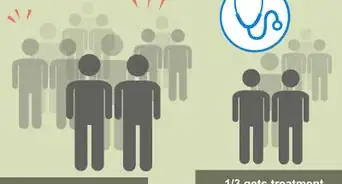
Getting control over social anxiety is the first step to feeling happier and more comfortable with friends, strangers, and at public events. If you’re someone who experiences the telltale signs of social anxiety—fears of judgment, sweating, and nausea during or before social situations—you’re not alone. Around 7% of Americans experience social anxiety, so there are plenty of people in the same boat.[1] We’ve put together some strategies for dealing with social anxiety in the moment, so that you can feel more confident in your daily life.
Steps
Method 1
Method 1 of 11:Do a breathing exercise.
-
1Fight shallow breathing caused by anxiety with this simple technique. Inhale, deeply and slowly, for 4 seconds through your nose. Hold your breath for 2 seconds. Then, exhale through your mouth for 6 seconds, pushing out as much air as you can. Repeat this process, focusing only on your breathing, until you feel calmer.[2]
- How you breathe is just as important as how deeply. When doing this exercise, place one hand on your chest, and the other on your stomach. As you breathe, your hand on your stomach should rise, while the one on your chest should remain in place.[3]
Advertisement

Method 2
Method 2 of 11:Focus on completing a helpful task.
-
1Having a job to do can make social occasions much easier. When you’re doing a favor for someone else, you can focus on the task at hand. Best of all, your work will be appreciated by others at the event, which can keep some of your anxious feelings at bay.[4]
- If you’re having trouble finding a task, try lending someone who is already working on something a hand. Say something like, “I see you’re working on this, could I help? I really want to make myself useful.”

Method 3
Method 3 of 11:Say a mantra.
-
1Whether you say them out loud or in your head, mantras recenter you. Mantras are an ancient technique for calm and focus, and there are a number of spiritual ones that many people use daily. But you can also make up your own. Pick a phrase that you need to remind yourself of to restore your calm, and repeat it. You can try one of these options as well:[5]
- “Other people feel anxious and awkward in social situations too.”
- “I will get through this.”
- “I can take a break whenever I need to, but I don’t need to yet.”
Advertisement

Method 4
Method 4 of 11:Focus on your 5 senses.
-
1Pay attention to your surroundings to alleviate your anxiety. Your senses provide a wealth of real information, rather than the imagined feelings anxiety provokes. By taking note of that information, you can fixate less on your anxious thoughts. Acknowledge the following list of things in your head:[6]
- 5 things you can see: this can include simple, everyday things, like chairs, light fixtures, or the sky.
- 4 things you can touch: you might take notice of, for example, your clothes, your hair or a table.
- 3 things you can hear: this might be something like the sound of traffic, music, or footsteps.
- 2 things you can smell: if there’s food around, make a mental note of its smell. The same goes for smells of grass, air fresheners, or laundry.
- 1 thing you can taste: how does the inside of your mouth taste? Do you have any leftover tastes from earlier in the day?

Method 5
Method 5 of 11:Try progressive muscle relaxation.
-
1Redirect your focus from your anxiety to the sensations in your body. You might want some privacy for doing this, so head to the bathroom or outside for a bit. The technique involves going through each muscle group in your body, tensing your muscles for 4 to 10 seconds, then relaxing them. Breathe in while tensing your muscles, and exhale when relaxing them. Try doing this with all of the following muscle groups, in this order:[7]
- Hands: clench both of your hands into fists.
- Wrists and forearms: extend both of them out in front of you, then bend your hands back at the wrists and hold the position.
- Biceps and upper arms: clench your hands into fists, then bend your arms at the elbows and flex your biceps.
- Shoulders: raise them toward your ears, as if you’re shrugging.
- Forehead: lower your eyebrows as much as possible, as though you’re making a deep frown.
- Around your eyes and nose: shut your eyes as tightly as you can.
- Back of your neck: press the back of your head against the floor, a wall, or a chair.
- Front of your neck: touch your chin to your chest.
- Chest: take a deep breath, and hold it for 4 to 10 seconds.
- Back: arch your back away from the floor, a chair, or a wall.
- Stomach: suck it in, until it feels tight in your abdomen.
- Hips and buttocks: clench your buttocks together tightly.
- Thighs: clench them together tightly.
- Lower legs: bend your feet at their ankles, so that your foot is angled toward the rest of your body.
Advertisement

Method 6
Method 6 of 11:Ground yourself in the present.
-
1Keep your thoughts focused on what’s real, not what you imagine. You can’t predict how others are feeling about you, so remind yourself not to even try. You can only be yourself, and that is good enough. If you find yourself doing one of the following things, know that this is just your anxiety, and not real:[8]
- Catastrophizing: thinking that every minor perceived mistake you make is a huge deal, when really it’s going to be forgotten about soon enough.
- Personalizing: thinking that the comments that other people make are really about you, and forgetting that when people want to address you, they’ll generally do so directly.
- Mind-reading: imagining that you can tell what other people are thinking. This isn’t possible for any of us, so it’s best not to attempt it.

Method 7
Method 7 of 11:Put on a confident front.
-
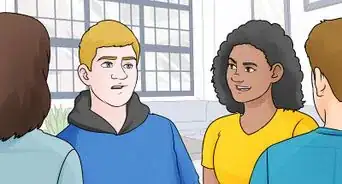
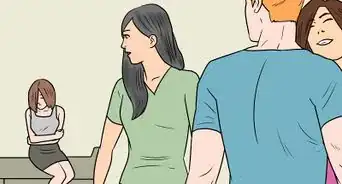
1When it comes to social anxiety, faking it till you make it is a good strategy. Think of it as playing a role, and pretending to be a confident and outgoing person. You don’t have to be the center of attention, but try introducing yourself to other people when you’re at a social event. Even a brief conversation is still a win.[9]
- This can be a scary prospect when you have social anxiety, but it’s worth trying. If you’re struggling to find someone to talk to at an event, try a simple introduction, like, “I saw you standing over here and since I’ve been separated from my friends, I thought I’d say hi.”
Advertisement

Method 8
Method 8 of 11:Replace substances with other tools.
-
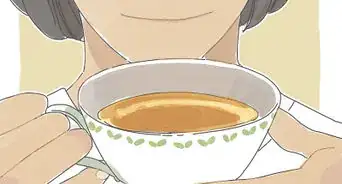
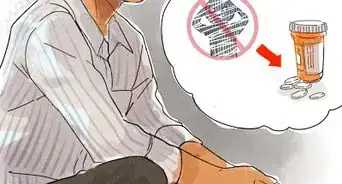
1Substances aren’t great crutches, so opt for something else. Although it’s commonly thought of as a help in social situations, alcohol exacerbates anxiety. Nicotine and caffeine can have the same effects. If you rely on one of these substances, try an alternative:[10]
- Remember you don’t need an excuse to go outside and get some air. Instead of grabbing a cigarette, just take a step outside during a social occasion, and enjoy a couple of minutes to yourself.
- Instead of alcohol and caffeine, try drinking a glass of water. This will keep you feeling hydrated, fresh, and calm.
- Chewing gum has also been shown to alleviate anxiety. Bringing a pack with you to your next social occasion can give you something to focus on, and ease some of your stress.[11]

Method 9
Method 9 of 11:Challenge negative thought patterns.
-
1In the long term, changing your thought patterns is the only way to fix social anxiety. Mental health professionals recommend challenging the negative thoughts you experience in social situations in order to overcome them. By asking yourself the following questions, you can tap into the logic-oriented part of your brain, and remind yourself that there is nothing to be worried about:[12]
- What is the worst thing that can happen in this situation?
- Is the worst thing that can happen really so bad?
- What will I do if the worst thing that can happen does happen?
Advertisement

Method 10
Method 10 of 11:Remember that you’re getting better.
-
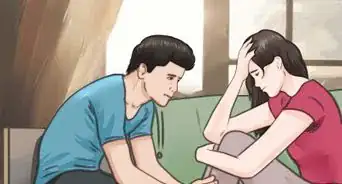
1Exposure to social situations is the best way to overcome anxiety. Every time you put yourself in a social environment, you’re actually taking steps to improve your symptoms. This makes the next time you meet new people an easier affair, so be proud of yourself. Over time, you’ll feel stronger and more capable.[13]

Method 11
Method 11 of 11:Talk to a therapist.
-
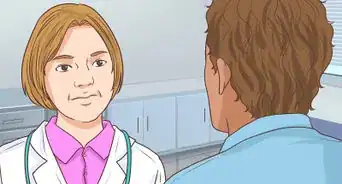
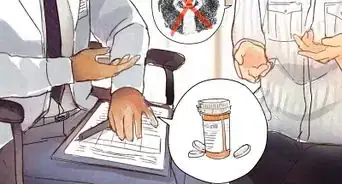
1Let a professional help you tackle social anxiety. Therapists are experienced at helping people manage and even eliminate their social anxiety. Be kind to yourself: you too can overcome this for good, and all it takes is a plan. Set up an appointment with a therapist to discuss the anxieties you have, and let them help you form a strategy to take it on.[14]Advertisement






References
- ↑ https://www.nimh.nih.gov/health/publications/social-anxiety-disorder-more-than-just-shyness
- ↑ https://www.helpguide.org/articles/anxiety/social-anxiety-disorder.htm
- ↑ https://www.helpguide.org/articles/anxiety/social-anxiety-disorder.htm
- ↑ https://www.sciencedaily.com/releases/2015/07/150701114813.htm
- ↑ https://www.sciencedirect.com/science/article/pii/S1876382018304591
- ↑ https://www.urmc.rochester.edu/behavioral-health-partners/bhp-blog/april-2018/5-4-3-2-1-coping-technique-for-anxiety.aspx
- ↑ https://www.uofmhealth.org/health-library/uz2225
- ↑ https://www.helpguide.org/articles/anxiety/social-anxiety-disorder.htm
- ↑ https://www.psychologytoday.com/us/blog/calmer-you/202007/12-powerful-ways-help-overcome-social-anxiety
- ↑ https://www.helpguide.org/articles/anxiety/social-anxiety-disorder.htm
- ↑ https://www.eurekalert.org/news-releases/660703
- ↑ https://www.helpguide.org/articles/anxiety/social-anxiety-disorder.htm
- ↑ https://www.apa.org/ptsd-guideline/patients-and-families/exposure-therapy
- ↑ https://www.psychologytoday.com/us/blog/calmer-you/202007/12-powerful-ways-help-overcome-social-anxiety















































Medical Disclaimer
The content of this article is not intended to be a substitute for professional medical advice, examination, diagnosis, or treatment. You should always contact your doctor or other qualified healthcare professional before starting, changing, or stopping any kind of health treatment.
Read More...