This article was co-authored by Lauren Baker, DVM, PhD. Dr. Baker is a Veterinarian and PhD candidate in Comparative Biomedical Sciences. Dr. Baker received her Doctor of Veterinary Medicine from the University of Wisconsin in 2016, and went on to pursue a PhD through her work in the Comparative Orthopaedic Research Laboratory.
This article has been viewed 4,410 times.
For whatever reason, some cats develop behaviors that are destructive or problematic for their owners. While such behaviors may be frustrating, persistent owners can take steps to counter-condition their cats. Counterconditioning has the impact of getting cats to abandon less desirable behaviors and behave in a way that is pleasing to their owners. By formulating a plan, engaging in positive reinforcement, and taking steps to create a good productive process, you’ll likely have success counterconditioning your cat.
Steps
Part 1
Part 1 of 3:Determining Your Course of Action
-
1Observe the cat. Spend some time observing your cat’s behavior. Without serious observation, you won’t fully understand the problem and won’t be able to determine a course of action to take. Try to commit relatively significant amount of time watching how your cat behaves.
- Use a notebook to record undesirable behavior. For example, make a note if your cat paws you or another cat.
- Pay special attention to what actions or events may trigger your cat’s undesirable behavior. For instance, your cat may exhibit bad behavior when there is a lot of noise or tumult in the room.
- Try to set aside some time every day to watch your cat. You may want to do this when your cat is more likely to behave poorly, like at meal time or when you have company.[1]
-
2Identify the problem. Before beginning a counterconditioning regimen, you’ll need to accurately identify a proper course of action. To do this, you need to consider what is causing the cat to behave in an undesirable way. Most negative cat behavior manifests because of:
- Fear
- Aggression
- Territorial problems[2]
Advertisement -
3Rank your goals. After you’ve watched your cat and identified issues you’d like to work on, you should write down and rank the goals of your counterconditioning program. Without ranking goals, you may not work on behaviors in a logical fashion.
- Consider what behaviors or problems are linked together. These should be ranked accordingly. For example, if your cat has food aggression and also appears territorial, you’ll need to work on these issues together.[3]
-
4Work on small behaviors, first. By working on less severe issues, you’ll be able to phase the cat into a counterconditioning program that eventually focuses on the most problematic or severe issues.
- Do things the cat is most comfortable with. For example, if a cat doesn’t like to be handled by people, but does favor some people, employ those people to get your cat used to being handled. Don’t have people the cat doesn’t favor handle it first.[4]
Advertisement


Part 2
Part 2 of 3:Using Positive Reinforcement
-
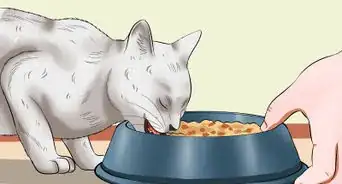
1Use food as a reward. Whenever your cat engages in behavior that is desirable, you should reward it with a treat. By rewarding your cat with a treat, you’ll set the expectation that certain behavior is desirable. As a result, the cat will be more likely to engage in behavior that earns it a reward.
- Give the cat their favorite snack when they engage in a behavior that is pleasing to you.
- Work the cat into expecting a reward for good behavior. For example, if you’re working with a cat that doesn’t like to be handled, work toward the cat walking over and sitting in your lap to get a treat.
- Make sure not to overfeed your cat.
- If your cat really enjoys its regular food, consider using the food as a treat, feeding your cat its meal over a training session rather than in a bowl at mealtime.
-
2Use verbal reinforcement. Almost all rewards should be paired with positive verbal reinforcement. By creating several levels of positive reinforcement, you’ll help counter condition the cat quicker. In addition, the cat will more easily associate positive verbal cue with other aspects of its counterconditioning training.
- Start with the cat’s name, if they don’t know it already.
- Employ simple words like “yes,” “good,” or “hold.”
- Pair verbal reinforcement with food rewards. For example, say “good” when you give your cat a treat.
- Verbal reinforcement is not as useful with cats as it is with dogs.[5]
-
3Try physical reinforcement, when appropriate. In addition to verbal reinforcement, you may need to offer physical reinforcement. While this may not work for all cats, some cats may benefit from a pat on the back or a friendly pet on the head.
- Use touching along with food rewards. For example, if the cat doesn’t like physical contact, pet the cat lightly after they’ve come to you expecting a treat.
- Use verbal reinforcement whenever you use physical reinforcement. By repeating phrases like “good cat” while petting the cat, you’ll be conditioning the cat to a certain behavior.
- Avoid physical contact if the cat seems averse to it. Make sure you’ve made progress on other parts of your counterconditioning regimen, first.[6]
Advertisement


Part 3
Part 3 of 3:Ensuring a Good Process
-
1Conduct counterconditioning in a calm environment. Before you start any conditioning program, you need to make sure that the space you conduct it in is a calm space that is conducive to training. If it’s not, your cat may be distracted, stressed, or anxious.
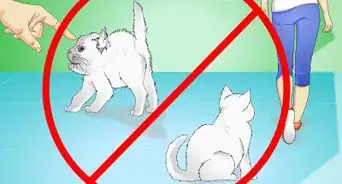
- Remove other pets or small children from the room. If for some reason they are necessary, make sure you control interaction as much as possible. For instance, create separate spaces for the cat in question and others in the room.
- Turn off music, television, and other distractions.
-
2Incorporate counterconditioning into your everyday activities. The most effective counterconditioning goes beyond planned training time. To be effective, you need to make sure you include it your daily regimen. This way, you can constantly reinforce the behavior you want.
- Use positive verbal cues.
- Reward positive behavior daily.[7]
-
3Avoid negative reinforcement, when possible. Negative reinforcement may undermine your counterconditioning program by making your cat fearful or anxious. As a result, try to limit negative reinforcement to only the most necessary circumstances.
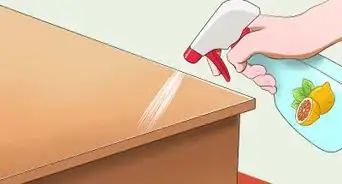
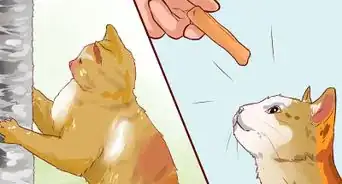
- If the cat is destructive, you may need to use verbal cues like “no” or even employ a spray bottle to send the signal that the cat should not destroy an item. In these cases, it is best if the negative reinforcement does not come directly from you. Try an remote-controlled trainer, or, if you are trying to get your cat to avoid a certain area, use a motion-activated deterrent.
- Negative reinforcement will not be successful if you trying to get a cat to overcome a fear of humans.[8]
-
4Go slowly. Perhaps the most important thing to do when counterconditioning a cat is to go as slow as you need. If your training is rushed, the cat will feel anxiety and may not result positively to your efforts.
- Set aside regular time every day to conduct explicit counterconditioning training. This could be as little as 10 minutes or as long as an hour.
- Create a schedule based on realistic expectations. For example, don’t expect to eliminate territorial behavior over the course of a week or even a month. The process may take months or even longer.[9]
Advertisement







References
- ↑ https://www.animalhumanesociety.org/training/counter-conditioning-and-desensitization
- ↑ https://www.animalhumanesociety.org/training/counter-conditioning-and-desensitization
- ↑ https://www.animalhumanesociety.org/training/counter-conditioning-and-desensitization
- ↑ https://www.animalhumanesociety.org/training/counter-conditioning-and-desensitization
- ↑ http://www.vetstreet.com/our-pet-experts/5-keys-to-picking-up-and-holding-your-cat-the-right-way
- ↑ http://www.vetstreet.com/our-pet-experts/5-keys-to-picking-up-and-holding-your-cat-the-right-way
- ↑ https://www.animalhumanesociety.org/training/counter-conditioning-and-desensitization
- ↑ http://www.catster.com/lifestyle/behavior-reasons-not-to-punish-your-cat
- ↑ https://www.animalhumanesociety.org/training/counter-conditioning-and-desensitization
About This Article

If you want train your cat to correct its bad behaviors, first spend some time observing your cat to fully understand the problem. In a notebook, record the undesirable behavior, paying special attention to what actions or events may be triggering it. For example, your cat might behave poorly whenever it hears a loud noise or when you have company. Once you’ve identified the behaviors you want to address, start by rewarding your cat with a treat whenever it behaves well to teach your cat that this behavior is good. In addition to the treat, give your cat positive verbal reinforcement, like “yes” or “good.” As you train your cat, be patient and expect the process to take a few weeks or a month. For more tips from our Veterinary co-author, like how to incorporate counterconditioning into your everyday activities, keep reading!