This article was co-authored by wikiHow staff writer, Janice Tieperman. Janice is a professional and creative writer who has worked at wikiHow since 2019. With both a B.A. and M.A. in English from East Stroudsburg University, she has a passion for writing a wide variety of content for anyone and everyone. In her free time, you can find her working on a new crochet pattern, listening to true crime podcasts, or tackling a new creative writing project.
There are 9 references cited in this article, which can be found at the bottom of the page.
This article has been viewed 102,506 times.
Learn more...
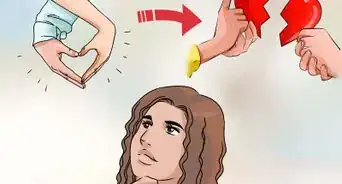
Few things in life are as agonizing as false hope. How are you supposed to keep moving forward and pushing through when your heart is set on the impossible? Keep your chin up; you can make it through this. Keep reading for plenty of tips, tricks, and advice on how you can cope with, let go of, and push past false hope once and for all.
Steps
Method 1
Method 1 of 14:Give yourself a chance to feel your feelings.
-
1Your emotions are real and valid, and they deserve to be felt. Maybe you feel disappointed that your relationship didn’t pan out, or angry that all of your waiting and hoping didn’t amount to anything.[1] Whatever the case, try to label exactly how you’re feeling at the moment. Then, remind yourself that it’s perfectly okay to feel that way.[2] You might tell yourself:
- “I’m feeling sad, and that’s okay.”
- “I’m allowed to feel angry about this. Everyone feels upset at some point.”
- “I feel really crushed and heartbroken, and those emotions are valid.”
Advertisement

Method 2
Method 2 of 14:Vent your feelings in a productive way.
-
1Your feelings won’t disappear overnight, but you shouldn’t bottle them up in the meantime. Look for healthy, productive ways to channel your feelings instead of waiting for them to go away. Here are a few safe, healthy venting strategies you might try:[3]
- Punching your pillow a few times
- Sketching out your feelings on a blank sheet of paper
- Writing your feelings down and ripping them up
- Talking to a trusted friend or relative about how you’re feeling

Method 3
Method 3 of 14:Calm down from the disappointment with some relaxing activities.
-
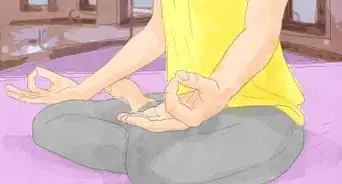
1Relaxation exercises may help you get better control over your emotions at the moment. Start with something simple, like a round of belly breathing or progressive muscle relaxation. Listening to a guided meditation, podcast, or audiobook may also help you relax and unwind. Here are a few other ideas that may help:[4]
- Playing with modeling clay
- Trying a few yoga poses
- Taking a break from electronics
- Going for a walk outside
Advertisement

Method 4
Method 4 of 14:Compare your capabilities and goals with your current expectations.
-
1A self-evaluation can let you know if your hopes are realistic or false. Maybe you’re aiming to be a famous soccer player, or hoping for the person of your dreams to ask you out. Whatever the case, try looking at the situation from an objective perspective. You could be setting yourself up for false hope if your expectations and goals don’t line up with reality.[5] Here are a few examples of unrealistic expectations:
- Expecting to get a college-level job as a high school student
- Expecting to make the varsity team when you’re not as experienced as the other players who tried out
- Expecting a guy to ask you out when you’ve never talked to him

Method 5
Method 5 of 14:Identify unrealistic hopes and expectations by the way they make you feel.
-
1False hopes and expectations leave us with a feeling of disappointment. Chasing false, unrealistic hope rarely feels good; in fact, you’re almost always feeling disappointed in yourself, or that the efforts you make are never quite enough. Make a list of all your goals and dreams, whether they’re academic, athletic, or something else entirely. Do you feel fulfilled and happy as you try to reach these goals, or do you feel a sense of helplessness?[6] Take a look at these examples:
- You want to be a coder, but you’re struggling to pass your computer programming classes even with plenty of studying and tutoring.
- You want to be a pro wrestler but you’re just not able to bulk up, even when you follow a consistent diet and workout regimen.
- You want to be at the top of your class even though you feel overwhelmed with challenging courses and assignments.
Advertisement

Method 6
Method 6 of 14:Ask a friend or loved one for their perspective.
-
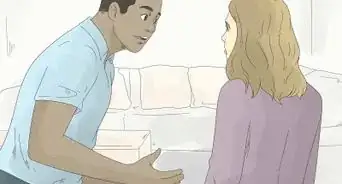
1They can help ground you in reality instead of your false hopes. Chat with a friend or relative who knows the full story and understands the source of your problems. Ask them what they think about the situation, and if they think your false hopes are warranted. Your loved ones can give you some valid insight and help you see the scenario in a new light.[7] You might ask:
- “Yale was my number one college choice, and I worked so hard on my application. Was it unrealistic to think that I’d make it in?”
- “Megan said she’d call me last week, but she never did. I tried texting her a couple of times, but she still didn’t respond. Is it worth waiting for her, or is she just blowing me off?”

Method 7
Method 7 of 14:Switch goals instead of hanging onto unrealistic hopes.
-
1There’s nothing wrong with refocusing yourself in a new direction. Concentrate on adjusting your hopes and expectations to a more realistic, attainable goal. For some, that might mean breaking a larger goal into baby steps; for others, it could mean setting a course for an entirely new goal. Think about which path makes the most sense for you as well as your hopes and dreams.[8]
- For example, if you’re a chemistry student who’s struggling to get Cs and Ds in your chemistry classes, you might be better off switching majors.
- It could be worth switching mediums if you’re an artist who can’t seem to master a specific art form.
Advertisement

Method 8
Method 8 of 14:Set realistic goals.
-
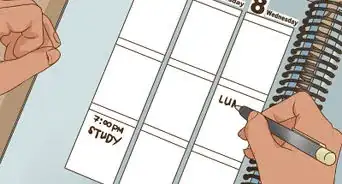
1Use the SMART method to set achievable goals. False hopes often occur when you set the bar a little too high for yourself. That’s where Specific, Measurable, Attainable, Realistic, and Trackable (SMART) goals come in. This goal-setting method helps you focus on what you can accomplish, instead of what you want to accomplish.[9] Here are few ways you might make your goals SMART:
- Specific: I’m going to write 1 page of my novel each day.
- Measurable: I’m going to practice for 30 minutes every day so I’m more prepared for basketball tryouts.
- Attainable: I’m going to learn 50 new vocab words by the end of the semester.
- Realistic: I’m going to have a conversation with Kelly by the end of the month.
- Trackable: I’m going to mark down my exercise and calorie intake in an app so I can keep track of the progress that I’m making.

Method 9
Method 9 of 14:Tell people what your goals are.
-
1Your close friends and loved ones can help you stay on track. Let them what you hope to achieve and what exactly you’re doing to reach that goal. Sharing your long-term plan with other people can help you keep your eye on the prize. After all, you don’t want to tell your friends and family that you’re slacking off![10] Here are a couple of ways to approach your loved ones:
- You might tell your Mom, “I’ve decided to start learning Korean. I’m studying a little bit each day, and I’m hoping to take the TOPIK test next summer.”
- You might tell your friend, “I’m hoping to run a 5K next spring, so I’ve decided to start running 3 times a week.”
Advertisement

Method 10
Method 10 of 14:Conquer your self-doubt with critical thinking.
-
1It can be easy to doubt yourself when you work toward a new goal. With this in mind, take a closer look at your negative thoughts and feelings and try to analyze them. Is there evidence to support these thoughts, or are you being cruel to yourself for no reason? Here are some ways to be kinder and more patient with yourself:[11]
- Pinpointing negative thoughts: Pay attention to common patterns that your negative thoughts follow. A lot of people tend to filter out the positive things that happen to them or assume that the worst is going to happen.
- Rewriting negative thoughts: Narrow in on your negative thoughts and look for ways to reframe them in a positive way. Instead of thinking “I’ll never reach this goal,” think “This may not be in my wheelhouse, but I’m up for the challenge.”

Method 11
Method 11 of 14:Examine your goals after a few weeks or months.
-
1Achieving your hopes and dreams can take a bit of trial and error. After working at your goals for a little while, set aside some time to really examine your progress. How far have you come since you first started? Do you feel like you’re in a good spot to reach your goals?[12]
- For example, if your goal is to lose 1 lb (0.45 kg) per week, check your past calorie and exercise logs to see where you’re ending up.
Advertisement

Method 12
Method 12 of 14:Adjust your goals as needed.
-
1There’s nothing wrong with lowering the bar if your original goal is too difficult. Setting and following unrealistic goals is a recipe for even more dashed hopes, especially if you aren’t seeing the results you want. Don’t be afraid to adjust your goals to a more manageable level if you’re starting to feel overwhelmed.[13] You might:
- Adjust your daily fitness goal from 1 hour to 30 minutes
- Give yourself 1 month to learn a new dance instead of giving yourself 2 weeks
- Practice soccer 3 times a week instead of 5

Method 13
Method 13 of 14:Treat yourself with kindness.
-
1It can take a long time to heal and grow from dashed hopes. Don’t rush yourself through the process, and don’t be too hard on yourself if you have a tough time letting go and moving forward. Instead, take care of yourself and practice self-love on a regular basis. You might:[14]
- Unwind after a long day with a hot bath
- Whip up a healthy meal
- Get to bed at a decent time
Advertisement

Method 14
Method 14 of 14:Visit a therapist for extra support.
-
1Some situations are really hard to walk away from on your own. Maybe you’re struggling with your weight loss goals, or you’re just working through the end of a long-term relationship. Whatever the case, a therapist can help support and guide you through this difficult time.[15]

Expert Q&A
-
QuestionIs false hope better than no hope?
 Kateri Berasi, PsyDDr. Kateri Berasi is a Licensed Clinical Psychologist based in Brooklyn, New York. With over ten years of experience in the mental health field, Dr. Berasi specializes in working with adults from the LGBTQIA+ community and creative industries through individual therapy, couples counseling, group therapy, and costume therapy. She holds a BA in Psychology, Art History, and French Language and Literature from George Washington University and an MA and MEd in Mental Health Counseling from Columbia University. Dr. Berasi also holds a PsyD in Clinical Psychology from Long Island University.
Licensed Clinical PsychologistNot really. Now that you've done much of the work by acknowledging that your hope is false, try processing, accepting and letting go of it. It can be challenging to accept reality, but in the end, being able to “deal” with it can help you through anything.







References
- ↑ https://psychcentral.com/blog/how-to-cope-with-disappointment#1
- ↑ https://au.reachout.com/articles/how-to-deal-with-disappointment
- ↑ https://www.mhanational.org/helpful-vs-harmful-ways-manage-emotions
- ↑ https://www.mhanational.org/helpful-vs-harmful-ways-manage-emotions
- ↑ https://www.psychologytoday.com/us/blog/think-well/201409/how-know-if-your-goals-are-realistic
- ↑ https://www.psychologytoday.com/us/blog/think-well/201409/how-know-if-your-goals-are-realistic
- ↑ https://au.reachout.com/articles/how-to-deal-with-disappointment
- ↑ https://www.psychologytoday.com/us/blog/think-well/201409/how-know-if-your-goals-are-realistic
- ↑ https://www.mayoclinichealthsystem.org/hometown-health/speaking-of-health/setting-smart-goals
- ↑ https://www.entrepreneur.com/article/318347
- ↑ https://www.mayoclinic.org/healthy-lifestyle/stress-management/in-depth/positive-thinking/art-20043950
- ↑ https://www.entrepreneur.com/article/318347
- ↑ https://www.entrepreneur.com/article/318347
- ↑ https://www.goodtherapy.org/blog/15-tips-for-letting-go-of-a-relationship-that-is-not-healthy-0829167
- ↑ https://www.goodtherapy.org/benefits-of-therapy.html
About This Article