This article was co-authored by wikiHow Staff. Our trained team of editors and researchers validate articles for accuracy and comprehensiveness. wikiHow's Content Management Team carefully monitors the work from our editorial staff to ensure that each article is backed by trusted research and meets our high quality standards.
There are 8 references cited in this article, which can be found at the bottom of the page.
This article has been viewed 1,592 times.
Learn more...
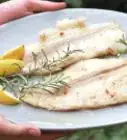
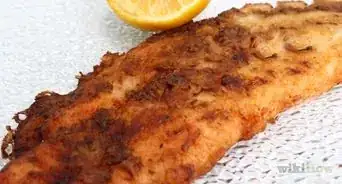
The bottom-dwelling skate fishes have large pectoral fins that place them in the ray family, which is why they're called "skate wings." From French culture to American cuisine, their delicious, succulent flavor and moist texture makes them a very appetizing dinner choice. With the right sauce and a gentle pan-fry, you can enjoy this unique shark relative in no time at all.
Ingredients
Pan-Frying Your Skate Wings
- 4 skinless skate wings (boneless)
- 1⁄2 cup (0.12 L) of milk
- 4 tablespoons (56.7 grams) of all-purpose flour
Creating Your Sauce
- 1 large egg
- 1 small garlic clove
- 1/2 teaspoon (2 grams) of mustard powder
- 1/2 teaspoon (2 grams) of sea salt
- Freshly ground black pepper
- 1 teaspoon (4.9 mL) of lemon juice
- 1 tablespoon (14.3 grams) of fresh parsley leaves
- 1 tablespoon (14.3 grams) of salted capers
- 4 baby gherkins (cornichons)
Steps
Part 1
Part 1 of 3:Preparing Your Skate Wings
-
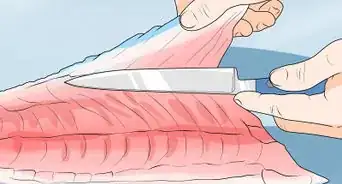
1Remove the skin with a pair of long-nosed pliers. Lay the skate wing onto a cutting board thick-side up. Grip a corner of its skin using pliers. Gently pull the skin off the fish while simultaneously using a kitchen knife to gently scrape away the flesh attached to the skin. Eventually, the skin should come cleanly off the wing without any flesh clinging to it. At this point, you should be able to pull the skin clean off with your pliers without using your knife.[1]
- Squeeze the pliers hard and give them a strong pull—skate fish skin doesn't come off easily.
-
2Cut the bony portion of the top off using a heavy chopping knife. Locate the bony part of the fish at the top—imagine the fish as if it has a head (the bone) with two wings extending from it. Place the knife beside the bone, parallel to the wings. Hit the knife on the top with a rolling pin or other solid piece of wood. One solid hit should make a single cut in the right place. If you put enough force into your subsequent swings, the piece should come off after 6 to 7 hits.[2]
- Hold the handle of the knife firmly with your non-dominant hand.
-
3Trim the jagged bottom edge of the fish with kitchen scissors. The bottom region of the fish—the thinnest part—needs to be trimmed to remove its jagged, uneven edges. Use heavy-duty kitchen scissors for the best results. You should be able to cut the edges without much effort—as if you're cutting a piece of cardboard. If you're finding the fish too hard to cut, you're cutting too far up.[3]
Part 2
Part 2 of 3:Pan-Frying Your Skate Wings
-
1Heat a 10 inch (25 cm) diameter frying pan on low heat. Typically, low heat is between 100 to 200 °F (38 to 93 °C). Let the pan warm up while you prepare your fish.[4]
- Don't put any oil into your pan just yet.
-
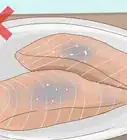
2Place your 4 skate fillets onto a large plate or dish. Make sure the dish is a size that can hold all your fillets in a single layer. Always lay your fillets down as flat as possible.[5]
- A sheet pan works great as a plate. You can purchase these from cookware and big box stores.
-
3Pour milk over your fillets and season them with salt and pepper. Use a measuring cup to measure 0.5 cups (0.12 L) of milk and gently pour about half of it over your fillets. Maintain a steady flow to prevent splashing. Afterwards, turn the fillets over and pour the rest of your milk over them.[6]
- Turn the fillets over a couple of times after pouring the milk on to ensure even coating.
- After pouring your milk on, sprinkle some pepper and salt over the fillets for taste.
-
4Dredge your fillets in 4 tablespoons (56.7 grams) of flour. Scatter your flour across a large plate or dish. Hold your fillets gently by one end and pull them across the flour. Once the side has a nice consistent coat, repeat the process for the other side.[7]
- Drag your fillets as gently as possible to avoid breaking them.
-
5Heat 3 tablespoons (44 mL) of oil in your pan on medium-high heat. Typically, this is between 300 to 400 °F (149 to 204 °C). Gently pour the oil into the pan and then turn the heat up to medium-high heat. Let the oil cook for about 1 minute.[8]
- Leave the oil cooking until it gets hot, but not to the point that it smokes.
-
6Cook your fillets for 3 minutes on each side. Gently drop your fillets into the pan. Fry the fish, using a spatula to check the color of the bottom side every 15 to 20 seconds. Once the fish is golden brown, flip it to the other side. Once all of your fillets are sufficiently cooked on both sides, use your spatula to move them onto a plate for serving.[9]
- To test your fish, make a small cut down to its bone. The flesh of properly cooked fish should be creamy-white and part with the bone easily.
- If you don't have enough room for all of your fish, use the same oil for a second batch.
Part 3
Part 3 of 3:Creating Your Sauce
-
1Mix 1 large egg, 1 small garlic glove, mustard powder, and sea salt. A food processor is ideal for mixing, but a blender will work as well. Gently break the egg against a flat, hard surface. Once it cracks, hold it from both ends of the shell and pour it into the bowl of your food processor or blender. Add 1/2 teaspoon (2 grams) of both the mustard powder and salt to the mixture.[10]
- Keep the garlic clove unpeeled.
- Once you've added the ingredients, turn on the motor. Place one of your hands firmly on top of the feeder tube as the ingredients mix.
-
2Add 6 fluid ounces (175 mL) of olive oil into the feeder tube. The tube extends outward from the top of your food processor's lid. Gently pour the oil into the tube as slowly as possible, maintaining a steady, thin trickle.[11]
- Pouring the oil can take as long as 2 minutes at the right pace.
- Keep your hand firmly pressed against the processor's lid as you pour the oil into the tube.
- If you're using a blender, turn it off, pour the olive oil in, and then turn it back on.
-
3Mix the rest of your ingredients in once the sauce has thickened. Add freshly ground black pepper to taste, 1 teaspoon (4.9 mL) of lemon juice, 1 tablespoon (14.3 grams) of fresh parsley leaves, 1 tablespoon (14.3 grams) of salted capers, and 4 baby gherkins (also known as cornichons). Once you've added them all in, hit your processor's "pulse" button.[12]
- After hitting the "pulse" button, wait until the ingredients are chopped to your liking. If you like them chopped finely, pulse them for a longer time.
- Give your seasoning a taste after mixing everything together. If it's not to your liking, consider adding a bit more of any desired ingredients.
-
4Pour your seasoning into a medium-sized bowl. Remove the lid of your processor. Grip the handle of the main container firmly and steadily pour your sauce out into a bowl.[13]
- To avoid making a mess, be sure not to pour your sauce too fast.
-
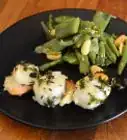
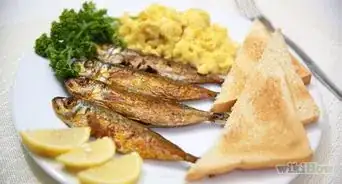
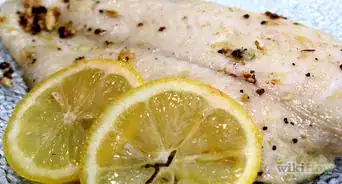
5Pour a small portion of the sauce onto your serving plate beside your fish. Gently dip each piece of fish into the sauce as needed. If you'd like, garnish the plate with parsley and 2 to 3 lemon wedges to squeeze over your fish for taste.
Things You'll Need
- Long-nose pliers
- Heavy-duty kitchen knife
- Kitchen scissors
- Food processor
- 10 inch (25 cm) diameter frying pan
- 2 large plates or dishes
References
- ↑ http://www.clovegarden.com/ingred/sf_skatewz.html
- ↑ https://youtu.be/H7t7gtRrpO4?t=57s
- ↑ https://youtu.be/H7t7gtRrpO4?t=2m11s
- ↑ https://cooking.nytimes.com/recipes/9719-pan-fried-skate-wings-with-capers
- ↑ https://cooking.nytimes.com/recipes/9719-pan-fried-skate-wings-with-capers?regi=1&join_cooking_newsletter=false®ister=google
- ↑ https://cooking.nytimes.com/recipes/9719-pan-fried-skate-wings-with-capers
- ↑ https://cooking.nytimes.com/recipes/9719-pan-fried-skate-wings-with-capers
- ↑ https://cooking.nytimes.com/recipes/9719-pan-fried-skate-wings-with-capers
- ↑ https://cooking.nytimes.com/recipes/9719-pan-fried-skate-wings-with-capers
- ↑ https://youtu.be/TsJPQCwz--4?t=1m52s
- ↑ https://www.deliaonline.com/recipes/collections/quick-and-easy-recipes/fried-skate-wings-with-very-quick-home-made-tartare-sauce
- ↑ https://www.deliaonline.com/recipes/collections/quick-and-easy-recipes/fried-skate-wings-with-very-quick-home-made-tartare-sauce
- ↑ https://youtu.be/TsJPQCwz--4?t=2m3s
- ↑ http://www.clovegarden.com/ingred/sf_skatewz.html
About This Article