This article was co-authored by David Jia. David Jia is an Academic Tutor and the Founder of LA Math Tutoring, a private tutoring company based in Los Angeles, California. With over 10 years of teaching experience, David works with students of all ages and grades in various subjects, as well as college admissions counseling and test preparation for the SAT, ACT, ISEE, and more. After attaining a perfect 800 math score and a 690 English score on the SAT, David was awarded the Dickinson Scholarship from the University of Miami, where he graduated with a Bachelor’s degree in Business Administration. Additionally, David has worked as an instructor for online videos for textbook companies such as Larson Texts, Big Ideas Learning, and Big Ideas Math.
This article has been viewed 531,922 times.
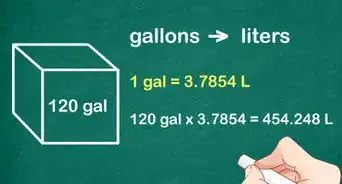
In the metric system, grams are used to measure light weights and kilograms are used to measure heavier weights. There are 1,000 grams in one kilogram. This means that converting grams to kilograms is easy: just divide the number of grams by 1,000.
Steps
Method 1
Method 1 of 2:Converting With Math
-
1Write the number of grams. Label it "grams" or "g." If you're using a calculator, just type the number in.[1]
- In this section, we'll follow along with an example problem to make things easier. Let's say that we want to convert 20,000 grams to kilograms. To start, we would write "20,000 grams" on our paper.
-
2Divide by 1,000. A kilogram is one thousand grams. This means that to get kilograms from grams, you just need to divide the number of grams by 1,000.[2]
- In our example, we would get kilograms by dividing 20,000 grams by 1,000.
- 20,000/1,000 = 20
Advertisement - In our example, we would get kilograms by dividing 20,000 grams by 1,000.
-
3Label your answer. Don't forget this step! Labeling your answer with the proper units is important. If you're doing this conversion for schoolwork, you can lose points if you don't label. If you're doing it for something else, people may assume the wrong units.[3]
- In our case, we would label our answer with the label "kilograms" like this:
- 20 kilograms.
- In our case, we would label our answer with the label "kilograms" like this:
-
4To get back to grams, multiply by 1,000. As discussed above, a kilogram is one thousand grams. This means that if you ever want to get back to grams from kilograms, all you need to do is multiply the number of kilograms by 1,000. Since multiplications is basically the "opposite" operation as division, this will "undo" the division and give you grams.[4]
- To get 20 kilograms back to grams, we just multiply by 1,000 (don't forget to label your answer again):
- 20 kilograms × 1,000 = 20,000 grams
Advertisement


Method 2
Method 2 of 2:Converting by Shifting the Decimal Point
-
1Start with your number of grams. Believe it or not, you can convert between grams and kilograms without doing any math. This works because the metric system is a base 10 system of measurements. In other words, metric units are always a multiple of 10 apart from each other — there are 10 millimeters in a centimeter, 100 centimeters in a meter, 1,000 meters in a kilometer, and so on.
- In this section, let's convert 37 grams to kilograms. We would begin the same way as in the section above, writing "37 grams" on our paper.
-
2Shift the decimal point three spaces to the left. Now, find the decimal point in your number of grams. If you're converting a whole number, this won't usually be written, but you can assume it its to the right of the ones place. Move the decimal point three spaces to the left. Each time you move past a number counts as one space. If you run out of numbers to move past, keep moving it, leaving blank spaces.[5]
- In our example, the decimal point in 37 grams is to the right of the 7 (i.e., 37 grams is the same as 37.0 grams). If we go one space at a time, moving the decimal point three spaces to the left looks like this:
- 37.
- 3.7
- .37
- ._37 — note that we leave an empty space when we run out of numbers.
-
3Add zeroes in any empty spaces. You can't leave empty spaces in your answer, so fill in each one with a zero. You can also put a zero to the left of the decimal place if there aren't any numbers there, but this is optional — it just depends how you like to write your answers.
- In our example, we have one empty space between the decimal point and the 3, so we'll fill it in with a zero like this:
- .037
- Adding the proper label (plus an extra zero to the left of the decimal point for presentation purposes), we get our final answer:
- 0.037 kilograms
- In our example, we have one empty space between the decimal point and the 3, so we'll fill it in with a zero like this:
-
4To get back to grams, shift the decimal place back. When you have kilograms, shifting the decimal place three spaces to the right will give you grams again. Fill in any empty spaces with zeroes as normal.
- In our example, we can shift the decimal place three spaces to the right like this:
- 0.037
- 00.37
- 003.7
- 0037. — the zeroes on the left don't matter any more, so we can rewrite this as simply 37 grams.
Advertisement - In our example, we can shift the decimal place three spaces to the right like this:


Community Q&A
Did you know you can get expert answers for this article?
Unlock expert answers by supporting wikiHow
-
QuestionHow do you calculate kilograms to grams?
 David JiaDavid Jia is an Academic Tutor and the Founder of LA Math Tutoring, a private tutoring company based in Los Angeles, California. With over 10 years of teaching experience, David works with students of all ages and grades in various subjects, as well as college admissions counseling and test preparation for the SAT, ACT, ISEE, and more. After attaining a perfect 800 math score and a 690 English score on the SAT, David was awarded the Dickinson Scholarship from the University of Miami, where he graduated with a Bachelor’s degree in Business Administration. Additionally, David has worked as an instructor for online videos for textbook companies such as Larson Texts, Big Ideas Learning, and Big Ideas Math.
Academic TutorThere are 1000 grams in 1 kilogram. You can remember that because "kilo" means "thousand." If you start with 5000 grams, you would divide by 1000, so the answer would be 5 kilograms. On the other hand if you have 43 kilograms and you want to convert it to grams, you'd multiply by 1000 to get 43,000 grams.
Support wikiHow by unlocking this expert answer.
-
QuestionHow do I convert for a newborn baby born at 2000 grams into pounds?
 DonaganTop AnswererDivide grams by 453.6.
 -
QuestionHow do I convert kilograms to grams?
 Community Answer1 Kilogram = 1000 grams (kilo = thousand). Grams = kilograms x 1000, and kilograms = grams ÷ 1000.
 -
QuestionHow much flour would I need to make 90 portions of sponge in kilos?
 Community Answer1 sponge is made out of 55 gm of flour. You multiply 90*55, then divide it with 1000.
 -
QuestionHow do I convert cost per gram to cost per kilogram?
 WikiHowUser20170728202545Community AnswerCost/kg is the same as cost/1000g, so to get from cost/g to cost/1000g, you have to multiply by 1000.
 -
QuestionWhat do you need to multiply a measurement in kilograms by to change it to grams? Please help me!DonaganTop AnswererMultiply by 1,000.
-
QuestionHow do I do it if I have only a one digit number?
 Community AnswerDivide the amount of grams you have by one thousand, even if the amount of grams is just one digit. If you have 5 grams, for example, you divide that by 1,000 to get .005 kilograms.
 -
QuestionHow do I subtract grams from grams?Community AnswerTake away the units, do the subtraction normally, and then return the units. 9 grams - 5 grams = (9 - 5) grams = 4 grams.
-
QuestionHow do I convert 800 g to 3 kg?Community AnswerYou can't do that, exactly. To convert grams to kilograms, you divide the number of grams you have by 1000. So, 800 g = 800/1000 = 0.8 kg. In order to get 3 kg, you would need to add 2.2 kg to the 0.8 kg you already have.
-
QuestionHow do I convert solid grams to a compounded liquid milligrams?DonaganTop AnswererYou would first weigh the solid material in grams. Then weigh it as a liquid. If you measure it in grams, multiply by 1,000 to get milligrams.
-to-Grams-(g)-Step-8-Version-5.webp)
References
- ↑ David Jia. Academic Tutor. Expert Interview. 14 January 2021.
- ↑ David Jia. Academic Tutor. Expert Interview. 14 January 2021.
- ↑ https://www.nist.gov/pml/weights-and-measures/writing-metric-units
- ↑ David Jia. Academic Tutor. Expert Interview. 14 January 2021.
- ↑ https://www.montereyinstitute.org/courses/DevelopmentalMath/TEXTGROUP-1-8_RESOURCE/U06_L2_T1_text_final.html
- ↑ http://www.thefreedictionary.com/Gram+(unit)
- ↑ http://www.merriam-webster.com/dictionary/gram
About This Article

To convert grams to kilograms, first write your measurement in grams on the page. Once you have the measurement in grams, divide it by 1,000 to convert to kilograms, since there are 1,000 grams in a kilogram. For example, if you have a 20,000 gram measurement, you would divide by 1,000 to get an answer of 20 kilograms. Be sure to label your answer in the proper units, which are kilograms in this case. If you want to learn how to convert grams to kilograms by shifting the decimal point, keep reading the article!


-to-Grams-(g)-Step-8-Version-5.webp)