This article was co-authored by wikiHow staff writer, Janice Tieperman. Janice is a professional and creative writer who has worked at wikiHow since 2019. With both a B.A. and M.A. in English from East Stroudsburg University, she has a passion for writing a wide variety of content for anyone and everyone. In her free time, you can find her working on a new crochet pattern, listening to true crime podcasts, or tackling a new creative writing project.
There are 10 references cited in this article, which can be found at the bottom of the page.
This article has been viewed 1,173 times.
Learn more...
Whether you have a small garden or large farm, locusts can be a menace to your plants and crops. While these pests can cause some issues for your property, there’s no need to worry! There are lots of ways you can control a locust population, whether you’re dealing with a swarm or just a few pests.
Steps
Method 1
Method 1 of 9:Biopesticide
-
1Use biopesticides to kill locusts without hurting the environment. The Metarhizium anisopliae fungus is a green alternative to insecticides. Research shows that, when sprayed over crops, these spores can kill 70-90% of locusts in a 2-3 week period without harming other plants and bugs.[1] Simply spray the biopesticides all over your crops, where the locusts are gathering.[2] Within a few weeks, you should notice some improvements.[3]Advertisement

Method 2
Method 2 of 9:Traditional Pesticides
-
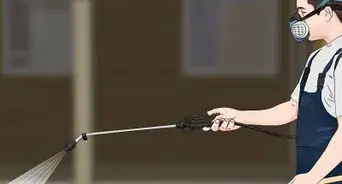
1The pesticide fipronil kills locusts by targeting their nervous system. Spray your crops when it’s about 14 to 24 °C (57 to 75 °F) degrees outside. Typically, fipronil takes about 8 to 16 days to kill off locusts.[6] Always follow the instructions on the pesticide label before spraying your garden or crops—most chemical companies recommend wearing protective equipment as you spray.[7]
- Don’t spray any pesticides when it’s windy outside—the chemicals may travel to your neighbor’s property, depending on where you live.
- If any pesticides get on your skin, wash off the exposed area with soap and warm water right away.

Method 3
Method 3 of 9:Bait Powder
-
1Bait helps you kill off locusts before they grow wings. If you notice hoppers, or young, wingless locusts on your property, bait is a handy way to get rid of them. Mix wheat bran and bendiocarb powder together at a 0.05 to 1 ratio. Then, spread the mixture near the hoppers, so they eat the bait. Once they’ve eaten the bran mixture, the hoppers will die off.[8]
- Bendiocarb is a type of insecticide.
- This type of locust control works best for larger properties. For instance, you might mix 200 kg (440 lb) of wheat bran with 10 kg (22 lb) of bendiocarb powder.
- You can scatter bait by hand, with a hand-blower, or with a machine powder-duster, which covers large sections of crops.
Advertisement

Method 4
Method 4 of 9:Crop Cover
-
1Drape insect mesh or shadecloth on top of your prized garden plants. This helps guard and protect your plants from hungry locusts. Don’t use a green sheet of mesh or cloth for this—locusts are attracted to the color green. Leave this mesh or cloth in place whenever locusts are in the area, so your plants can stay intact.[9]
- You can buy insect mesh and shadecloth online, or at home improvement stores.

Method 5
Method 5 of 9:Noise
-
1Locust swarms may break up if they hear loud noises. Some farmers hit metallic containers, while others honk their vehicles. Even basic screams can break up swarms, which makes them easier to control and manage.[10]
- Making noise won’t get rid of your locusts, but it will divide swarms into smaller groups and make them easier to kill off.
Advertisement

Method 6
Method 6 of 9:Smoke
-
1Burn tires or set bonfires around your property. Fire tends to scare locust swarms, and the small blazes may keep the pests away from your crops.[11]
- Ask your neighbors for permission before setting any fires, since there’s a chance that the smoke could float over to their property.
- There isn’t a lot of research about this control method, but some farmers find it useful.

Method 7
Method 7 of 9:Trenches
-
1Dig trenches to bury nymphs. Nymphs, or hoppers, look really similar to grasshoppers—they haven’t developed wings yet, so they can’t fly around your property.[12] If you notice a lot of grasshopper-like pests on your land, dig a deep trench on your property. Then, use your shovel to bury the nymphs in the trenches under the displaced soil.[13]
- Your trench needs to be deep enough to completely cover the pests, so they can’t escape.
Advertisement

Method 8
Method 8 of 9:By Hand
-
1Eliminate small numbers of locusts by hand. Walk around your garden and look for any locusts hanging around your plants. If you spot one, squash it by hand—this way, you’ll have one less critter to worry about.[14]
- This control method works better for small amounts of pests—not huge swarms.

Method 9
Method 9 of 9:Low-Carb Crops
-
1Locusts prefer crops that are rich in carbs, so switch your crops if you can. Studies show that farmers who grew millet in healthy soil yielded a low-carb crop. This may not be as appealing to locusts, and may help control the local population.[15]
- If you can’t change up your crops, biopesticides or traditional pesticides might be a better option.
Advertisement

Warnings


References
- ↑ https://pubmed.ncbi.nlm.nih.gov/11112183/
- ↑ http://www.fao.org/fao-stories/article/en/c/1267098/
- ↑ https://pubmed.ncbi.nlm.nih.gov/11112183/
- ↑ http://www.fao.org/ag/locusts/common/ecg/812_en_FightingDLsafelyE.pdf
- ↑ http://www.fao.org/fao-stories/article/en/c/1267098/
- ↑ https://www.abc.net.au/science/articles/2010/08/25/2992887.htm
- ↑ https://www.dpi.nsw.gov.au/climate-and-emergencies/locusts/industry-information/home-gardener
- ↑ http://www.nzdl.org/gsdlmod?e=d-00000-00---off-0hdl--00-0----0-10-0---0---0direct-10---4-------0-1l--11-en-50---20-about---00-0-1-00-0--4----0-0-11-10-0utfZz-8-00&cl=CL1.10&d=HASHd1edbf77fbe3fa2e5e3da5.9.2&x=1
- ↑ https://www.dpi.nsw.gov.au/climate-and-emergencies/locusts/industry-information/home-gardener
- ↑ https://www.farmafrica.org/downloads/2020/desert-locusts-flyer.pdf
- ↑ https://www.farmafrica.org/downloads/2020/desert-locusts-flyer.pdf
- ↑ https://www.nationalgeographic.com/animals/invertebrates/group/locusts/
- ↑ https://www.farmafrica.org/downloads/2020/desert-locusts-flyer.pdf
- ↑ https://www.dpi.nsw.gov.au/climate-and-emergencies/locusts/industry-information/home-gardener
- ↑ https://www.npr.org/sections/goatsandsoda/2019/08/19/752361368/maybe-the-way-to-control-locusts-is-by-growing-crops-they-dont-like
- ↑ http://www.nzdl.org/gsdlmod?e=d-00000-00---off-0hdl--00-0----0-10-0---0---0direct-10---4-------0-1l--11-en-50---20-about---00-0-1-00-0--4----0-0-11-10-0utfZz-8-00&cl=CL1.10&d=HASHd1edbf77fbe3fa2e5e3da5.9.2&x=1
- ↑ https://www.thenewhumanitarian.org/news/2013/08/14/eating-locusts-no-substitute-madagascar-s-lost-rice-harvests
- ↑ https://www.dpi.nsw.gov.au/climate-and-emergencies/locusts/industry-information/home-gardener
- ↑ https://www.dpi.nsw.gov.au/climate-and-emergencies/locusts/industry-information/home-gardener
About This Article