This article was co-authored by Emily Silva Hockstra. Emily Silva Hockstra is a Certified Life Coach and Career Coach with over 10 years of coaching and management experience with various corporations. She specializes in career transitions, leadership development, and relationship management. Emily is also the author of "Moonlight Gratitude" and "Find Your Glow, Feed Your Soul: A Guide for Cultivating a Vibrant Life of Peace & Purpose." She received her Spiritual Life Coaching certification from the Life Purpose Institute and a Reiki I Practitioner certification from Integrative Bodywork. She has a BA in History from California State University, Chico.
This article has been viewed 3,789 times.
If you’re trying to gather facts and data, an in-depth interview with someone who knows what they’re talking about is one of the best ways to do it! In-depth interviews are designed to collect information for a variety of purposes such as strategic planning, fine-tuning a product or program, or identifying issues with a strategy or program that need to be addressed. They’re also easier to conduct than you may think. With the proper preparation and the right approach, you can nail your interview. To make it easier, we’ve put together a useful list you can use to help you do it.
Steps
Method 1
Method 1 of 13:Clarify the purpose of your interview.
-
1It can help you come up with questions and structure your interview. Ask yourself whether you’re conducting the interviews for a purpose such as gathering information for future planning or to evaluate an existing program. Think about what you’d like to learn from the interview to help further that purpose and identify what key information you hope to gather.[1]
- For instance, if you’re interviewing someone to find out what consumers think about a new brand of shampoo, you might want to learn things such as how they feel about the way it cleans their hair, how they feel about the price, and whether or not they plan to continue to use the shampoo.
Advertisement

Method 2
Method 2 of 13:Come up with open-ended questions.
-
1They’ll help you gain more information from your interviewee. Open-ended questions require the respondent to give a full explanation. By contrast, closed-ended questions can often be answered with a single, “Yes” or “No.” As you’re working to create questions for your interview, stick to ones that encourage your interviewee to keep talking and expand on their answers.[2]
- Ask questions such as, “Can you tell me what you like or don’t like about the company’s new vacation policy?” instead of, “Do you like the company’s new vacation policy?”

Method 3
Method 3 of 13:Create a guide to structure the interview.
-
1It can help keep your interview focused and on track. Write out all of the questions you plan to ask in the interview in a single document. Arrange them in a logical order that will help guide the interview in a way that makes sense and feels like a natural conversation. That way, your interview won’t get too far off track, and you can easily bring it back if you do get side-tracked.[3]
- For example, if you’re interviewing someone about their promotion to an executive position, you could start by asking about their education, then how they started at the company, followed by the promotion, and ending with questions about what they hope to accomplish.
- If you're conducting an information interview to learn more about working for a company, you might write down questions like, "How do I stand out in the applicant pool?" and "What key words should I include in my application?"[4]
- It’s normal for a conversation to veer off track, and it can often lead to great information, but you want to have a guide you can refer to when you need to refocus the interview.
Advertisement

Method 4
Method 4 of 13:Contact your respondent and schedule the interview.
-
1Reach out by phone, email, or some other form of communication. Introduce yourself and briefly explain the purpose of the interview. Talk about the general nature of your questions and ask them if they’re interested in participating. Try to be as considerate as you can and find a time that is most convenient for your interviewee.[5]
- For instance, you could say something like, “Hi Chris! My name is Jack Johnson and I’d like to interview you about your experience working in the service industry. I’d like to ask some questions about what it’s like managing a restaurant. Is that something you’d be interested in doing?”
- Make sure your interviewee knows about how long you expect the interview to last as well so they can plan around it.
- You can also schedule a phone or video interview if you can’t meet in person.

Method 5
Method 5 of 13:Move from general questions into more specific ones.
-
1Start with the broad and then get more focused. General questions allow your interviewee to give basic information about a topic so they’re a great way to assess how someone thinks or feels about something. Follow up with specific questions designed to parse out more detailed information. Use this structure as you move through topics during your interview.[6]
- For instance, if you’re interviewing someone about how they feel about a new traffic law, you could ask a broad question like, “How do you feel about the new law?” and then follow up with specific questions such as, “Do you know the penalty for breaking the new law?” and “Do you think you’ll have trouble following the new law?”
Advertisement

Method 6
Method 6 of 13:Follow your guide to keep your interviewee focused.
-
1Ask your questions and allow them to respond. Start off with your first question and give your interviewee the time and space they need to answer it. Try not to cut them off and allow them to finish. Then, move on to your next question. Keep working your way through your list of questions and let your interviewee do most of the talking.[7]
- Try not to interject and put words in your interviewee’s mouth. Let the conversation flow naturally and allow them to take their time.

Method 7
Method 7 of 13:Ask factual questions before opinion questions.
-
1That way you get both information and an explanation. Use factual questions to establish and confirm specific information. Then, ask opinion questions that allow your interviewee to further explain the facts and information so you end up with a more complete and authentic response.[8]
- For instance, if you’re interviewing someone about a new after-school program, you could first ask, “What activities does the new program include?” Then, you can ask an opinion question like, “What do you hope the program will accomplish?”
Advertisement

Method 8
Method 8 of 13:Use probing questions to get more information.
-
1They can be great tools to get your interviewee to explain something. A probing or clarifying question is designed to get someone to think more deeply or expand their answers. If you feel like you didn’t get a satisfactory response, or you’re a little unclear of your interviewee’s meaning, try asking a probing question to get more information.[9]
- A few examples of probing questions include: “Can you elaborate more on that?” or “Would you give me an example of what you mean?”
- A clarifying probing question can look something like, “I’m not sure I fully understand, can you explain a little more?”

Method 9
Method 9 of 13:Avoid asking “Why?”
-
1It can put your respondent on the defensive. Allow your interviewee to answer your questions in their own words and without any potential influence or judgment. Try not to make it feel like an interrogation. If you need to explore or clarify an answer, use alternative questions that ask about the specifics of their answer.[10]
- For instance, if an interviewee says they don’t like their manager, try asking, “What about their management style do you not enjoy?” instead of “Why?”
Advertisement

Method 10
Method 10 of 13:Keep an open mind throughout the interview.
-
1Judgment or criticism can make it difficult to communicate. No matter what kinds of answers your interviewee gives you, hold off on any sort of judgment or condemnation so they’ll continue to share their opinions. You can always draw your conclusions later when you’re writing up the interview.[11]
- You want your interview to feel natural and you want your interviewee to feel comfortable answering your questions.
- Criticism can shut down your interviewee and they may not answer any more of your questions.
- Try to remove yourself emotionally from the interview and serve as an impartial observer.

Method 11
Method 11 of 13:Use the interview process to remove your own bias.
-
1Stick to the script and use your guide to keep it objective. Ask your questions in the same order as they appear on your guide for every person you interview. If an interviewee starts to go off-topic or begins to inadvertently answer a question that you plan to ask later, ask them to wait and focus on your current question. Keep control of the pace and tone of your interview and it’ll help keep it unbiased.[12]
- This is especially important if you plan to interview multiple people. Asking the same questions in the same order for each person will help guarantee objective responses and results.
Advertisement

Method 12
Method 12 of 13:End with a “catch-all” question.
-
1Make sure there isn’t anything you missed. Give your interviewee a last chance to talk about something you may not have covered in the interview. You never know what last little bits of information can really enhance your interview![13]
- You can say something like, “Okay, I’m just about done, but is there anything I’m missing or something you wanted to make sure you mentioned?”

Method 13
Method 13 of 13:Thank the interviewee and let them know the next steps.
-
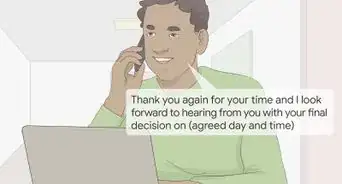
1Explain what they can expect now that the interview is over. If you plan to send a draft of your report to your interviewee to review, let them know when they can expect to receive it. If you plan to use the interview as part of a published article or story, tell them when it’ll be published. Give as much info as you can and genuinely thank your interviewee for taking time out of their day to talk to you.[14]Advertisement

Warnings
- Make sure you get someone’s permission before you record them.Thanks!








References
- ↑ http://greenmedicine.ie/school/images/Library/Conducting%20An%20In%20Depth%20Interview.pdf
- ↑ https://donate.pathfinder.org/site/DocServer/m_e_tool_series_indepth_interviews.pdf;jsessionid=00000000.app273b?NONCE_TOKEN=4E9D2D88EA82FCFAF953B604D59EBFED
- ↑ http://greenmedicine.ie/school/images/Library/Conducting%20An%20In%20Depth%20Interview.pdf
- ↑ Emily Silva Hockstra. Career & Life Coach. Expert Interview. 4 October 2018.
- ↑ https://www.wallacefoundation.org/knowledge-center/Documents/Workbook-E-Indepth-Interviews.pdf
- ↑ https://www.wallacefoundation.org/knowledge-center/Documents/Workbook-E-Indepth-Interviews.pdf
- ↑ http://greenmedicine.ie/school/images/Library/Conducting%20An%20In%20Depth%20Interview.pdf
- ↑ https://donate.pathfinder.org/site/DocServer/m_e_tool_series_indepth_interviews.pdf;jsessionid=00000000.app273b?NONCE_TOKEN=4E9D2D88EA82FCFAF953B604D59EBFED
- ↑ https://donate.pathfinder.org/site/DocServer/m_e_tool_series_indepth_interviews.pdf;jsessionid=00000000.app273b?NONCE_TOKEN=4E9D2D88EA82FCFAF953B604D59EBFED
- ↑ https://www.wallacefoundation.org/knowledge-center/Documents/Workbook-E-Indepth-Interviews.pdf
- ↑ http://greenmedicine.ie/school/images/Library/Conducting%20An%20In%20Depth%20Interview.pdf
- ↑ https://globalhealth.duke.edu/news/five-tips-conducting-effective-qualitative-interviews
- ↑ https://www.sjsu.edu/faculty/weinstein.agrawal/urbp298_phI_handout_Interviews.pdf
- ↑ https://www.sjsu.edu/faculty/weinstein.agrawal/urbp298_phI_handout_Interviews.pdf
About This Article