This article was co-authored by Marcus Shields. Marcus is the owner of Maid Easy, a local residential cleaning company in Phoenix, Arizona. His cleaning roots date back to his grandmother who cleaned homes for valley residents in the 60’s through the 70’s. After working in tech for over a decade, he came back to the cleaning industry and opened Maid Easy to pass his family’s tried and true methods to home dwellers across the Phoenix Metro Area.
wikiHow marks an article as reader-approved once it receives enough positive feedback. This article received 18 testimonials and 86% of readers who voted found it helpful, earning it our reader-approved status.
This article has been viewed 3,351,842 times.
Coffee makers are convenient household appliances that can provide you with a fresh cup of java first thing in the morning. However, due to the high levels of moisture, they can easily harbor mold and bacteria. Drip filter coffee makers require cleaning after each use. They also need to be deep cleaned monthly to remove hard water deposits, leftover coffee oils, and other impurities. With a little elbow grease, you can keep your coffee maker nice and clean.
Steps
Method 1
Method 1 of 3:Cleaning Your Coffee Maker After Each Use
-
1Disassemble the coffee maker. Remove any parts that come off, such as the pot, the brew basket, and any other removable parts. These part should be cleaned separately from the rest of the coffee maker.[1]
-
2Wash the removable parts. Submerge the removable parts in warm, soapy water, and wash them using a dish rag. You can wash removable parts of your coffee maker the same way you would wash dishes.[2]
- Glass pots can be very breakable. When washing your coffee maker's pot, treat the glass gingerly.
- Some coffee makers may have parts that can be washed in a dishwasher. Check the instructions manual, if you still have it. If you're unsure if your coffee maker can be washed in the dishwasher, err on the side of caution and hand wash it.
Advertisement -
3Wipe down the outside of the machine. Take a wet, soapy rag and give the outside of the machine a good wipe down. Wipe down the sides and remove any coffee grinds from the warming plate. When you're down, wipe off any soap suds with a clean, damp rag.[3]
-
4Reassemble your machine. After all the parts are dry, you can put your coffee machine back together. It is ready to use again. Make a habit of cleaning your coffee maker like this after each use.Advertisement
Method 2
Method 2 of 3:Deep Cleaning Your Coffee Maker
-
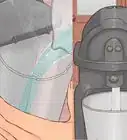
1Add a vinegar and water solution to your coffee maker. Make a mixture using 2 parts warm water and 1 part white vinegar.[4] The precise amounts will vary depending on the size of your coffee maker, but make roughly enough to fill the reservoir. Pour the mixture into the reservoir like you normally would with water when making coffee.[5]
-
2Let the coffee machine run half a brew cycle. Turn the coffee machine on. Keep an eye on it as it brews. Once about half the pot is full with the filtered vinegar/water mixture, turn the pot off.[6]
-
3Let the coffee maker sit for an hour. Set a timer for an hour. Let the coffee pot sit for this time frame.[7] This will give the vinegar time to sit in the machine and clean out any mold.
-
4Complete the brew cycle. After letting the coffee maker sit for an hour, turn the machine back on. Let it run the rest of the brew cycle. When done, all the vinegar/water mixture should be filtered into the pot. You can pour this mixture down the sink.[8]
-
5Run two brew cycles with plain water. Fill your coffee pot with clean water. Pour this into the reservoir and run a complete brew cycle. When it's done, pour the water out and run one more brew cycle with clean water. This should clean any vinegar out of your coffee maker.[9]
-
6Wipe down the coffee maker. After disinfecting the coffee maker, take a clean, damp rag. Wipe down the exterior of the machine to remove any dirt and debris. You should also make sure to remove coffee grinds from the warming plate.[10]Advertisement

Method 3
Method 3 of 3:Avoiding Common Mistakes
-
1Read your instruction's manual. If you still have the instructions manual, read it before cleaning your coffee maker. Most coffee makers can safely be cleaned with a vinegar/water mixture, but it's always a good idea to check first.[11]
- If you don't have the instructions manual, try looking up your model online. You may be able to find an instructions manual on the Internet.
-
2Leave the reservoir lid open. Many people keep the reservoir lid closed. However, it's a good idea to leave it open when not in use. This will help dry out the machine, preventing mold and bacteria from growing in a moist environment.[12]
-
3Rinse the brew basket in the sink regularly. The brew basket is very susceptible to mold as it gets wet during the brewing process. Make sure you rinse out the brew basket after each use and make a habit of cleaning it each time you do dishes. This will keep your coffee maker mold and germ free.[13]Advertisement


Community Q&A
-
QuestionHow often should you clean a coffee maker?
 Marcus ShieldsMarcus is the owner of Maid Easy, a local residential cleaning company in Phoenix, Arizona. His cleaning roots date back to his grandmother who cleaned homes for valley residents in the 60’s through the 70’s. After working in tech for over a decade, he came back to the cleaning industry and opened Maid Easy to pass his family’s tried and true methods to home dwellers across the Phoenix Metro Area.
House Cleaning ProfessionalTry to deep clean your coffee maker once a month so mold doesn't grow inside of it, especially if you use it every day. -
QuestionHow can I get rid of the vinegar taste after cleaning with vinegar?
 Community AnswerDo a full cup of water. Let it run through.
 -
QuestionHow can I clean a Keurig coffee maker?
 Community AnswerPut a mixture of vinegar and water in the water reservoir. Run a cycle of a few cups without the k cup, they have plastic k cups for normal coffee at Walmart for about a dollar. Use one of those, after you have run all the solution through, repeat the process with plain water.
 -
QuestionHow do I clean my coffee pot if I don't have any vinegar?
 Community AnswerUse a pot's worth of water and two denture tablets. Dissolve the tablets in a separate container of water and not the coffee-maker water reservoir. Undissolved tablets can make the rinsing process lengthy.
 -
QuestionWhat should I do when no vinegar drips through when cleaning a coffee maker?
 Community AnswerThis likely means your heater line is completely clogged with hard mineral deposits. Your only options at this point would be to buy a new coffee maker or take yours apart and try to clean it out. It's almost just always better and easier to buy a new machine. Just make sure to run 1/3 vinegar to 2/3 water through your machine once in a while to prevent another clog up.
 -
QuestionDo I need to remove the filter before I clean the coffee marker?Community AnswerEmpty the filter as usual. Place empty filter back in the maker. What you're doing is making coffee without the coffee but with all the maker's parts.
-
QuestionDo I have to replace a new charcoal water filter after cleaning the coffee maker?Community AnswerIf it has been more than 3 months since the filter was changed, it's a good time to replace the charcoal filter. You don't have to replace it at the same time you clean the coffee maker.
-
QuestionHow do I clean the stainless steal carafe that came with the coffee maker?Community AnswerFill the carafe with boiling water and one dishwasher detergent pod. Close the carafe, swirl it around, and let it soak for 20 minutes. Rinse it out well with clean water.
-
QuestionWhy is the water moving through the filter so slowly that it is causing it to overflow?Community AnswerIt could be that your coffee pot isn't on securely and is keeping the exit closed.
-
QuestionHow do I shut off a blinking clean light on my coffee maker?Community AnswerTry unplugging the machine and plugging it back in after 1-2 minutes. If that doesn't work, run the coffeemaker through the clean cycle.






References
- ↑ http://www.goodhousekeeping.com/home/cleaning/tips/a26565/cleaning-coffee-maker/
- ↑ http://www.goodhousekeeping.com/home/cleaning/tips/a26565/cleaning-coffee-maker/
- ↑ http://www.goodhousekeeping.com/home/cleaning/tips/a26565/cleaning-coffee-maker/
- ↑ Marcus Shields. House Cleaning Professional. Expert Interview. 22 September 2019.
- ↑ http://www.thekitchn.com/how-to-clean-a-coffee-maker-cleaning-lessons-from-the-kitchn-200908
- ↑ http://www.thekitchn.com/how-to-clean-a-coffee-maker-cleaning-lessons-from-the-kitchn-200908
- ↑ http://www.southernliving.com/how-to/how-to-clean-a-coffee-pot
- ↑ http://www.thekitchn.com/how-to-clean-a-coffee-maker-cleaning-lessons-from-the-kitchn-200908
- ↑ http://www.thekitchn.com/how-to-clean-a-coffee-maker-cleaning-lessons-from-the-kitchn-200908
- ↑ http://www.thekitchn.com/how-to-clean-a-coffee-maker-cleaning-lessons-from-the-kitchn-200908
- ↑ http://www.consumerreports.org/coffee-makers/how-to-clean-your-coffee-maker/
- ↑ https://www.realsimple.com/home-organizing/cleaning/cleaning-kitchen/how-to-clean-a-coffee-pot
- ↑ http://www.consumerreports.org/coffee-makers/how-to-clean-your-coffee-maker/
About This Article

To clean your coffee maker, disassemble the moving parts and wash them in warm, soapy water. Wipe down the outside of the machine. Then, reassemble it once the parts are dry. If you need a deeper cleaning, mix equal parts of water and vinegar. Pour the solution into the machine's reservoir. Brew half a cycle, then pause the machine for an hour so the pot and reservoir can soak in the solution. Then, resume the brew cycle. Dump the cleaning solution and brew 2 cycles of plain water to rinse out the coffee maker thoroughly. If you want to learn how to avoid growing mold and bacteria in the coffee maker, keep reading!