This article was co-authored by Laura Marusinec, MD and by wikiHow staff writer, Jessica Gibson. Dr. Marusinec is a board certified Pediatrician at the Children's Hospital of Wisconsin, where she is on the Clinical Practice Council. She received her M.D. from the Medical College of Wisconsin School of Medicine in 1995 and completed her residency at the Medical College of Wisconsin in Pediatrics in 1998. She is a member of the American Medical Writers Association and the Society for Pediatric Urgent Care.
There are 7 references cited in this article, which can be found at the bottom of the page.
This article has been viewed 1,846 times.
If you're overwhelmed by the number of insect repellents available, you'll need to learn which ones are safe to use on your kids. Depending on where you live or where you're traveling, pick a repellent that will protect your kids from viruses and bacteria that are carried by mosquitoes or ticks. Once you've selected an insect repellent, apply it properly and watch for skin irritation or reactions. Remember to replace your insect repellents once they've expired.
Steps
Method 1
Method 1 of 2:Choosing a Repellent For Your Kids' Needs
-
1Protect your kids from mosquitoes carrying Zika virus. If your children live in or will be travelling to a region affected by the Zika virus, choose an insect repellent that will protect against mosquitoes. Look for a product that contains one of these ingredients and choose a higher concentration of the repellent if your child will be outdoors for a long time:[1]
- Picaridin (20%)
- IR3535 (20%)
- DEET (7% to 30%)
-
2Choose a repellent that protects from mosquitoes carrying West Nile Virus. Since insect repellents that protect against mosquitoes contain similar ingredients, you could use the same repellent to protect against Zika virus and West Nile Virus. If you're choosing a repellent specifically against mosquitoes carrying West Nile Virus, you could choose products with a lower percentage of Picaridin and DEET. You could also use a botanical repellent, oil of lemon eucalyptus (30 to 40%).[2]
- If your child is under 3 years old, avoid using repellents that contain oil of lemon eucalyptus.
- Oil of lemon eucalyptus is also known as p-menthane-3,8-diol or PMD.
Advertisement -
3Pick a repellent that prevents tick bites. If your kids will be in a forested area that may be home to ticks carrying Lyme disease, you can apply a repellent that contains Picaridin (20%), IR3535 (20%), oil of lemon eucalyptus (30 to 40%), or DEET (20% to 30%).[3]
- Remember not use oil of lemon eucalyptus on children under 3 years old.
- To reduce your chance of a tick bite, you should also treat your clothing with a 0.5% permethrin solution.[4]
-
4Use a repellent with picaridin for children with allergies. If your child has sensitive skin or allergies, try an insect repellent that contains Picaridin (5% to 20%). It is effective at repelling insects (especially mosquitoes) for a long period of time and it won't irritate your kids' skin or eyes. Choose a lower concentration if your kids won't be outdoors for very long.[5]
- Always test the repellent on a small patch of skin before applying it all over.
-
5Limit your use of products with DEET. DEET is in a lot of insect repellents to protect against mosquitoes and ticks. While DEET is safe for kids to use in the short term, avoid using insect repellents with DEET every day since it may cause neurological symptoms (like dizziness, headaches, and trouble concentrating). You shouldn't apply DEET more than once a day.[6]
- Consider using products that contain IR5353. It acts similar to DEET, but has fewer side effects.
-
6Avoid using insect repellents on babies under 2 months old. If your child is under 2 months old, avoid using any insect repellent on them. Instead, place a fine netting over your baby's stroller or baby carrier when you're outside to protect them from insects.[7]
- Products containing Picaridin, DEET, and IR5353 are safe for babies over 2 months old. Wait to use oil of lemon eucalyptus until your child is over three years old.
-
7Consider using an herbal non-toxic insect repellent. If you'd like to avoid commercial insect repellents, ask your child's pediatrician to recommend an herbal insect repellent. Neem oil is commonly used in insect repellents that are marketed as natural. Researchers are unsure if neem oil is effective in areas where viral diseases like West Nile and Zika are widespread.[8]
- You may want only want to use products with neem oil to protect against common insect bites.
Advertisement


Method 2
Method 2 of 2:Applying Insect Repellent
-
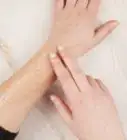
1Test a repellent. Before you apply insect repellent all over your kids' skin, rub just a little over a small patch of skin. Watch the skin for any irritation. Avoid applying the repellent if you notice:[9]
- Redness or rash
- Blisters
- Hives
-
2Rub insect repellent on your child's skin. Squirt some of the insect repellent into the palms of your hands. Rub your hands onto your child's skin. Don't apply it near the mouth, eyes, or hands (since kids often put their hands in their mouths). Only apply a little repellent near their ears.[10]
- Don't let your kids put their own insect repellent on since they may accidentally get it in their eyes or mouths.
- Avoid applying insect repellent to cuts or irritated skin.
-
3Apply the product outdoors. If you're using an insect repellent spray, ensure that you apply it in a well-ventilated space (like outside) and avoid spraying near the mouth. This will reduce the risk that your kids will breathe in the repellent.[11]
- You may want to avoid using repellent sprays on small children since it will be harder to stop them from breathing in the spray as you apply it. Instead, spray the repellent on your hands, and rub it onto their skin. Wash your hands afterwards.
-
4Apply a stick or lotion. If you're using insect repellent on younger children, you may want to apply an insect repellent lotion or rub an insect repellent stick on their skin. These will give you more control in applying the repellent.
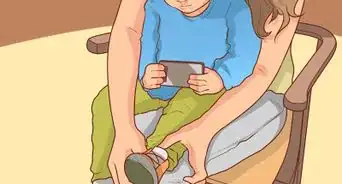
- You may want to give the child something to look at or play with while you apply the lotion. This can distract them long enough for you to apply the repellent.
-
5Talk with your child's doctor if you suspect a reaction. If your child has skin or eye irritation, stop using the insect repellent. Talk with your child's doctor about a less-irritating alternative to repellents. IR5353 and DEET can cause mild irritation. If you think your child is having an allergic reaction to oil of lemon eucalyptus (hives, swelling, rash), stop using the repellent immediately and contact the doctor.Advertisement


Warnings
- Do not apply insect repellent to cut, scraped, or broken skin.Thanks!




References
- ↑ http://www.ewg.org/research/ewgs-guide-bug-repellents/kids
- ↑ http://www.ewg.org/research/ewgs-guide-bug-repellents/kids
- ↑ http://www.ewg.org/research/ewgs-guide-bug-repellents/kids
- ↑ https://www.cdc.gov/ticks/avoid/on_people.html
- ↑ http://www.medicaldaily.com/four-best-bug-repellents-deet-ir3535-picaridin-oil-lemon-eucalyptus-most-effective-says-ewg-247785
- ↑ http://www.medicaldaily.com/four-best-bug-repellents-deet-ir3535-picaridin-oil-lemon-eucalyptus-most-effective-says-ewg-247785
- ↑ https://www.cdc.gov/malaria/resources/pdf/fsp/repellents_2015.pdf
- ↑ https://www.ncbi.nlm.nih.gov/pmc/articles/PMC3059459/
- ↑ http://www.aaaai.org/conditions-and-treatments/allergies/skin-allergy
About This Article