This article was co-authored by Jay Safford. Jay Safford is an Automotive Consultant and Project Manager. He is Automotive Service Excellence (ASE), NAFA Fleet Management Association, Ford, and L1 Certified. He has over 15 years of automotive repair experience and has served as an Automotive Instructor at the Lincoln Technical Institute in West Palm Beach, Florida.
wikiHow marks an article as reader-approved once it receives enough positive feedback. This article received 13 testimonials and 95% of readers who voted found it helpful, earning it our reader-approved status.
This article has been viewed 1,030,620 times.
You get into your car and discover that the engine won't start and that the headlights won't turn on. After you jump start the car, you should find out whether or not you need a new battery or alternator. Follow these steps to check a car battery.
Steps
Method 1
Method 1 of 3:Check Your Battery with a Voltmeter
-
1Turn your ignition off.[1]
-
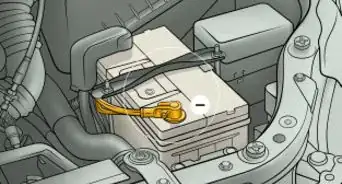
2Remove the battery's positive terminal cover. Check and clean the battery terminals.
-
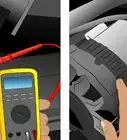
3Connect your voltmeter's positive lead to the positive terminal on your battery. The positive lead on a voltmeter is usually red.[2]
-
4Attach the negative voltmeter lead to the negative battery terminal.
-
5Check the voltmeter. If your battery is in good condition, the voltage should be between 12.4 and 12.7 volts. A reading lower than 12.4 volts means that your battery needs to be charged.
- If the reading is lower than 12.2 volts, "trickle charge" the battery, which is a slow charge. And then re-check.
- If the reading is over 12.9 volts, you have excessive voltage. Turn on the high beams to remove excessive voltage surface charge. Over voltage may be an indication the alternator is over charging the battery.
- While you have the voltmeter handy, you may also want to do load testing.
Method 2
Method 2 of 3:Check Your Battery with a Power Probe
-
1Remove the battery's positive terminal cover.
-
2Connect your Power Probe's positive lead to the positive terminal on your battery. The positive lead on a voltmeter is usually red.
-
3Attach the Power Probe's negative lead to the negative battery terminal.
-
4Connect the tip of the probe to the positive battery terminal. Check the probe for voltage reading.
-
5Check the Power Probe reading. If your battery is in good condition, the voltage should be between 12.4 and 12.7 volts.
Method 3
Method 3 of 3:Check Your Battery by Cranking the Engine
-
1"Crank" the engine by turning the ignition until the starter engages and hold for 2 seconds Have an assistant crank the engine while you check battery voltage drop.
-
2At the time of the crank, check the reading of the Power Probe. It should not go below 9.6 volts.[3]
- A battery with a volt reading less than 9.6 volts means the battery is sulfated and not holding/accepting the charge.
Warnings
- Never short between battery terminals. Serious burns, damage to the terminals or an explosion from hydrogen gas can occur.Thanks!
Things You'll Need
- Voltmeter

References
- ↑ https://carfromjapan.com/article/car-maintenance/how-to-test-a-car-battery/
- ↑ https://haynes.com/en-us/tips-tutorials/how-test-car-battery-multimeter
- ↑ https://www.autobatteries.com/en-us/battery-testing-and-maintenance/car-battery-voltage-and-testing
- ↑ https://shop.advanceautoparts.com/r/advice/car-maintenance/how-long-should-a-car-battery-last
- Battery Test
- Diagnosing a Car Battery That Runs Down
About This Article

To check a car battery, turn off the ignition and pop your vehicle's hood. Hook up a voltmeter to the car's battery by connecting the red lead to the positive terminal and the black lead to the negative terminal. If the battery is in good condition, the voltage will read between 12.4 and 12.7 volts. A reading lower than 12.4 volts means your battery needs to be charged. If the reading is over 12.9 volts, you may want to consider having the alternator checked by a professional to figure out why this is happening! To learn more from our Master Mechanic co-author, like how to use a power probe, keep reading the article!