This article was co-authored by Audra Barrios. Audra Barrios is a Marine Biologist and owner of Lick Your Eyeballs, a business offering experiemces, reptiles, supplies and plants. With over 15 years of experience, Audra specializes in reptiles and exotic animals, environmental education, marine biology, conservation issues, and animal husbandry. Audra earned a BASc in Marine Biology from the University of California, Santa Cruz, and studied Natural Sciences at the College of Marin. She is the founder and Executive Director of Things That Creep, a non-profit dedicated to herptile conservation through education. She has spent the last nine years working as a biologist at the California Academy of Sciences.
There are 9 references cited in this article, which can be found at the bottom of the page.
This article has been viewed 11,125 times.
Turtles are fun pets to have, but they also require a little extra care and maintenance. One of the most important parts is setting up the perfect habitat with clean water, a heating lamp, and plenty of space. Then, feed it a healthy diet of plants and protein and take it to the vet once a year. Turtles can live for over 20 years, so with the proper care, you can enjoy your pet for a long time!
Steps
Method 1
Method 1 of 3:Creating Your Turtle’s Home
-
1Pick a tank that’s at least 5 times the size of your turtle. Multiply the length and width of your turtle by 5 to get the minimum dimensions of its habitat. Use a tank that’s at least 30 gallons (133.5 L) for a turtle that’s 4 to 6 inches (10 to 15 cm). For a turtle that’s 6 to 8 inches (15 to 20 cm), go with a 55-gallon (208 L) tank and, for a turtle that’s larger than 8 inches (20 cm), get a tank that’s between 75 and 125 gallons (284 and 473 L).[1]
- If you have a baby turtle that is going to get bigger, you can start with a smaller tank appropriate for its current size and then move it to a larger tank as it grows.
- For example, a red-eared slider will grow to be about 10 to 12 inches (25 to 30 cm) long, so buy a tank that's at least 50 to 60 inches (130 to 150 cm) long.
-
2Add non-chlorinated water that’s 77 to 80 °F (25 to 27 °C). Fill the tank with water depending on the type of turtle you have. Aquatic turtles requires 75% of the tank to be water, semi-aquatic turtles require 50%, and tortoises require 25% or less.[2]
- Keep a thermometer in the water so you can monitor the temperature to make sure it doesn’t get too cold or warm.
- If you have a red-eared slider, map turtle, or painted turtle, know that these are aquatic turtles, so they need at least 75% of the tank to be water.
Tip: You may need to place a heating pad underneath the tank or use a submersible heater to maintain water that’s between 77 and 80 °F (25 and 27 °C).
-
3Set up a basking area with a 60-watt UV lamp. Place the lamp on top of the tank in one section, like a corner, and put a flat rock underneath it where the turtle can lay to sun itself. Set the temperature of the lamp to about 80 to 85 °F (27 to 29 °C).[3]
- You can also use a piece of driftwood instead of a rock.
- If your tank is mostly filled with water, try a floating basking rock.
- Put the lamp high enough so that it’s 12 inches (30 cm) away from the top of the turtle when the animal is basking.[4]
-
4Use a mechanical and biological filter that’s twice the size of your tank. For example, if your tank is 55 gallons (208 L), get a filter that can handle at least 110 gallons (416 L). Pick one that has both mechanical and biological filtration, too. Mechanical will clean out physical objects, while biological will remove dangerous chemicals.[5]
- You can find filters for your tank at a pet supply store or from an online retailer.
- A filter is necessary to keep your turtle's tank water clean and prevent your turtle from getting sick.[6]
-
5Decorate your turtle’s habitat with plants and rocks if you want to. To make the tank more aesthetically pleasing or to provide entertainment for your pet, add decorations like aquatic plants, peat moss, or large rocks. Make sure you leave enough open space for your turtle to move around freely though.[7]
- Box turtles, for instance, like having a place to hide, so include a hollowed out log or small shelter.
- Some popular aquatic plants for turtle tanks include hornwort, java fern, or waterweed.
- Avoid using gravel or rocks smaller than your turtle’s head. Otherwise, your pet may try to eat them and could choke.
- You can also use fine sand or fluorite to line the bottom of the tank. Don't pick rocks or sand from nature, though, as they can contain harmful bacteria. Buy the materials from a pet store or online retailer.
-
6Keep your turtle tank out of direct sunlight and away from other animals. If you have other pets in your house, make sure the tank is somewhere that they can't get to, like on a counter or table. Choose a spot that's in a room temperature area that doesn't get too hold or cold.
- Place a mesh cover securely over the top of the tank to prevent other pets from reaching into the tank. Turtles can't fully go inside their shells so they're vulnerable to attacks.
-
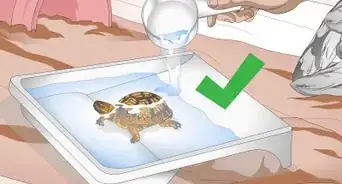
7Clean the tank at least once a month. Remove everything from the tank, then fill it with a diluted bleach solution made with 1 part bleach and 9 parts water. Let it sit for 10 minutes before rinsing the tank out with water. Do this at least one time every month, especially for aquatic turtles who spend most of their time in the water.[8]
- Keep your turtle in a bucket, bowl, or carrying case while you clean the tank.
- Wear gloves when dealing with bleach to protect your hands.
- If you notice feces in the tank in between cleanings, use a paper towel or plastic glove to pick it up.


Method 2
Method 2 of 3:Feeding Your Turtle
-
1Give your turtle a diet of 25% pellets, 25% protein, and 50% plants. Feed your pet pelleted food made specifically for turtles, along with protein, like fish or insects. For plants, choose dark leafy greens like lettuce, cabbage, kale, or dandelion leaves.[9]
- You can also give your turtle veggies like broccoli or celery. Chop it into small bite-sized pieces first.
- Buy turtle pellet food from a pet store or online retailer.
- Some popular protein options for turtles include earthworms, caterpillars, crickets, and mosquito fish.
- Different species of turtle have different dietary needs. Always research the type of turtle you have so you know you're feeding it a healthy diet.[10]
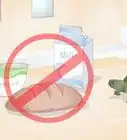
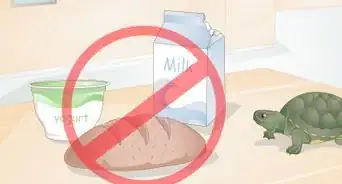
Warning: Avoid giving your turtle scraps of your own food or food from other pets. It can make them sick.
-
2Feed young turtles daily and adult turtles every other day. Because juvenile turtles require more nutrition and calories, give younger turtles under the age of 7 the proper mix of food every day. Feed adult turtles, which are older than 7, 4 to 5 times a week. Measure out their food by giving them an amount equal to the size of their head.[11]
- If you go to feed your turtle and there’s leftover food from the day before, remove it and give your turtle fresh food. Old food will decay and dirty up the tank.
- Another way to determine how much food to give your turtle is to feed them an amount that they can eat within 15 to 20 minutes.
-
3Use fruit sparingly as a treat. While most turtles love fruit, only give it to your pet occasionally as a treat since it doesn’t provide as much nutritional value. Feed your turtle pieces of berries, grapes, melon, or apple every 3rd or 4th meal, for instance.[12]
- Cut the fruit up into tiny bite-sized chunks to make it more manageable for your pet.


Method 3
Method 3 of 3:Keeping Your Turtle Healthy
-
1Wash your hands before and after handling your turtle. Always rinse your hands with soap and water whenever you touch your turtle. This prevents you from passing germs to your turtle and from your turtle spreading harmful bacteria, mainly salmonella, to you.[13]
- To be extra careful, wash your hands before and after touching anything in the turtle’s tank, too.
-
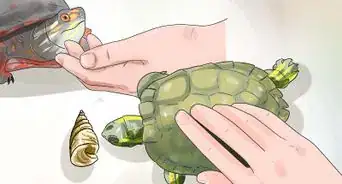
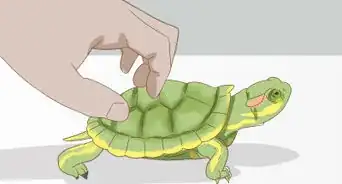
2Use 2 hands to pick up your turtle, being extra careful with its shell. Never pick up your turtle by its tail, by the back of the shell, or with one hand. Place your hands securely around the middle of the shell to gently lift it, keeping the turtle right-side up. Set it down carefully when you're finished so you don't injure its legs or organs.[14]
- Don't turn the turtle quickly, wave it around, or flip it over in a full circle while you're holding it.
- Avoid tapping or hitting the turtle's shell, which is very sensitive.
-
3Take your turtle to the vet for an annual checkup. Even if your turtle seems fine, have it examined by a vet once a year. They’ll be able to make sure your turtle is healthy and give it any special care it needs. If it’s your first time going to a vet, call ahead to make sure they treat turtles or reptiles.[15]
- Be aware that the average cost of a vet checkup is $45 to $55. However, if your turtle needs special treatment, that cost will go up.
Tip: To find a good vet near you, ask for recommendations from your friends who are also pet owners or read reviews online.
-
4Monitor your turtle to notice any changes in behavior or appearance. Keep an eye on your pet so you can identify if there are any drastic changes, like weepy eyes or refusing to eat. If you do notice something concerning, take your turtle to the vet immediately.[16]
- Pay attention to your turtle’s shell, too. Talk to your vet if you see anything abnormal, like a softened shell or a shell that’s growing in a pyramid shape.


Community Q&A
Did you know you can get expert answers for this article?
Unlock expert answers by supporting wikiHow
-
QuestionDo I need a filter for my aquatic turtle's tank?
 Audra BarriosAudra Barrios is a Marine Biologist and owner of Lick Your Eyeballs, a business offering experiemces, reptiles, supplies and plants. With over 15 years of experience, Audra specializes in reptiles and exotic animals, environmental education, marine biology, conservation issues, and animal husbandry. Audra earned a BASc in Marine Biology from the University of California, Santa Cruz, and studied Natural Sciences at the College of Marin. She is the founder and Executive Director of Things That Creep, a non-profit dedicated to herptile conservation through education. She has spent the last nine years working as a biologist at the California Academy of Sciences.
Marine Biologist & Reptile SpecialistYes, a good filter is a must. Turtles are pretty messy—they go to the bathroom in their tank all day—so it's really important that you're cycling the water and keeping it clean.
Support wikiHow by unlocking this expert answer.
-
QuestionWhat kind of light do I need for my turtle?Audra BarriosAudra Barrios is a Marine Biologist and owner of Lick Your Eyeballs, a business offering experiemces, reptiles, supplies and plants. With over 15 years of experience, Audra specializes in reptiles and exotic animals, environmental education, marine biology, conservation issues, and animal husbandry. Audra earned a BASc in Marine Biology from the University of California, Santa Cruz, and studied Natural Sciences at the College of Marin. She is the founder and Executive Director of Things That Creep, a non-profit dedicated to herptile conservation through education. She has spent the last nine years working as a biologist at the California Academy of Sciences.
Marine Biologist & Reptile SpecialistUV light is essential for reptiles that are awake during the daytime, like turtles and tortoises, so they can produce calcium. Having a really high-quality UV light is going to be important for your turtle's health. The UV bulbs should be within 12 inches of your animal. That way they get the optimal amount of UV coming in.Support wikiHow by unlocking this expert answer.
-
QuestionDo aquatic turtles need any land in their tank?Audra BarriosAudra Barrios is a Marine Biologist and owner of Lick Your Eyeballs, a business offering experiemces, reptiles, supplies and plants. With over 15 years of experience, Audra specializes in reptiles and exotic animals, environmental education, marine biology, conservation issues, and animal husbandry. Audra earned a BASc in Marine Biology from the University of California, Santa Cruz, and studied Natural Sciences at the College of Marin. She is the founder and Executive Director of Things That Creep, a non-profit dedicated to herptile conservation through education. She has spent the last nine years working as a biologist at the California Academy of Sciences.
Marine Biologist & Reptile SpecialistYes, aquatic turtles are going to need a big swimming area and also a space to pull out of the water and allow their body to dry off. We call that a basking space. You can have a half water, half land enclosure, or you can have a full water enclosure with an island. Either works as long as your turtle is able to get out of the waterSupport wikiHow by unlocking this expert answer.
-
QuestionCan I prevent salmonella from infecting my turtle?
 FutureHowCommunity AnswerNo, most turtles/reptiles carry the bacteria. The best way to prevent yourself from getting salmonella is to wash your hands after each handling and clean the enclosure regularly.
 -
QuestionIs it a danger to have a water turtle around 2-3 years old?
 Community AnswerNo, it is not a danger. Water turtles are completely safe and 2-3 years old is a fine age.
 -
QuestionCan I keep a wild turtle for a short period of time?
 Nathan ParkCommunity AnswerYou can, but it depends on how short you are talking about. If a turtle is injured, then you can take it in to nurse it back to health, but only if you can. You should not keep it as a pet, as it can have high-stress levels from a new environment and die.
 -
QuestionHow do I fix a turtle's ear abscess?
 Community AnswerThis is a serious medical issue and it will need to be treated by a vet.
 -
QuestionHow long do aquatic turtles live?FutureHowCommunity AnswerThey can live to be 30 years of age with expert care, but 15-25 years is most common.
-
QuestionWe have a little box turtle. He used to be wild, but has been with us for 3 years. His lips are usually white, but this may be because we let him out and he hunts slugs. Is something wrong?
 RootbeerextrarootCommunity AnswerSlugs are a good source of food along with earthworms, catapillers, spiders, and other bugs. You can also give him assorted berries. As for his health, take him to the vet.
 -
QuestionI am 10, with proper research and supplies could I care for a red eared slider?
 Parakeet LoverCommunity AnswerIf your parents or any family member you're living with agrees, then yes! You can have a pet red-eared slider. Keep in mind though that red-eared sliders are semi-aquatic. So make the tank: Land~(50%), water~(50%).





References
- ↑ http://www.reptilesmagazine.com/Turtles-Tortoises/Turtle-Care/Keeping-a-Turtle-Here-are-Some-Tips-All-New-Turtlekeepers-Need-To-Know/
- ↑ https://www.petful.com/other-pets/how-create-turtle-habitat/
- ↑ https://www.petful.com/other-pets/how-create-turtle-habitat/
- ↑ Audra Barrios. Marine Biologist & Reptile Specialist. Expert Interview. 18 August 2020.
- ↑ https://static1.squarespace.com/static/59d7dcbb9f8dce3ebe3f7805/t/59e6c3c78fd4d2b9e7c9a78c/1508295624900/water+turtle-aquarium.pdf
- ↑ Audra Barrios. Marine Biologist & Reptile Specialist. Expert Interview. 18 August 2020.
- ↑ https://www.aaha.org/pet_owner/pet_health_library/other/general_health/box_turtle_care.aspx
- ↑ https://www.petmd.com/reptile/care/evr_rp_turtles-101-how-to-clean-and-care-for-your-turtles-tank
- ↑ https://www.petful.com/other-pets/how-to-care-for-your-pet-turtle/
- ↑ Audra Barrios. Marine Biologist & Reptile Specialist. Expert Interview. 18 August 2020.
- ↑ https://www.petful.com/other-pets/how-to-care-for-your-pet-turtle/
- ↑ https://www.petful.com/other-pets/how-to-care-for-your-pet-turtle/
- ↑ https://www.petful.com/other-pets/how-to-care-for-your-pet-turtle/
- ↑ https://www.matts-turtles.org/handling-turtles.html
- ↑ https://www.petful.com/other-pets/how-to-care-for-your-pet-turtle/
- ↑ http://www.reptilesmagazine.com/Turtles-Tortoises/Information-News/Keeping-Your-Turtle-Healthy/
About This Article

To care for your turtle, make sure you keep it in a tank at least 5 times its size, since turtles need space to move around. You should also keep the tank away from direct sunlight and out of reach of other pets to keep your turtle safe. In addition to maintaining a healthy environment, feed your turtle a diet of 25 percent pellets, 25 percent protein, like earthworms, caterpillars, and crickets, and 25 percent plants. Before and after you touch your turtle, make sure you wash your hands to prevent the spread of bacteria that can make you and your turtle sick. For more tips, including how to properly pick up your turtle, read on!