This article was co-authored by Harmony Corelitz and by wikiHow staff writer, Madeleine Criglow. Harmony Corelitz is a Plant Specialist and the Operations Manager at Plants and Friends, a plant shop and nursery based in the San Francisco Bay Area. Harmony grew up helping her parents run their family business in plant maintenance and interior plantscaping. She holds a BA in Literature and Spanish from the University of San Francisco. Harmony specializes in indoor plant care and interior plant design. She started her pop-up plant and vintage home goods shop called Younger Child and has helped Plants and Friends grow and expand to two locations.
wikiHow marks an article as reader-approved once it receives enough positive feedback. This article received 32 testimonials and 88% of readers who voted found it helpful, earning it our reader-approved status.
This article has been viewed 500,383 times.
Moth orchids are a beautiful means to liven up a space. As one of the most popular houseplants, moth orchids are also pretty easy to take care of once you get the hang of them. You just need to make sure they’re getting the right balance of light, water, and nutrients.
Here are 8 tips for caring for a moth orchid so it thrives.
Steps
Method 1
Method 1 of 8:Pot your orchid in a clay pot.
-
1Use a potting mixture meant for orchids. The size of the pot depends on the size of your orchid, but choose one just big enough to fit the roots of your plant without twisting or manipulating them. Make sure it has drainage holes in the bottom and get a saucer to put under the pot. Next, cover the bottom of the pot with the potting mixture. Then, set the plant inside the center of the pot with the lower leaves hanging just above the rim. Add more potting mix to fill the gaps in between the roots. Keep filling the pot until you've reached below the base of the lower leaves.[1]
- Avoid using a pot that's too big for your plant. Its size makes it hold excess water, which can rot the roots.
- Try not to leave any air bubbles between the soil and the roots. It's also best to avoid using regular houseplant soil to pot your orchid.
- Water the plant after potting!
-Step-1-Version-2.jpg)
Method 2
Method 2 of 8:Water your orchid only when the soil is dry.
-
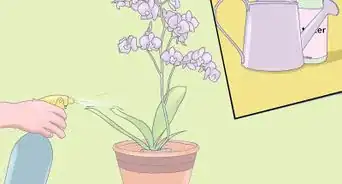
1Gently pour water over the potting mixture. Do so until water runs through the bottom of the pot. Get rid of any water remaining in the saucer underneath the pot, as this can rot the roots. Wait to water your orchid again until the potting mix is completely dry. This helps you avoid overwatering your orchid.[2]
- Stick to just watering the potting mix. Watering the flowers or the leaves can damage your plant.
- It may help to set the orchid pot in the sink while you water it.
- It's better to underwater than to overwater your orchid. Overwatering can cause the roots to rot.
-Step-2-Version-2.jpg)
Method 3
Method 3 of 8:Fertilize your orchid after you water it.
-
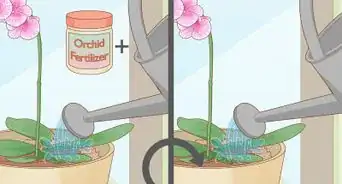
1Use half or a quarter strength fertilizer meant for orchids.[3] These come in powder and liquid forms. Check the container label and follow the dosage requirements.[4] Fertilize your orchid after you water it. During winter, skip a feeding every fourth time you water the plant. Orchids don't need to feed as often during this season.[5]
- Orchids don't need as many nutrients as other houseplants, so the ingredients and dosage recommendations for regular fertilizer are too strong for them.[6]
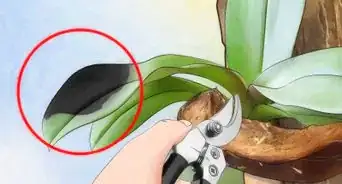
- Over-fertilization can really damage the orchid. You may be overfertilizing your plant if the tips of the leaves start to turn brown. If you notice this, there's a solution! Flush the potting mixture with water to get rid of the excess fertilizer.[7]
-Step-3-Version-2.jpg)
Method 4
Method 4 of 8:Display your orchid in low to medium light.
-Step-4-Version-2.jpg)
Method 5
Method 5 of 8:Keep your orchid at a warm temperature.
-
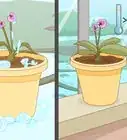
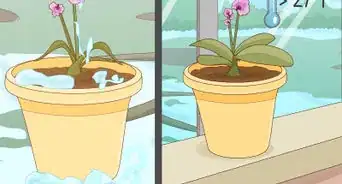
1During the day, keep the temperature at 19–30 °C (66–86 °F). Adjust the temperature in the evening to allow your plant to cool off. Lower the temperature to 16–19 °C (61–66 °F).[12]
- If your plant is healthy but doesn't seem to be flowering, try lowering the temperature by 5°C for 4 weeks. This can help your plant produce flowers![13]
-Step-5-Version-2.jpg)
Method 6
Method 6 of 8:Cut the flowers when they wilt.
-
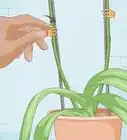
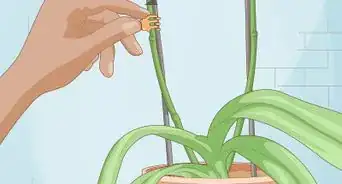
1Trim the flowering stalk back to the second node under the flowers. Orchid flowers usually last about 3 months. If you notice a flower starting to wilt, cut it with scissors. It may be hard to part with the gorgeous bloom, but this will help ensure another flower in the future![14]
-Step-6-Version-2.jpg)
Method 7
Method 7 of 8:Repot your orchid when the lower leaves die.
-
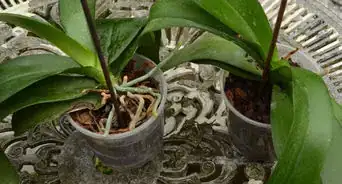
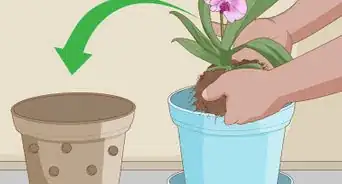
1This usually ends up being about every 2 years. First, grab your orchid by the stem and carefully ease it out of the pot. You may have to break the pot to avoid damaging the plant. Pick off the dead leaves at the bottom with your hands. Remove any dead bloom stalks as well. Next, use a razor blade to cut off the dead roots. Repot the plant and don't forget to water it once the job is done![15]
- Dead roots are hollow and much less solid than live roots.
- Pay attention to the state of the potting mix. If the bark chips are starting to decompose, it's time to repot your orchid.
- Never repot your orchid while it's blooming. Wait until they have finished blooming so you don't lose those beautiful flowers![16]
-Step-7.jpg)
Method 8
Method 8 of 8:Get rid of bugs with insecticidal soap.
-
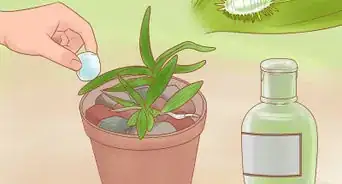
1Check your orchids for bugs often to avoid any damage they can cause! If you notice only one or a few bugs on the orchid, simply remove them by spraying them with water. You can also use an alcohol swab to gently take them off the plant. If you notice a potential infestation, use insecticidal soap or horticultural oil to get rid of them. Follow the dosage instructions according to the product label.[17]
- Don't use pesticides on your orchid. These aren't really meant for indoor plants and could be too harsh.[18]
-Step-8.jpg)
Community Q&A
-
QuestionHow do I know if my orchid needs to be repotted?
 Harmony CorelitzHarmony Corelitz is a Plant Specialist and the Operations Manager at Plants and Friends, a plant shop and nursery based in the San Francisco Bay Area. Harmony grew up helping her parents run their family business in plant maintenance and interior plantscaping. She holds a BA in Literature and Spanish from the University of San Francisco. Harmony specializes in indoor plant care and interior plant design. She started her pop-up plant and vintage home goods shop called Younger Child and has helped Plants and Friends grow and expand to two locations.
Plant SpecialistIn general, you should repot your orchid once a year. You might need to repot it sooner if the roots have completely overgrown the pot it is in or if it starts to lose some lower leaves. -
QuestionHow do you repot an orchid?Harmony CorelitzHarmony Corelitz is a Plant Specialist and the Operations Manager at Plants and Friends, a plant shop and nursery based in the San Francisco Bay Area. Harmony grew up helping her parents run their family business in plant maintenance and interior plantscaping. She holds a BA in Literature and Spanish from the University of San Francisco. Harmony specializes in indoor plant care and interior plant design. She started her pop-up plant and vintage home goods shop called Younger Child and has helped Plants and Friends grow and expand to two locations.
Plant SpecialistFor an orchid, you're going to need to take care to see what type of soil substrate it needs. Orchids aren't typically grown in actual soil. They're going to be grown in Spagna moss, or a mix of bark. They can be potted in orchid bark as well. You're going to want a pot that has lots of aeration. Orchids are epiphytic, so their roots need a lot of aeration and drainage. You're never going to want to pot an orchid into a pot that is much bigger than its existing grow pot. They like to stay very compact in the soil since their structure is really held together by the roots. I would suggest choosing a pot that's only 1-2 inches wider in diameter. -
QuestionWhat does it mean if I notice brown marks in the leaves?
 wikiHow Staff EditorThis answer was written by one of our trained team of researchers who validated it for accuracy and comprehensiveness.
Staff AnswerwikiHow Staff EditorStaff AnswerThis may mean that you are overfertilizing your orchid. Flush out the potting mixture with water for a few minutes to remove any excess fertilizer. This can hopefully help your orchid get healthy again! -
QuestionWhat sort of flower pots should they be used?
 Community AnswerTransparent pots are best for phals so you can see if there's a need for water by actually seeing the roots.
 -
QuestionWhy are the leaves on my orchid turning soft and yellow?Community AnswerAt a certain time, it's normal for phalenopsis orchids to lose their leaves as they produce new leaves. It is sometimes caused due to overwatering as well.
-
QuestionMy plants have lost their leaves. Can they still live?
 Community AnswerIf the roots are healthy, it could recover, but it may take a while.
 -
QuestionWhat do I do if my moth orchids are turning silver?Community AnswerIf you mean the roots are turning silver, it means they are healthy but can use a watering. If you mean the leaves, it could mean there are spider mites or a fungal disease.
-
QuestionHow can I tell the difference between a root and a new flower stalk?
 Community AnswerThe flower stalks are thinner and grow upward, whereas the roots are fatter and grow sideways/down.
 -
QuestionCan I use water with ice cubes?Community AnswerNo, just use cold or room temperature water.
-
QuestionCan they go outside in the day?Community AnswerUnless you live in their native Southeast Asia, the answer is no.






References
- ↑ https://www.missouribotanicalgarden.org/gardens-gardening/your-garden/help-for-the-home-gardener/advice-tips-resources/visual-guides/repotting-phalaenopsis-and-other-monopodial-orchid.aspx
- ↑ https://www.missouribotanicalgarden.org/Portals/0/Gardening/Gardening%20Help/Factsheets/Orchid%20Problems34.pdf
- ↑ https://www.missouribotanicalgarden.org/Portals/0/Gardening/Gardening%20Help/Factsheets/Orchid%20Problems34.pdf
- ↑ https://youtu.be/3wVKQ6C3CUM?t=57
- ↑ https://www.rhs.org.uk/advice/profile?pid=388
- ↑ https://youtu.be/3wVKQ6C3CUM?t=57
- ↑ https://www.missouribotanicalgarden.org/Portals/0/Gardening/Gardening%20Help/Factsheets/Orchid%20Problems34.pdf
- ↑ https://www.plantindex.com/phalaenopsis-orchid-light-requirements/
- ↑ https://www.rhs.org.uk/advice/profile?pid=388
- ↑ https://www.rhs.org.uk/advice/profile?pid=388
- ↑ https://www.rhs.org.uk/advice/profile?pid=388
- ↑ https://www.rhs.org.uk/advice/profile?pid=388
- ↑ https://www.rhs.org.uk/advice/profile?pid=388
- ↑ https://www.rhs.org.uk/advice/profile?pid=388
- ↑ https://www.missouribotanicalgarden.org/gardens-gardening/your-garden/help-for-the-home-gardener/advice-tips-resources/visual-guides/repotting-phalaenopsis-and-other-monopodial-orchid.aspx
- ↑ https://www.missouribotanicalgarden.org/gardens-gardening/your-garden/help-for-the-home-gardener/advice-tips-resources/visual-guides/repotting-phalaenopsis-and-other-monopodial-orchid.aspx
- ↑ https://www.missouribotanicalgarden.org/Portals/0/Gardening/Gardening%20Help/Factsheets/Orchid%20Problems34.pdf
- ↑ https://www.missouribotanicalgarden.org/Portals/0/Gardening/Gardening%20Help/Factsheets/Orchid%20Problems34.pdf
About This Article

For the healthiest phals orchid possible, make sure your orchid is in a plastic or clay pot filled with bark mix. Set your phals in an area where it has access to indirect or filtered sunlight, and keep it at a temperature of around 70 °F. Water your phals weekly, and supplement the bark mix with a 10/10/10 or 20/20/20 food formula diluted in water every month.