This article was co-authored by wikiHow staff writer, Kira Jan. Kira Jan earned her B.A. in English from Stanford University in 2021. She has published work in a variety of literary magazines and edited for bestselling authors. Kira now writes and edits for the content team at wikiHow with the goal of reaching audiences of all backgrounds, skillsets, and interests. She enjoys continually learning alongside wikiHow readers and working to create connection through the written word.
There are 8 references cited in this article, which can be found at the bottom of the page.
This article has been viewed 16,952 times.
Learn more...
You don’t have to sacrifice the appeal of Windows software for the stability, security, customizability (and even old-school cool) of Linux. We’ll walk you through the methods to run Windows executable files and software with your Linux operating system. These methods should work on any Linux distributions, including Ubuntu, Kali Linux, CentOS, and more.
Steps
Question 1
Question 1 of 5:Will .exe files run on Linux?
-
1Yes, you can run .exe files on Linux through Wine (a free software). Wine is a compatibility layer that acts between the operating system (Linux) and the file (written for Windows).[1] It is the only way to run .exe files without a copy of Windows.[2] Since .exe files are native to Windows operating systems, to run them, you must have a compatibility layer (like Wine) or copy of Windows via a Windows emulator (which means you'll no longer solely be using Linux).

Question 2
Question 2 of 5:How do I download Wine?
-
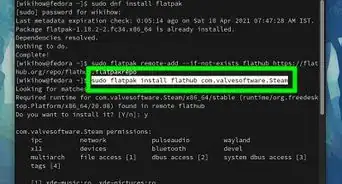
1Open your Linux terminal and type these commands one-by-one. Start by updating the Linux kernel repositories. To do so, type sudo apt update and press ↵ Enter. When prompted, enter your password and press ↵ Enter. Then, when prompted, type clear and press ↵ Enter. Now you’re ready to enter the commands to download Wine:[3]
- sudo apt-get install wine and press ↵ Enter
- sudo apt-get install wine32 and press ↵ Enter
- sudo apt-get install libwine and press ↵ Enter
- Even though the terminal might look intimidating, don’t worry! You’re unlikely to mess anything up, and all you have to do is copy these commands.

Question 3
Question 3 of 5:How do I run .exe files on Linux?
-
1Navigate to the directory with the file, then open the file with Wine. In the terminal, navigate to the directory containing the file with the command cd <directory name>.[4] Then, run the file with the command wine <filename>.exe. For instance, if the file example.exe were stored on your desktop, you’d follow this procedure:[5]
- cd Desktop/ and press ↵ Enter
- wine example.exe and press ↵ Enter

Question 4
Question 4 of 5:How can I run Windows software on Linux?
-
1Use Wine for single applications. This is the only option for running software designed for Windows without a true version of Windows. Wine is open-source, free software that recreates just enough of Windows to run Windows programs. As a result, you might encounter more bugs and lower performance running software through Wine.[6]
-
2Choose a virtual machine for slightly better performance. Virtual machines are programs that run a full copy of Windows in their own window. This approach is less buggy than running apps through Wine, because you’re technically running the apps in their native environment (Windows). The downside is that you’ll be running two operating systems (Linux and Windows) simultaneously, so your PC’s performance might suffer.[7]
- Popular virtual machines include: VirtualBox, VMware, and Linux’s built-in KVM (Kernel-based Virtual Machine).[8]
- Because of the computing power required to run both Linux and Windows, this approach works great for productivity apps like Microsoft Office, but not great for graphics/computing-intensive programs like video games.
-
3Use dual-booting to run Windows games and complex applications. Dual-booting means you’ll reboot your computer into Windows so the application can run in its native environment. This method is best for games or applications that need high performance. Unfortunately, it does mean you’ll have to reboot your machine every time you want to run Windows software.[9]


Question 5
Question 5 of 5:What is the .exe equivalent in Linux?
-
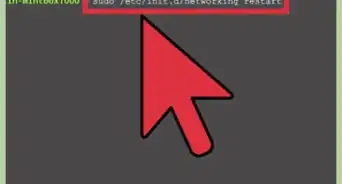
1Linux does not have a direct .exe equivalent. For Windows, .exe indicates an executable file, meaning the operating system can run the file. Linux doesn’t use file extensions to indicate which files are executable. Instead, it uses permissions (the basic permissions are read r, write w, and execute x). Permissions determine which files are executable.[10] As a result, Linux files can have different extensions (ex. .sh) or no file extensions and still be executable.[11] Here’s how to change file permissions and run a file:[12]
- Type chmod +x file-name.run in the command line to change the file permission to “executable.”
- Type ./file-name.run to execute the file.
- If an error pops up, type sudo ./file-name.run. Typing sudo allows you to run the file as an admin. Just be careful, since sudo allows you to make changes to your system.
- Software installation will often require you to type sudo.

References
- ↑ https://www.winehq.org/about
- ↑ https://www.pcworld.com/article/2900497/how-to-run-windows-software-in-linux-everything-you-need-to-know.html
- ↑ https://www.youtube.com/watch?t=10&v=uasl5KxzETo&feature=youtu.be
- ↑ https://www.youtube.com/watch?v=FTTr2bjI2UM&t=40s
- ↑ https://www.youtube.com/watch?v=uasl5KxzETo&t=97s
- ↑ https://www.pcworld.com/article/2900497/how-to-run-windows-software-in-linux-everything-you-need-to-know.html
- ↑ https://www.pcworld.com/article/2900497/how-to-run-windows-software-in-linux-everything-you-need-to-know.html
- ↑ https://www.pcworld.com/article/2900497/how-to-run-windows-software-in-linux-everything-you-need-to-know.html
- ↑ https://www.pcworld.com/article/2900497/how-to-run-windows-software-in-linux-everything-you-need-to-know.html
About This Article