This article was co-authored by Dale Prokupek, MD and by wikiHow staff writer, Hannah Madden. Dale Prokupek, MD is a board-certified Internist and Gastroenterologist who runs a private practice based in Los Angeles, California. Dr. Prokupek is also a staff physician at Cedars-Sinai Medical Center and an associate clinical professor of medicine at the Geffen School of Medicine at the University of California, Los Angeles (UCLA). Dr. Prokupek has over 30 years of medical experience and specializes in the diagnosis and treatment of diseases of the liver, stomach, and colon, including chronic hepatitis C, colon cancer, hemorrhoids, anal condyloma, and digestive diseases related to chronic immune deficiency. He holds a BS in Zoology from the University of Wisconsin – Madison and an MD from the Medical College of Wisconsin. He completed an internal medicine residency at Cedars-Sinai Medical Center and a gastroenterology fellowship at the UCLA Geffen School of Medicine.
There are 12 references cited in this article, which can be found at the bottom of the page.
wikiHow marks an article as reader-approved once it receives enough positive feedback. This article has 15 testimonials from our readers, earning it our reader-approved status.
This article has been viewed 465,489 times.
If you deal with nerves or anxiety on the regular, you’re probably familiar with the feeling of a nervous stomach. Churning, cramping, and bloating are never easy to deal with, and they can often add to your sense of anxiety. Fortunately, there are a few ways you can learn to manage your nervousness and calm your stomach down to conquer your worries.
Steps
Method 1
Method 1 of 15:Take a few deep breaths.
-
1Deep breathing can help calm you down and relax your mind. When you’re feeling nervous, sit in a comfortable position and take a deep breath in through your nose. Hold it for a few seconds, then let it out through your mouth. Do this 5 to 10 times until you feel slightly calmer.[1]
- As you breathe in, try to push your belly outwards instead of your chest. It will help you take in more air and calm down faster.

Method 2
Method 2 of 15:Talk to a friend.
-
1Releasing your feelings might help you work through them. Call up a friend or a family member and talk to them about what’s on your mind. They might be able to offer you advice, but they can also just be a listening ear as you express your worries.[2]
- You could also talk to a mental health professional like a therapist or a counselor. They can help you cope with your anxiety over time so you don’t have to deal with a nervous stomach as often.

Method 3
Method 3 of 15:Keep a journal.
-
1Work through your emotions in a healthy way. Set aside 5 to 10 minutes of your day to sit down and write in a journal. You could jot down your thoughts, your feelings, what you did that day, or what you’re looking forward to next. Don’t worry about grammar or sentence structure—simply write until you don’t have anything else to say.[3]
- Journaling works well over a long period of time. Try to journal daily to relieve stress and anxiety.

Method 4
Method 4 of 15:Get some exercise.
-
1It will release endorphins and help counteract stress. Endorphins are often called “happy chemicals,” and for good reason. When you exercise, your body releases endorphins in your brain that lift your mood and make you feel better almost instantly.[4]
- You could try running, jogging, swimming, jumping rope, weight lifting, or cycling.
- Even just 15 minutes of exercise can help you feel better.

Method 5
Method 5 of 15:Do some yoga.
-
1It’s a relaxing way to get some exercise. Change into workout clothes and roll out your yoga mat. Look up a beginner’s yoga video online to follow along with simple poses. Focus your mind on your body, and concentrate on exercising instead of thinking about what’s making you nervous.[5]
- Doing yoga for 15 minutes every day can help lower your stress and anxiety levels overall.

Method 6
Method 6 of 15:Try meditation.
-
1Empty your mind to get rid of your nervousness. Sit in a comfortable spot and focus on breathing deeply. Try to think about nothing at all, and focus on how your body feels in the moment. Try to do this for at least 10 minutes to calm your stomach and your nerves.[6]
- Thinking about nothing can be tough, especially when you first start. You can look up a guided meditation video to help you along if you need to.

Method 7
Method 7 of 15:Listen to soothing music.
-
1A calming playlist can help block out stressors and calm you down. Create a playlist on Spotify, YouTube, or Apple Music that you can keep on your phone to take with you. Pick out instrumental or classical music that helps keep you calm and wash away your worries.[7]
- Songs without lyrics generally work best for calming and soothing, but you can pick whichever genre works for you.

Method 8
Method 8 of 15:Take a relaxing bath.
-
1Practice self-care to help alleviate your worries. Run yourself a nice bubble bath or take a long soak with a bath bomb. If you don’t want to sit in silence, turn on some music or listen to an audiobook in the background.[8]
- You can also take a warm shower or do a face mask.

Method 9
Method 9 of 15:Practice mindfulness.
-
1Focus on your body as it exists right now. Try not to worry about what’s going to happen in the future or what has happened in the past. Think about how your body feels, and focus on what you’re doing in this exact moment.[9]
- It might be helpful to think about your senses. What can you see, hear, feel, touch, and smell right now?

Method 10
Method 10 of 15:Confront the source of your nerves.
-
1It’s the best way to stop a nervous stomach for good. If you’ve overcommitted to plans and you’re stressed out, call and cancel a few so you feel better. If you’re stressed about seeing your least favorite relative at dinner, make plans with a friend instead. The less stressed you feel, the better your stomach will be.[10]
- Some big things, like debt, can’t be solved in the moment. If you have a large stressor that you can’t take care of right away, try making an action plan to solve it by taking baby steps. For instance, you could create a budget and plan to set aside $100 each month to pay off your debt.

Method 11
Method 11 of 15:Repeat a mantra to yourself.
-
1You can say it out loud or inside your head. Tell yourself that everything’s going to be okay, and that you don’t need to worry. Some quality mantras include:[11]
- “I’m feeling nervous, but I can handle it.”
- “I am bigger than my anxiety.”
- “This feeling will pass.”

Method 12
Method 12 of 15:Avoid caffeine and alcohol.
-
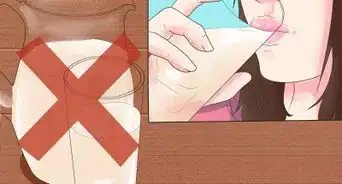
1Both of these can give you more anxiety and upset your stomach. If you’re dealing with cramps, nausea, or bloating, try not to drink anything that contains alcohol or caffeine. When you’re thirsty, go for a glass of ice water instead to wake you up and keep you hydrated.[12]
- Caffeine is a type of stimulant and will amplify the effects of adrenaline in a stressful situation, as it activates your sympathetic nerve system and can induce a "fight-or-flight" response.
- Drinking alcohol makes your stomach produce more stomach acid, which can intensify bloating, cramping, nausea, and vomiting.

Method 13
Method 13 of 15:Don’t eat anything.
-
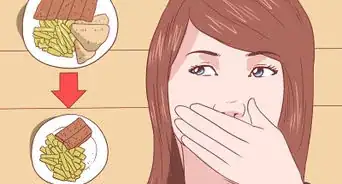
1Food can make your stomach feel worse. If you’re already nervous, try not to eat anything until your stomach ache goes away. If your stomach is empty, it will probably hurt less.[13]
- If you’re feeling hungry, try eating something small and plain, like crackers or toast. Or, go for a hard candy like ginger or peppermint to help soothe your stomach.

Method 14
Method 14 of 15:Treat your symptoms with medicine.
-
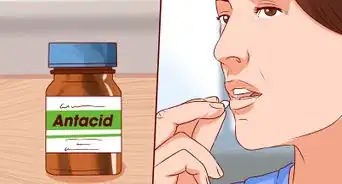
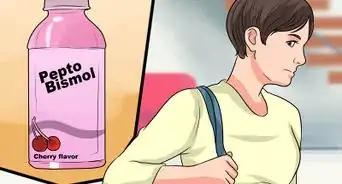
1Over-the-counter antacids can relieve stomach pain. If the non-medicinal techniques aren’t working for you, there are some medications that can help calm the stomach. Common over-the-counter examples include:[14]
- Tums
- Pepto-Bismol
- Rolaids
- Alka-Seltzer
- Emetrol
- Mylanta

Method 15
Method 15 of 15:Sip on ginger tea.
-
1It will help settle your stomach and relieve nausea. When your stomach starts to feel weird, pour yourself a glass of something that contains real ginger, like ginger tea. Take small, slow sips to avoid overwhelming your stomach and help it feel better.[15]
- While ginger ale is often recommended for stomach pain, it actually contains a lot of sugar which can make your symptoms worse. Look for a tea that contains real ginger instead.

Expert Q&A
Did you know you can get premium answers for this article?
Unlock premium answers by supporting wikiHow
-
QuestionWhat are some signs that something may actually be wrong?
 Dale Prokupek, MDDale Prokupek, MD is a board-certified Internist and Gastroenterologist who runs a private practice based in Los Angeles, California. Dr. Prokupek is also a staff physician at Cedars-Sinai Medical Center and an associate clinical professor of medicine at the Geffen School of Medicine at the University of California, Los Angeles (UCLA). Dr. Prokupek has over 30 years of medical experience and specializes in the diagnosis and treatment of diseases of the liver, stomach, and colon, including chronic hepatitis C, colon cancer, hemorrhoids, anal condyloma, and digestive diseases related to chronic immune deficiency. He holds a BS in Zoology from the University of Wisconsin – Madison and an MD from the Medical College of Wisconsin. He completed an internal medicine residency at Cedars-Sinai Medical Center and a gastroenterology fellowship at the UCLA Geffen School of Medicine.
Board Certified Internist & GastroenterologistBlood in your stool is the really big one. If you're bleeding it could be a serious sign. Keep in mind that blood in your stool could be bright red, or black and tarry depending on where you're bleeding. Pus and mucus in your stool can be a concerning sign as well. Then there are the obvious concerns, like vomiting or a fever. You should see a doctor if any of these apply to you.
Support wikiHow by unlocking this expert answer.
-
QuestionHow do I calm myself down before a performance?
 Chris M. Matsko, MDDr. Chris M. Matsko is a retired physician based in Pittsburgh, Pennsylvania. With over 25 years of medical research experience, Dr. Matsko was awarded the Pittsburgh Cornell University Leadership Award for Excellence. He holds a BS in Nutritional Science from Cornell University and an MD from the Temple University School of Medicine in 2007. Dr. Matsko earned a Research Writing Certification from the American Medical Writers Association (AMWA) in 2016 and a Medical Writing & Editing Certification from the University of Chicago in 2017.
Family Medicine PhysicianTry deep breathing techniques. This will stimulate the diaphragm and your parasympathetic nervous system, which can relax you.Support wikiHow by unlocking this expert answer.
-
QuestionI have functional dyspepsia, and I feel slightly sick to my stomach all the time. Any advice?Chris M. Matsko, MDDr. Chris M. Matsko is a retired physician based in Pittsburgh, Pennsylvania. With over 25 years of medical research experience, Dr. Matsko was awarded the Pittsburgh Cornell University Leadership Award for Excellence. He holds a BS in Nutritional Science from Cornell University and an MD from the Temple University School of Medicine in 2007. Dr. Matsko earned a Research Writing Certification from the American Medical Writers Association (AMWA) in 2016 and a Medical Writing & Editing Certification from the University of Chicago in 2017.
Family Medicine PhysicianIf you are on NSAIDS they should be discontinued, and you should consider taking a proton pump inhibitor. Talk to your doctor about this option.Support wikiHow by unlocking this expert answer.







References
- ↑ https://www.health.harvard.edu/blog/ease-anxiety-and-stress-take-a-belly-breather-2019042616521
- ↑ https://www.mayoclinic.org/healthy-lifestyle/adult-health/in-depth/friendships/art-20044860
- ↑ https://www.urmc.rochester.edu/encyclopedia/content.aspx?ContentID=4552&ContentTypeID=1
- ↑ https://adaa.org/learn-from-us/from-the-experts/blog-posts/consumer/how-calm-anxious-stomach-brain-gut-connection
- ↑ https://adaa.org/learn-from-us/from-the-experts/blog-posts/consumer/how-calm-anxious-stomach-brain-gut-connection
- ↑ https://adaa.org/learn-from-us/from-the-experts/blog-posts/consumer/how-calm-anxious-stomach-brain-gut-connection
- ↑ https://healthblog.uofmhealth.org/wellness-prevention/using-music-times-of-anxiety
- ↑ https://health.clevelandclinic.org/stomach-churning-may-gut-stress/
- ↑ https://www.mayoclinic.org/healthy-lifestyle/consumer-health/in-depth/mindfulness-exercises/art-20046356
- ↑ https://health.clevelandclinic.org/stomach-churning-may-gut-stress/
- ↑ https://www.mayoclinic.org/tests-procedures/meditation/in-depth/meditation/art-20045858
- ↑ https://www.health.harvard.edu/blog/nutritional-strategies-to-ease-anxiety-201604139441
- ↑ https://www.nhs.uk/live-well/eat-well/five-lifestyle-tips-for-a-healthy-tummy/
- ↑ https://patient.info/digestive-health/indigestion-medication/antacids
- ↑ https://health.clevelandclinic.org/ginger-ale-and-saltine-crackers-5-ways-to-ease-stomach-pain-and-nausea/
- ↑ https://health.clevelandclinic.org/stomach-churning-may-gut-stress/
About This Article

Medical Disclaimer
The content of this article is not intended to be a substitute for professional medical advice, examination, diagnosis, or treatment. You should always contact your doctor or other qualified healthcare professional before starting, changing, or stopping any kind of health treatment.
To calm a nervous stomach, first try taking a deep breath in through your nose and breathing out through your mouth to help you relax. Taking a warm bath or listening to soothing music can also help calm you down and soothe your stomach. Certain medicines like Pepto Bismol and Tums might provide some relief, as well as lozenges with mint or ginger in them. However, you should avoid caffeine, alcohol, and heavy meals, as they can make your stomach hurt worse. If you get a nervous stomach often, consider trying yoga, meditation, exercise, and journaling to lower your anxiety levels over time. To learn more from our Gastroenterologist co-author, like how to know when something's actually wrong with your stomach, keep reading!