This article was co-authored by wikiHow Staff. Our trained team of editors and researchers validate articles for accuracy and comprehensiveness. wikiHow's Content Management Team carefully monitors the work from our editorial staff to ensure that each article is backed by trusted research and meets our high quality standards.
The wikiHow Tech Team also followed the article's instructions and verified that they work.
This article has been viewed 22,914 times.
Learn more...
This wikiHow teaches you how to calculate the exact standard error value of a data set on an Excel spreadsheet file, using a desktop computer. You will need to first calculate your data sample's standard deviation in order to calculate the standard error.
Steps
Part 1
Part 1 of 2:Calculating the Standard Deviation
-
1Open the Excel file you want to edit. Find the Excel spreadsheet you want to make calculations on, and double-click on its name or icon to open it.
-
2Click an empty cell. You will need to use two empty cells in order to calculate the standard error of a data sample.Advertisement
-
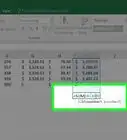
3Type =STDEV.S(<range>) into the empty cell. This formula will allow you to calculate the standard deviation of a sample data set in any selected range on your spreadsheet.
-
4Replace <range> with the cell range you want to pull data from. Enter the first and the last cells in the parentheses, and separate the two cell numbers with a semicolon.
- For example, if your data is in cells B5 to B11, your formula should look like =STDEV.S(B5:B11).
- Alternatively, you can pull data from nonsequential cells, and separate each cell number with a comma. If your data is in cells A3, B7, and D2, your formula should look like =STDEV.S(A3,B7,D2).
-
5Hit ↵ Enter or ⏎ Return on your keyboard. This will calculate the standard deviation of the given data sample, and return it in the formula cell.
-
6Note the cell number of your standard deviation cell. Note down the number of the cell you've used to calculate your standard deviation here.
- You will need this cell number in order to calculate the standard error later.
Advertisement


Part 2
Part 2 of 2:Calculating the Standard Error
-
1Click an empty cell on the spreadsheet. You will need to use another formula, and pull the standard deviation value in order to calculate the standard error.
-
2Type =<SDcell>/SQRT(COUNT(<range>)) into the empty cell. This formula will return the standard error value of your data sample.
-
3Replace <SDcell> with your standard deviation cell number. This will pull the standard deviation value from the specified cell, and use it to calculate your standard error.
- For example, if your standard deviation value from the previous calculation is listed in cell G5, type G5 here.
-
4Replace <range> with the cell range of your data. Enter the first and the last cells of your raw data here, and separate the two cells with a semicolon.
- For example, if your raw data is listed from cells B5 to B11, your formula will look like =G5/SQRT(COUNT(B5:B11)).
-
5Hit ↵ Enter or ⏎ Return on your keyboard. This will calculate the standard error of the given data sample, and return the exact value in the formula cell.Advertisement





About This Article

1. Open an Excel spreadsheet.
2. Type the Excel formula for standard deviation in an empty cell.
3. Plug your data range into the formula.
4. Hit Enter or Return.
5. Type the Excel formula for standard error value in another cell.
6. Plug your standard deviation cell number into the formula.
7. Plug your data range into the formula.
8. Hit Enter or Return.