This article was co-authored by David Jia. David Jia is an Academic Tutor and the Founder of LA Math Tutoring, a private tutoring company based in Los Angeles, California. With over 10 years of teaching experience, David works with students of all ages and grades in various subjects, as well as college admissions counseling and test preparation for the SAT, ACT, ISEE, and more. After attaining a perfect 800 math score and a 690 English score on the SAT, David was awarded the Dickinson Scholarship from the University of Miami, where he graduated with a Bachelor’s degree in Business Administration. Additionally, David has worked as an instructor for online videos for textbook companies such as Larson Texts, Big Ideas Learning, and Big Ideas Math.
This article has been viewed 333,292 times.
In statistics, range represents the difference between the highest value of a data set and the lowest value of a data set. The range shows how spread out the values in a series are. If the range is a high number, then the values in the series are spread far apart; if the range is a small number, then the values in the series are close to each other. If you want to know how to calculate range, just follow these steps.
Steps
-
1List the elements of your data set. To find the range of a set, you'll need to list all of the elements of the set so that you can identify the highest and lowest numbers. Write down all of the elements. The numbers in this set are: 20, 24, 25,19, 24, 28 and 14.[1]
- It can be easier to identify the highest and lowest number in the set if you list the numbers in ascending order. In this example, the set would be rearranged like this: 14, 19, 20, 24, 24, 25, 28.
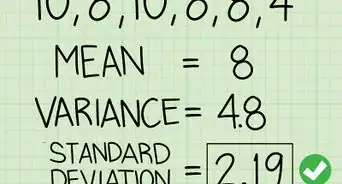
- Listing the elements of the set in order can also help you make other calculations, such as finding the mode, mean, or median of the set.
-
2Identify the highest and lowest numbers in the set. In this case, the lowest number in the set is 14 and the highest number is 28.[2]
-
3Subtract the smallest number in your data set from the largest number. Now that you've identified the smallest and largest numbers in the set, all you have to do is subtract them from each other. Subtract 14 from 28 (28 - 14) to get 14, the range of the set.[3]
-
4Label the range clearly. Once you've found the range, label it clearly. This will help you avoid confusing it with any other statistical calculations that you may need to make for the set, such as finding the median, mode, or mean.[4]


Community Q&A
Did you know you can get expert answers for this article?
Unlock expert answers by supporting wikiHow
-
QuestionWhat is the range of a list of numbers?
 David JiaDavid Jia is an Academic Tutor and the Founder of LA Math Tutoring, a private tutoring company based in Los Angeles, California. With over 10 years of teaching experience, David works with students of all ages and grades in various subjects, as well as college admissions counseling and test preparation for the SAT, ACT, ISEE, and more. After attaining a perfect 800 math score and a 690 English score on the SAT, David was awarded the Dickinson Scholarship from the University of Miami, where he graduated with a Bachelor’s degree in Business Administration. Additionally, David has worked as an instructor for online videos for textbook companies such as Larson Texts, Big Ideas Learning, and Big Ideas Math.
Academic TutorIf you're given a set of data, find the smallest number, then the largest number. Subtract them from each other to get the range.
Support wikiHow by unlocking this expert answer.
-
QuestionWhat would the range of these numbers be? -8, -6, 0, 1, 3, 4, 20
 Chelsea sodenCommunity AnswerFirst order the data from least to greatest, then subtract the smallest value from the largest value in the set.
 -
QuestionHow do I calculate mean, median and mode?
 Community AnswerFor mean, add all numbers up and divide them by how many numbers there are. For median, place all numbers in ascending order then find the middle number. For mode, find the most commonly-occurring number.
 -
QuestionWhat is the range of 12,400?
 Community AnswerYou have to have multiple numbers to calculate the range.
 -
QuestionHow can I find the range with negative and positive numbers?
 Community AnswerYou know that if a negative number is higher, it is less (eg -4 < -2), so the negative with the "highest" number would be the lowest part, and you would then take the highest positive number, and then subtract the lower part from the higher. Eg: Your numbers are -9, -4, 0, 3, and 7. Well, you take the negative with the "highest" positive number, ie., -9, and then the highest positive number, 7. Subtract 7 - (-9), and you get 16.
 -
QuestionWhy do we measure the range?
 DonaganTop AnswererIt gives us an overview of a set of data, an idea of how much "space" is contained within those data points.
 -
QuestionThe range is a data set is 14. If the smallest number in the set is 24, what is the largest number?DonaganTop AnswererAdd the range to the smallest number.
-
QuestionHow do I calculate mean?Community AnswerAdd all the numbers and divide the sum by the number of entries in the range.
-
QuestionHow do I create range from mean?DonaganTop AnswererIf all you know is the mean, you don't have enough information to find the range.
-Step-13.webp)



-Step-16.webp)
References
- ↑ David Jia. Academic Tutor. Expert Interview. 14 January 2021.
- ↑ David Jia. Academic Tutor. Expert Interview. 14 January 2021.
- ↑ David Jia. Academic Tutor. Expert Interview. 14 January 2021.
- ↑ https://www.mathsisfun.com/data/range.html
About This Article

To calculate range, write down all of the numbers in your set in ascending order and identify the highest and lowest numbers in the set. Subtract the smallest number in your data set from the largest number. The resulting number is the range. To learn how arranging your set in order can help you find other calculations, read on!


-Step-13.webp)