This article was co-authored by Dalia Miguel. Dalia Miguel is a violinist and violin instructor based in the San Francisco Bay Area. She is studying Music Education and Violin Performance at San Jose State University and has been playing violin for over 15 years. Dalia teaches students of all ages and performs with a variety of symphonies and orchestras in the Bay Area.
wikiHow marks an article as reader-approved once it receives enough positive feedback. In this case, 95% of readers who voted found the article helpful, earning it our reader-approved status.
This article has been viewed 178,755 times.
Violins range in price from hundreds to thousands of dollars, making it difficult to assess which is the right option for you. Research into the type of violin that is best suited for your skill level, musical style, and size. To ensure that you are purchasing a quality violin that has been made with the proper craftsmanship, examine and test the violin.
Steps
Method 1
Method 1 of 3:Choosing a Style of Violin
-
1Buy a student violin if you are a beginner. Student violins are usually made from less expensive woods and are manufactured by machines rather than by hand. These are less expensive, typically ranging from $100 to $800 and are perfect for beginners.[1]
- If you are just starting to take violin lessons, you may not want to invest in an expensive and high quality violin only to discover that this is not the instrument for you.
-
2Select an intermediate violin for improved quality. Once you have been playing the violin for a few years and want to improve the overall quality and sound of your instrument, you should upgrade to an intermediate level violin. Some brands will not produce an intermediate level violin, but those that do price them around $1,000.[2]
-
3Choose a professional violin if you are an advanced violinist. Professional violins are hand-crafted by a master luthier and are made from high quality wood. These instruments can cost thousands of dollars and are ideal for professional musicians or art collectors.[3]
-
4Buy an acoustic violin to play classical and folk music. Traditional acoustic violins create warm and rounded tones as a result of the natural resonance of the tonewood. These instruments are best suited for classical and folk music.[4]
- It is possible to attach an amplifier to an acoustic violin. If you only need an amp for some songs, it is best to stick with an acoustic violin.
-
5Get an electric violin to play rock and jazz music. Electric violins have built in pickups that amplify the sound and produce a brighter and more raw sound than the acoustic violin. This is preferred if you are playing rock or jazz music.[5]
- Consider the type of music you like. If you listen to rock music, you may be more inclined to use an electric instrument that can create a rock sound.
-
6Inquire about a rent-to-buy program. If you are just starting out with playing the violin, you may prefer renting prior to making an investment. In many instances, you can actually rent the violin to begin with and then eventually buy the violin. Your rent payments will go towards the purchase price.


Method 2
Method 2 of 3:Selecting the Right Size
-
1Buy a full size violin if you are over the age of eleven. Violins come in a variety of different sizes, but most adults use a full size (4/4) violin. Typically, if you are over the age of eleven, you will fit a full size violin.[6]
-
2Measure your child’s arm from the base of their neck to their wrist. For children, you will need to measure their arm length to determine which size of violin is best. Ask the child to extend their left arm straight out and away from their body. Then measure the length of the arm from the neck to the wrist or palm.[7]
- If you measure to the wrist, this will be the most comfortable fit, and if you measure to the palm, it will be the largest size your child can play.
- Violins range in size from a 4/4 violin size (23 inch (58 cm) measurement) to a 1/32 violin size (13 inch (33 cm) measurement).
-
3Rent a violin if your child is still growing. To save money, you may want to consider renting a violin if your child is still growing. Your child will likely grow quite quickly and it can be expensive to constantly buy a new violin each time they grow. Instead, you can save money by renting violins until they reach full size.


Method 3
Method 3 of 3:Examining the Quality
-
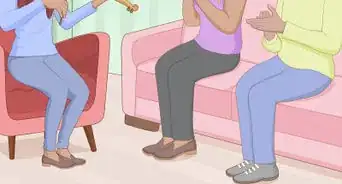
1Test the violin before purchasing. Before you purchase a violin, you should play the instrument. Most music shops will actually have a separate room for this purpose. Play the violin to get a sense of the feel and tone.[8]
- You should also have a friend or music teacher with you so that they can hear and test the instrument as well.
- Some shops will even allow you to take the violin home for a test period. Ask to see if that is possible and take advantage of the store’s policy. You may find that the violin sounds different once you get it home.
-
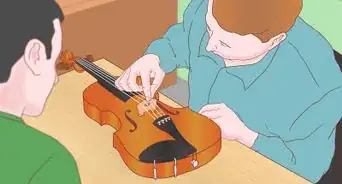
2Look for cracks in the wood. Cracks in the wood can be expensive to repair and will impact the quality of the sound produced by the violin. Inspect the instrument for any cracks before purchasing. This is especially necessary if you are buying a used or antique violin.[9]
-
3Check the ribs for bulging. The ribs, or sides of the violin, should not bulge out beyond the edges of the top or back of the violin. This is typically a sign that the wood was not treated properly. It can also be common among violins that are over fifty years old. Consult a violin repair shop before purchasing a violin with this type of wear.[10]
- The cost to make the repairs may be expensive.
-
4Check that the bridge is adequately curved. The bridge of the violin should be rounded, allowing for you to play a single string or multiple strings at the same time. If the bridge is flat at the top it may be very difficult to play a single note.[11]
-
5Ask what type of wood the violin is made from. The type and quality of wood can drastically impact the price of a violin. The best types of wood are spruce wood tops with maple wood necks, backs, and sides. Typically wood that has been aged for longer will be drier and stronger and is considered better quality for violins.[12]
- Ebony is typically used for the fingerboard.
- Less expensive violins may use cheaper wood types and may even have a plastic chin rest.
-
6Ensure an antique violin comes with an authentication certificate. If you are interested in buying an antique professionally made violin, such as a Stradivarious, you should make sure the instrument has been professionally appraised and authenticated before purchasing. There are only 600 Stradivari left in the world. An appraisal will help ensure that you avoid spending hundreds of thousands of dollars on a fake.[13]


Community Q&A
Did you know you can get expert answers for this article?
Unlock expert answers by supporting wikiHow
-
QuestionHow much do violins cost?
 Dalia MiguelDalia Miguel is a violinist and violin instructor based in the San Francisco Bay Area. She is studying Music Education and Violin Performance at San Jose State University and has been playing violin for over 15 years. Dalia teaches students of all ages and performs with a variety of symphonies and orchestras in the Bay Area.
Experienced Violin InstructorThe price range for violins varies widely. Violins can cost anywhere from a hundred dollars to hundreds of thousands of dollars. I had an older violin once that was appraised for $4,000.
Support wikiHow by unlocking this expert answer.
-
QuestionHow should a beginner buy a violin?Dalia MiguelDalia Miguel is a violinist and violin instructor based in the San Francisco Bay Area. She is studying Music Education and Violin Performance at San Jose State University and has been playing violin for over 15 years. Dalia teaches students of all ages and performs with a variety of symphonies and orchestras in the Bay Area.
Experienced Violin InstructorIf the violin is for a child, I always tell the parents to consider the ages. I usually recommend for parents to not buy violins, because if it’s a child, he or she is going to keep growing. So I usually recommend for them to rent until they reach their full size. Then, if you buy a violin, make sure that it has a really good sound. The sound is one of the most important things. A lot of the beginner violins sound plastic-y. Always go to a violin shop, because they will have really quality violins.Support wikiHow by unlocking this expert answer.
-
QuestionWhat are all the 4/4, 3/4, etc. about?
 Community AnswerIt is the size of the violin. 4/4 is a full size violin, 3/4 is 1/4 smaller than a full size violin.
 -
QuestionI cant decide whether to buy a Hyburg or Flavian violin?
 Community AnswerTest them both out and get a sense of the feel and sound of each instrument. Make your decision based on how they play.
 -
QuestionI was told my violin was good, because it was a "Gibson." I did not know Gibson even made violins. Was I ripped off? I paid $75.00 for it from a pawn shop.
 Elizabeth FilippiCommunity AnswerThey do make violins, and they're very antique! The quality of the sound is the most important, to mention the size, and how accustomed you are to it.
 -
QuestionCan I buy a violin for $100?Community AnswerYou can buy an inexpensive violin for $100, but it may also be low quality. Look into renting a higher quality violin or purchasing a used violin instead.
-
QuestionIs it hard to play violin?Community AnswerYes, it's hard. But it's worth the effort!
-
QuestionHow much does a violin cost?Community AnswerIt depends on whether it's used, and what brand it is. A used one can cost from around $100 to $200 while still in good condition. Some are cheaper, but have scratches in the wood. A new one can go to be extremely expensive for one a professional would use. However, to start off with, a student one is great. If it is a vintage one, such as a Stradivarius, it can go for hundreds of thousands or even more but you're most likely not in the market for such sweet music-makers just yet.
-
QuestionIs it true that when I buy a violin, I have to change the current strings?
 JustmelgCommunity AnswerThis is not necessarily true. The store or individual that's selling the violin should have put new strings on there before selling it to you. However, if the strings look like they are starting to thin or appear damaged overall, then you might need to buy a new set.
 -
QuestionWhat are the best violin brands?Community AnswerIt depends on your price range. The best thing to do is to go to a local violin shop and try the instruments they have there. If you are not comfortable playing yet, they will often have someone who can play the instrument for you and show you how it sounds. It is much safer and more reliable than trying to buy something sight unseen based on the brand.
References
- ↑ http://thehub.musiciansfriend.com/band-orchestra-buying-guides/violin-buying-guide
- ↑ http://thehub.musiciansfriend.com/band-orchestra-buying-guides/violin-buying-guide
- ↑ http://thehub.musiciansfriend.com/band-orchestra-buying-guides/violin-buying-guide
- ↑ http://thehub.musiciansfriend.com/band-orchestra-buying-guides/violin-buying-guide
- ↑ http://thehub.musiciansfriend.com/band-orchestra-buying-guides/violin-buying-guide
- ↑ https://reverb.com/news/how-to-buy-a-violin-common-myths-and-misperceptions
- ↑ http://thehub.musiciansfriend.com/band-orchestra-buying-guides/violin-buying-guide
- ↑ https://reverb.com/news/how-to-buy-a-violin-common-myths-and-misperceptions
- ↑ https://reverb.com/news/how-to-buy-a-violin-common-myths-and-misperceptions
- ↑ http://www.childrensmusicworkshop.com/instruments/violin/
- ↑ https://reverb.com/news/how-to-buy-a-violin-common-myths-and-misperceptions
- ↑ http://thehub.musiciansfriend.com/band-orchestra-buying-guides/violin-buying-guide
- ↑ https://reverb.com/news/how-to-buy-a-violin-common-myths-and-misperceptions
About This Article

To buy a violin, try a student violin if you’re a beginner as they are made of less expensive woods and are a cheaper option. Once you’ve been playing the violin for a few years, you may want to improve the overall quality and sound of your instrument by upgrading to an intermediate violin, which cost around $1,000. If you typically play classical or folk music, then consider an acoustic violin. Alternatively, electric violins will suit those who play rock and jazz music. To learn how to buy the right size violin, keep reading!