This article was co-authored by Carlos Alonzo Rivera, MA and by wikiHow staff writer, Janice Tieperman. Carlos Alonzo Rivera is a guitarist, composer, and educator based in San Francisco, California. He holds a Bachelor of Arts degree in Music from California State University, Chico, as well as a Master of Music degree in Classical Guitar Performance from the San Francisco Conservatory of Music. Carlos specializes in the following genres: classical, jazz. rock, metal and blues.
There are 15 references cited in this article, which can be found at the bottom of the page.
This article has been viewed 5,902 times.
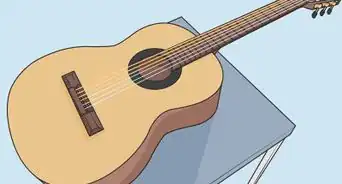
Used acoustic guitars offer a lot of bang for the buck—as these wooden instruments age, the guitar develops beautiful overtones that just can’t be found in a newer instrument. Before committing to a guitar, take some time to inspect the instrument in person. With a few tests, you can select a second-hand guitar that best meets your musical needs.[1]
Steps
Method 1
Method 1 of 3:Preliminary Inspection
-
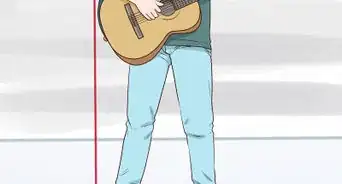
1Hold the guitar to see if it feels comfortable. Guitars come in a lot of different shapes and sizes. Before making a purchase, physically hold the instrument and play a few notes and chords. Is the guitar comfortable to hold, or do your hands and fingers feel strained after a little while? If so, set that guitar aside and look for a different instrument.[2]
- Guitars can have different depths, plus the neck widths can differ. These are all deciding factors as you shop for a used acoustic guitar!
-
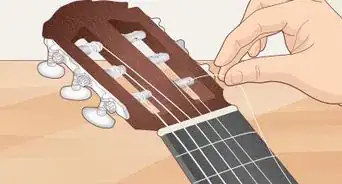
2Play the guitar and note how it sounds. Pluck all the strings and play chords on all the frets. Listen for any rattling or sounds of strings ringing. These sounds could mean that the strings have broken windings, or that the frets or bridge aren’t set properly.[3]
- Getting a full refret for your guitar costs several hundred dollars. If you’re just dealing with a few loose frets, you can get them re-glued for a small fee.[4]
-
3Check the price tag for seemingly good bargains. Your used guitar will probably need some type of repair, even if it’s not that extensive. Be wary of used acoustic guitars with extraordinarily cheap price tags—chances are, if the deal seems too unbelievable, it isn’t worth your time.[5] In general, decent-quality acoustic guitars cost at least $300.[6]
- A “cheap” guitar can quickly become expensive once you add up all the repairs.
-
4Search the instrument for cracks. If you find a crack, place both pointer fingers on either side of it. Then, press down with each finger, alternating pressure to see how much the crack shifts and moves around. If the crack is obviously lifting and warping, you’ll need to get it repaired.[7]
- Some second-hand guitars might have cracks that are already repaired. Insert a small mirror inside the body of your guitar to see if the repairs look solid or not.
- Cracks don’t have to be a dealbreaker! It really depends on how severe they are.
- Crack repairs can cost at least $40.[8]
-
5Look for rust along the instrument hardware. Rust on the metal fret bars and strings isn’t a big deal, and can be fixed or repaired easily. Instead, check the guitar hardware secured to the pickups and strings. If these sections look rusted, set the guitar aside and shop for a different instrument.[9]
- Not all acoustic guitars will come with pickups.
-
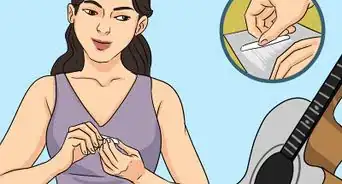
6Slide a finger along the seams to feel for obvious gaps. Feel along the neck joint, or section where the neck of the guitar meets the body. Then, drag a fingernail beneath the binding along the guitar body. If these joints and seams have a significant gap, shop for a different instrument.[10]
- Taking off and repositioning a guitar neck can cost several hundred dollars, and might be more trouble than it’s worth. Repairing acoustic guitar binding is also very pricey.
-
7Tap the guitar body to check for loose braces. Guitar braces are thin, structural pieces of wood secured within the body of a guitar. Listen as you tap the top and bottom of the guitar body—if you hear a rattling sound, some of these wooden braces are definitely loose. This isn’t necessarily a dealbreaker, but you’ll have to pay to get the braces repaired.[11]
- Repair costs ultimately depend on the repair-person. Some people charge per hour of labor, while others charge per brace.
-
8Look for a truss rod along the guitar neck. A truss rod is a thin, metal rod going up the neck of a guitar, providing extra support. Tilt your guitar downward, so you can see directly beneath the fretboard. Scan for a small, metal circle beneath the center of the fretboard—this means that the guitar does have a truss rod.[12]
- Reinforced guitar necks aren’t the end of the world, but truss rods are a better option for your potential instrument.
- Truss rod adjustments are pretty cheap, but replacing or fixing a truss rod can cost at least $750.[13]


Method 2
Method 2 of 3:Neck and Fretboard
-
1Hold the guitar at a slight angle and see if the neck is straight. Check that the neck is straight, and that it doesn’t twist or warp along its length. Then, hold up a ruler and see if the frets point directly to the top of the bridge.[14]
- If you’re shopping online, take a close look at the seller pictures to get a good look at the guitar neck.
- Neck resets can cost several hundred dollars, depending on the type of instrument you have.[15]
-
2Nudge the neck in different directions to see if it’s firm. See if the guitar neck shifts vertically or horizontally. If it moves around some, you’ll need to get it fixed.[16]
-
3Inspect the fretboard joints for any gaps. Examine where the fretboard connects to the top of the guitar. On a sturdy, good-quality guitar, the fretboard will fit flush with the guitar top without any gaps. If the fretboard doesn’t look secure, continue shopping for a different guitar.[17]
-
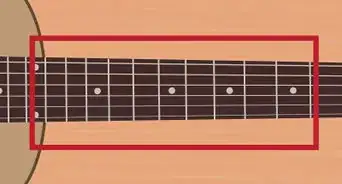
4Check the frets to see if they’re in good shape without signs of wear. Look along the guitar neck to see if any of the frets are uneven. Additionally, inspect the first few frets along the end of the guitar neck—some older guitar frets may have pitting.[18]
- If the seller had the guitar neck adjusted in the past, then the frets were probably replaced, too.
-
5Play notes on each fret. Pluck each string along every fret—each note should sound unique. Watch for signs of “fretting out,” where certain frets are positioned higher than others. If the notes don’t sound quite right, you’ll likely need to repair the guitar in the future.[19] As you play, watch out for divots or dents along the fretboard.[20]
- If your guitar frets out, you might need to repair the frets or reset the neck completely, which can be pricey.
-
6Measure the guitar action to see if the guitar’s neck angle is balanced. The guitar action is a fancy term for how far the guitar strings are from the frets. Find the 12th fret along the fretboard, measuring beneath the 3rd and 4th strings. If it’s less than 1⁄8 in (0.32 cm) or more than 1⁄4 in (0.64 cm), you’ll need to readjust the guitar’s neck angle.[21]
- This isn’t a dealbreaker if the guitar has a bolt-on neck—you can get it repaired with a simple set-up at your local repair shop. However, the repair is very pricey if the acoustic guitar is built with a dovetail neck joint, and can cost anywhere from $300 to $600.
- Set-up costs depend on the repair place, but are typically a good bargain compared to other repairs. During a set-up, a repair professional will inspect and tweak your instrument so it’s in great playing condition.[22]


Method 3
Method 3 of 3:Bridge and Headstock
-
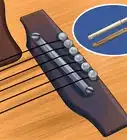
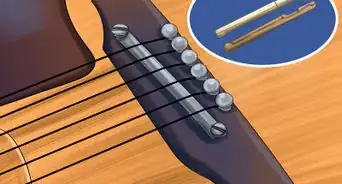
1Reset the guitar neck if the bridge and saddle heights are too low. The bridge is the long, wooden piece that secures the string along the base of the guitar, while the saddle is the white section on top of the bridge that’s directly beneath the strings. Take a close look: could you lower the bridge or saddle closer to the surface of the guitar? If both pieces are already low, you might need to reset the guitar neck.[23]
-
2Inspect the bridge for bulging and sinking. See if the space behind the bridge looks bulged, or if the front looks sunken in. If you notice either of these factors, don’t bother buying the guitar.[26]
-
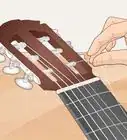
3Look over the headstock for past damage. Inspect the headstock for signs of wrinkles or ridges—this means that the headstock was repaired in the past. In general, guitars with previously damaged headstocks aren’t worth as much as unblemished guitars.[27]
- Headstock repairs are pretty pricey, can cost at least $150, depending on the damage.[28]


Community Q&A
Did you know you can get expert answers for this article?
Unlock expert answers by supporting wikiHow
-
QuestionShould I buy a used acoustic guitar?
 Carlos Alonzo Rivera, MACarlos Alonzo Rivera is a guitarist, composer, and educator based in San Francisco, California. He holds a Bachelor of Arts degree in Music from California State University, Chico, as well as a Master of Music degree in Classical Guitar Performance from the San Francisco Conservatory of Music. Carlos specializes in the following genres: classical, jazz. rock, metal and blues.
Professional GuitaristIf you want to! If you're looking for something really unique or you've got a special brand and model in mind, buying used may be a great way to get a deal. If you're just starting out and you haven't been playing for long, I'd just recommend buying a cheap starter guitar.
Support wikiHow by unlocking this expert answer.
-
QuestionHow much is a used acoustic guitar worth?Carlos Alonzo Rivera, MACarlos Alonzo Rivera is a guitarist, composer, and educator based in San Francisco, California. He holds a Bachelor of Arts degree in Music from California State University, Chico, as well as a Master of Music degree in Classical Guitar Performance from the San Francisco Conservatory of Music. Carlos specializes in the following genres: classical, jazz. rock, metal and blues.
Professional GuitaristIt totally depends on the make, model, and condition. It could be worth $10 or $1,000. There are just so many variables that play into this.Support wikiHow by unlocking this expert answer.
-
QuestionWhat's the most important thing to look for when buying a used guitar?Carlos Alonzo Rivera, MACarlos Alonzo Rivera is a guitarist, composer, and educator based in San Francisco, California. He holds a Bachelor of Arts degree in Music from California State University, Chico, as well as a Master of Music degree in Classical Guitar Performance from the San Francisco Conservatory of Music. Carlos specializes in the following genres: classical, jazz. rock, metal and blues.
Professional GuitaristObviously, you don't want to buy a used guitar with any cracks or damage. Also, you want to make sure that the guitar is comfortable for you to play, and that it sounds good when you play notes and chords.Support wikiHow by unlocking this expert answer.
References
- ↑ https://acousticguitar.com/how-to-shop-for-a-used-guitar/
- ↑ Carlos Alonzo Rivera, MA. Professional Guitarist. Expert Interview. 27 August 2019.
- ↑ Carlos Alonzo Rivera, MA. Professional Guitarist. Expert Interview. 27 August 2019.
- ↑ https://www.long-mcquade.com/imgs/ckfinder/userfiles/files/Long%20%26%20McQuade%20Guitar%20Repair%20Price%20List.pdf
- ↑ https://www.guitartricks.com/blog/Buying-a-used-guitar
- ↑ https://www.guitarworld.com/acoustic-nation/acoustic-nation-how-buy-acoustic-guitar-guide-first-time-buyer
- ↑ Carlos Alonzo Rivera, MA. Professional Guitarist. Expert Interview. 27 August 2019.
- ↑ https://www.ericdaw.com/repair-price-list/
- ↑ https://www.guitartricks.com/blog/Buying-a-used-guitar
- ↑ https://www.premierguitar.com/articles/21551-guitar-shop-101-tips-for-buying-a-used-flattop
- ↑ https://m.youtube.com/watch?v=PpZyeRVjq_s&t=6m11s
- ↑ https://www.guitarnoise.com/lessons/how-to-buy-a-used-acoustic-guitar/
- ↑ https://www.thirdcoastguitar.com/repair-estimates
- ↑ https://m.youtube.com/watch?v=PpZyeRVjq_s&t=1m8s
- ↑ https://www.thirdcoastguitar.com/repair-estimates
- ↑ https://www.guitarnoise.com/lessons/how-to-buy-a-used-acoustic-guitar/
- ↑ https://www.guitarnoise.com/lessons/how-to-buy-a-used-acoustic-guitar/
- ↑ https://m.youtube.com/watch?v=PpZyeRVjq_s&t=7m53s
- ↑ https://www.guitarnoise.com/lessons/how-to-buy-a-used-acoustic-guitar/
- ↑ https://pedals.thedelimagazine.com/5-tips-to-buying-a-used-or-vintage-acoustic-guitar/
- ↑ https://www.premierguitar.com/articles/21551-guitar-shop-101-tips-for-buying-a-used-flattop?page=3
- ↑ https://www.thirdcoastguitar.com/repair-estimates
- ↑ https://www.guitarnoise.com/lessons/how-to-buy-a-used-acoustic-guitar/
- ↑ https://pedals.thedelimagazine.com/5-tips-to-buying-a-used-or-vintage-acoustic-guitar/
- ↑ https://acousticbox.com/prices/
- ↑ https://www.guitarnoise.com/lessons/how-to-buy-a-used-acoustic-guitar/
- ↑ Carlos Alonzo Rivera, MA. Professional Guitarist. Expert Interview. 27 August 2019.
- ↑ https://acousticbox.com/prices/
- ↑ https://www.guitarnoise.com/lessons/how-to-buy-a-used-acoustic-guitar/
- ↑ https://www.guitarworld.com/acoustic-nation/acoustic-nation-how-buy-acoustic-guitar-guide-first-time-buyer
- ↑ https://www.guitarworld.com/acoustic-nation/acoustic-nation-how-buy-acoustic-guitar-guide-first-time-buyer
About This Article