This article was co-authored by Ben Barkan. Ben Barkan is a Garden and Landscape Designer and the Owner and Founder of HomeHarvest LLC, an edible landscapes and construction business based in Boston, Massachusetts. Ben has over 12 years of experience working with organic gardening and specializes in designing and building beautiful landscapes with custom construction and creative plant integration. He is a Certified Permaculture Designer, is licensed Construction Supervisor in Massachusetts, and is a Licensed Home Improvement Contractor. He holds an associates degree in Sustainable Agriculture from the University of Massachusetts Amherst.
There are 17 references cited in this article, which can be found at the bottom of the page.
This article has been viewed 9,112 times.
Bugs and other creepy crawlers are a nuisance for many gardening enthusiasts, but not everyone likes the idea of covering their plants with harsh chemicals in order to get rid of them. For these people, insecticides made with all-natural organic compounds can provide a useful alternative. When choosing an organic insecticide, it’s important to read the ingredients list closely to make sure it’s safe to use on your plants and follow the instructions outlined on the label to keep your garden healthy and thriving.
Steps
Part 1
Part 1 of 3:Getting the Right Product
-
1Identify the type of pest you’re dealing with. Before you can begin eradicating the pests that have invaded your garden, you’ll first need to learn what they are. Inspect your plants closely, paying attention to the physical characteristics of any insects you happen to spot. You can then run an internet search or consult a horticulture specialist to get more information about what they are and how to get rid of them.[1]
-
2Decide whether or not your plants require treatment. Take a minute to assess the severity of the problem, as well. One or two bugs isn’t a cause for alarm, but a full-fledged infestation will need to be dealt with immediately. Determining how serious the situation is will also help give you an idea of how much and what kind of insecticide you'll need.[4]
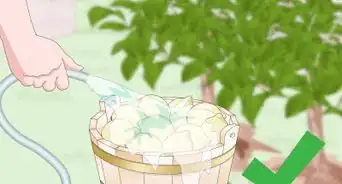
- If you only spot a few bugs, you may be able to simply brush them off by hand or blast them away using a garden hose.[5]
- Don't forget to check the backs of the stalks and the undersides of the leaves, as well. Insects can often be found hiding in shady, out-of-the-way places.
Advertisement -
3Make sure the insecticide you choose is safe to use on your plants. While organic insecticides tend to be gentler than chemical treatments, some may contain potent ingredients that aren’t a good mix with certain plants. Lime sulfur, for instance, can burn through foliage if applied in hot weather conditions. You’ll usually be able to find out what sorts of plants a product is designed to treat by reading the label.[6]
- Even organic pesticides can weaken or kill healthy growth if applied too frequently, or in too high a concentration.
- Be particularly careful about applying insecticides to seedlings or plants suffering from blight or another type of fungal infection.
- For instance, general copper is certified organic, so you can apply it as a pesticide in an organic garden. However, it can build up over time, creating a heavy metal problem in the soil.[7]
-
4Check to see whether the product is officially certified. All commercial pesticides must be approved by the EPA before they can be sold. These products will bear a seal of approval somewhere on the packaging, which indicates that they’re safe for the environment and for the people using them.[8]
- Organic pesticides should also feature a seal from the USDA confirming their organic status. It’s necessary for these solutions to be made from at least 70% natural compounds in order to qualify for the “organic” label.[9]
- Don’t buy a product if it doesn’t have a seal on it, or if it doesn’t contain at least 70% organic ingredients.
Advertisement


Part 2
Part 2 of 3:Shopping around for Organic Insecticides
-
1Visit your local gardening center. Not only are these places the most likely to carry the treatments you need, they’ll also have a more extensive selection. Greenhouses are another option, if you happen to have one in your area.
- While you’re there, consult the gardening specialists on staff about your pest problem. They’re trained to identify common species of invading insects, and will be able to tell you how best to eliminate them.
- It might also help to buy seeds or clippings of other plants that are known to protect against pests, like lavender, clover or chrysanthemums.[10]
-
2Browse the supermarket or pharmacy. The gardening center at big commercial outlets like Walmart might also have the products you’re looking for. Remember to scan for the EPA and USDA labels to make sure the pesticide you buy is organic and environmentally safe.
- Organic pesticides don’t tend to be as readily available as their chemical counterparts, so there’s no guarantee you’ll be able to find them at chain stores.
-
3Buy the product you need online. Search for organic insecticides on retail websites that specialize in natural gardening methods. The product listings will present you with a snapshot of everything you need to know about a treatment and how to apply it. You may also be able to find articles on related topics, including how to prevent pests from moving in in the first place.[11]
- The internet is one of your best resources when it comes to gathering information about pests and pesticides.
- Be sure to include important key terms like the species of plant that’s under attack and the type of insects that are to blame.
-
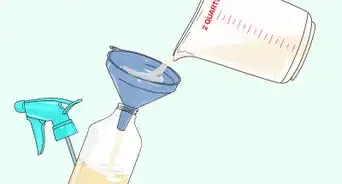
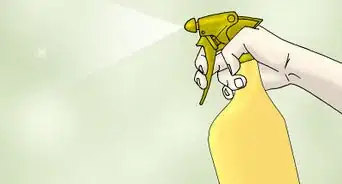
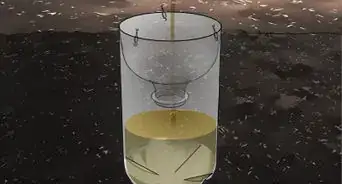
4Try a homemade remedy. In addition to commercial pesticides, you could also try mixing up your own DIY natural repellents at home. Substances like hot peppers, essential oils, garlic, onions, or even liquid dish detergent can be combined with a little water to form a solution. Transfer the solution to a spray bottle and mist it onto the foliage of the plants wherever you see unwanted insects.[12]
- Apply homemade solutions once or twice a day every 5-7 days until you begin to see an improvement.[13]
- Detergents and other substances like hydrogen peroxide are known as “contact pesticides,” which means they’ll need to be applied directly to insects to be effective.
- If you’re unable to find a suitable product, you could always pick up the components you need to whip up your own solution at home.
Advertisement


Part 3
Part 3 of 3:Applying Organic Insecticides
-
1Read the label first. Always look over the included instructions before you attempt to apply a commercial insecticide. They may include special directions that are worth knowing, like the best weather conditions or time of day to use the product. It can also make a difference to target the soil or roots of the plants as opposed to the foliage.[14]
- Using pesticides haphazardly can end up doing more harm to your plants than good.
- For homemade remedies that don’t come with instructions, it’s a good idea to err on the side of caution and use a lower concentration. You can reapply the solution later if it doesn’t do the trick right away.[15]
-
2Spray on liquid products. Mist the leaves thoroughly, making sure to cover them as evenly as possible. Use only as much as recommended for each application. If you’ve selected a contact pesticide, you’ll need to spray the insects themselves in order to get the desired effect.[16]
- Some liquid insecticides come prepackaged in convenient spray bottles. Others may need to be transferred to a sprayer or hooked up to a hose before you can use them to treat your garden.
- For your own protection, make sure you're wearing the proper safety gear: long sleeved clothing, thick rubber gardening gloves, eye protection and a facemask or respirator if available.[17]
-
3Sprinkle powdered pesticides over the plant. These can be sifted using a hand duster or simply placed in a separate container in the correct amount and shaken out. When using an insecticide in powdered or granulated form, it will usually be necessary to distribute some over the soil at the base of the plant, as well.[18]
- Use a spray bottle filled with water to wet the leaves of plants before applying a powdered product. This will help the pesticide stick better.
- Substances like food-grade diatomaceous earth can be spread by hand if no other tools are available.[19]
-
4Repeat as needed. Most insecticides act quickly, but they won’t work overnight. Wait 7-10 days after the initial application before following up with a second. In the meantime, keep an eye on the plants to see if the problem clears up. Within a few weeks, your garden will most likely be back to normal.
- Try not to expose your garden to foreign substances like insecticides more frequently than is absolutely necessary. Even if they’re safe to use on plants, they may be harmful to beneficial insects and other wildlife.[20]
- Homemade treatments can be employed on the spot whenever you notice insects swarming in large numbers.
Advertisement


Community Q&A
-
QuestionHow do you make organic pesticides at home?
 Ben BarkanBen Barkan is a Garden and Landscape Designer and the Owner and Founder of HomeHarvest LLC, an edible landscapes and construction business based in Boston, Massachusetts. Ben has over 12 years of experience working with organic gardening and specializes in designing and building beautiful landscapes with custom construction and creative plant integration. He is a Certified Permaculture Designer, is licensed Construction Supervisor in Massachusetts, and is a Licensed Home Improvement Contractor. He holds an associates degree in Sustainable Agriculture from the University of Massachusetts Amherst.
Garden & Landscape DesignerSoap and water or neem oil are good homemade options. Sometimes, just spraying plants with soap and water or neem oil can get rid of pests. -
QuestionHow do you make a natural pesticide?
 Maggie MoranMaggie Moran is a Professional Gardener in Pennsylvania.
Home & Garden SpecialistYou can make a natural pesticide with garlic. Crush about 5 bulbs worth of peeled cloves. Mix the crushed cloves with 17 oz of hot water and allow the garlic to infuse into the water for around 6 hours. Add in a little dish soap and pass it through a fine strainer. You can dilute this solution with 1 gallon of water and add to a spray bottle. -
QuestionIs Dawn an insecticidal soap?Maggie MoranMaggie Moran is a Professional Gardener in Pennsylvania.
Home & Garden SpecialistYes, when added to vegetable oil and soft water, it creates a pesticide. Be sure to use Dawn soap without bleach, as that can harm the plants. -
QuestionWhat is the best natural insect repellent?Maggie MoranMaggie Moran is a Professional Gardener in Pennsylvania.
Home & Garden SpecialistLemon Eucalyptus oil has been used since the 1940s and is a good natural insect repellent. -
QuestionWhat is an organic insecticide?Maggie MoranMaggie Moran is a Professional Gardener in Pennsylvania.
Home & Garden SpecialistOrganic insecticides are chemicals used to repel insects from plants and are made with all organic ingredients. -
QuestionHow do I stop an infestation of caterpillars or moths?
 Community AnswerStart with a natural powdered pesticide like diatomaceous earth. If that doesn't work, you can begin applying homemade remedies like a soap solution or hot pepper or allium (pungent plants like garlic, onions, shallots and cloves) infusion. If the problem still persists, you may need to invest in a stronger commercial insecticide that will eliminate the pests once and for all.
 -
QuestionWhat's best to use for hydrangea plants?
 Community AnswerTo avoid damaging the flowers, try picking unwanted insects off by hand or spraying them gently with a hose. After that, move on to mild DIY remedies. Only treat flowering plants with commercial insecticides as a last resort, as these can interfere with the healthy development of the plant.
Warnings
- Despite being made from natural ingredients, organic insecticides should be handled with caution. It may be unsafe to inhale or ingest even the mildest homemade remedies.Thanks!
- Use caution even when using organic products near children or pets, especially if you keep pet food or water near the treated plants.Thanks!
- Store any unused product in its original container in a cool, dry, well ventilated area, and make sure it is out of the reach of children and pets.Thanks!

References
- ↑ https://www.rodalesorganiclife.com/garden/top-ten-garden-insect-pests
- ↑ https://www.planetnatural.com/pest-problem-solver/garden-pests/
- ↑ https://www.lowes.com/projects/lawn-and-garden/pesticide-buying-guide/project
- ↑ https://www.fix.com/blog/common-garden-pests-and-how-to-get-rid-of-them/
- ↑ http://www.naturallivingideas.com/12-organic-ways-get-rid-aphids/
- ↑ http://web4.audubon.org/bird/at_home/pdf/3rd_ed_Guide_pg2.pdf
- ↑ Ben Barkan. Garden & Landscape Designer. Expert Interview. 14 April 2020.
- ↑ https://www.epa.gov/pesticide-registration/prn-2003-1-labeling-pesticide-products-under-national-organic-program
- ↑ https://www.usda.gov/media/blog/2012/03/22/organic-101-what-usda-organic-label-means
- ↑ http://www.organicauthority.com/organic-gardening/flowers-to-plant-in-your-garden-for-natural-pest-control.html
- ↑ http://www.doh.wa.gov/CommunityandEnvironment/Contaminants/Pesticides/BuyingPesticidesOnline
- ↑ http://www.naturallivingideas.com/homemade-organic-pesticides/
- ↑ http://www.motherearthnews.com/organic-gardening/organic-pesticides-zmaz94fmzraw
- ↑ https://www.lowes.com/projects/lawn-and-garden/pesticide-buying-guide/project
- ↑ http://www.motherearthnews.com/organic-gardening/organic-pesticides-zmaz94fmzraw
- ↑ https://www.youtube.com/watch?v=EUEXRKkO4Z4
- ↑ http://nasdonline.org/909/d000749/wear-protective-clothing-when-applying-pesticides.html
- ↑ https://www.lowes.com/projects/lawn-and-garden/pesticide-buying-guide/project
- ↑ https://www.youtube.com/watch?v=H-Pb0Ey9r0E&feature=youtu.be&t=75
- ↑ http://www.motherearthnews.com/organic-gardening/pest-control/pest-control-organic-pesticides-zl0z1305zkin
About This Article