This article was co-authored by wikiHow staff writer, Sophia Latorre. Sophia Latorre is a Content Manager on the wikiHow team. Before joining wikiHow, Sophia worked as a technical editor and was published in six International Energy Agency (IEA) Wind Annual Reports. Now, she writes, edits, and reviews articles for the wikiHow Content Team, working to make the content as helpful as possible for readers worldwide. Sophia holds a BA in English from Colorado State University.
There are 16 references cited in this article, which can be found at the bottom of the page.
This article has been viewed 1,619 times.
Learn more...
While the main reason many people start a keto diet (or ketogenic diet) is for weight loss, research shows that it’s possible to stick to one and gain muscle, too. When you’re in ketosis, your body burns fat instead of glucose, but that doesn’t mean you can’t bulk up! With the right diet and exercise techniques, you can lose excess fat and increase muscle growth so you look your best.
Steps
Method 1
Method 1 of 2:Eating Right
-
1Eat 15% more calories than you burn. In order to build muscle, your body needs extra fuel.[1] Figure out how many calories you burn on a daily basis, then add 15%. Aim to eat that many calories each day so you have enough calories stored to gain muscle.[2]
- For instance, if you burn 2,000 calories, eat about 2,300 calories (2,000 x 1.15).
-
2Include lots of protein in your diet. Protein helps you build muscle, so it’s an important part of your diet if you’re trying to maximize your gains. To increase muscle mass in general, experts recommend that you eat 1.6-2.2 g of protein per 1 kilogram (2.2 lb) of your body weight every day.[3] If you’re not already eating that much, increase your protein intake. Be wary of going overboard, though—too much protein can be bad for your health.[4]
-
3Limit your carb intake to 50 grams or less. You probably know that a keto diet is a low-carb diet, so in order to stay in ketosis, you have to restrict your carbohydrate intake. Studies show that eating 20-50 grams of carbs per day while on a 2,000-calorie diet is few enough to keep you in ketosis. This means that about 5-10% of your calories should come from carbs.[7]
- Eat your carbs before or after you exercise if you’re sticking to a targeted keto diet.
- People who eat a traditional American diet consume up to 350 grams of carbs per day, so you’ll be eating significantly less than that.
-
4Make healthy fats a staple of your diet. In addition to being low-carb, keto is a high-fat diet. Fat is really important on the keto diet since your body burns it for fuel and it will be your main source of energy. In fact, 55-60% of your calories should come from fat.[8]
-
5Stick with leafy greens for veggies. Fruits and vegetables are typically pretty high in carbs, so only eat those in small amounts. Leafy greens, though, like spinach, kale, and Swiss chard, as well as Brussels sprouts, broccoli, cauliflower, asparagus, cucumber, squash, celery, onions, garlic, and mushrooms are good low-carb options.[11]


Method 2
Method 2 of 2:Adjusting Your Exercise Routine and Lifestyle
-
1Expect your workouts to feel tougher at first. Because you’re not eating many carbs, your body has to work harder to obtain energy. Rather than relying on glycogen stores, your body must convert fat to energy. Don’t worry though—you’ll adjust pretty quickly, so your strength will return.[12]
- Don’t be surprised if you notice a difference in your exercise performance for a few days after you go keto.
-
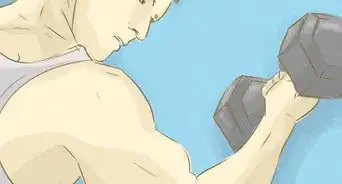
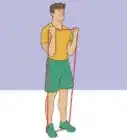
2Focus on resistance training. In order to gain muscle mass, incorporate strength training, like lifting weights or using an exercise band, into your daily routine. This will help you gain lean body mass and build muscle![13] On the flip side, cardio contributes to weight loss, so keep that to a minimum if your main goal is muscle growth.
- Do resistance-training workouts at least twice a week.[14] You could bench press and do squats, pull-ups, and push-ups, for instance.
- Work with a personal trainer if you need some guidance for weight training.
-
3Track your calorie intake. If you’re not used to counting calories, it can be a little tedious at first. Don’t give up, though—write down everything you eat so you can ensure you’re getting adequate protein and fat to maximize your keto gains.[15]
- There are lots of apps online that can make this easier, so feel free to take advantage of them!
-
4Stay hydrated. Did you know that foods that are high in carbs help you retain water? That means that if you reduce your carb intake, you’re probably not retaining as much water. To compensate, drink more water![16]
- Maintain the proper electrolyte levels, as well.
-
5


Warnings
- Take steps to avoid keto flu if you’re just starting this diet, which can drain your energy levels.Thanks!
- This type of diet is pretty strict, so it’s hard to maintain long-term as a weight loss diet.[20] It’s not typically something you could do for your entire life.Thanks!
- Doing a keto diet long-term could increase your risk of osteoporosis and kidney stones.[21]Thanks!
-Step-24.webp)
References
- ↑ https://www.frontiersin.org/articles/10.3389/fnut.2019.00131/full
- ↑ https://pubmed.ncbi.nlm.nih.gov/15107010/
- ↑ https://pubmed.ncbi.nlm.nih.gov/29497353/
- ↑ https://www.health.harvard.edu/nutrition/when-it-comes-to-protein-how-much-is-too-much
- ↑ https://www.ncbi.nlm.nih.gov/books/NBK234922/
- ↑ https://www.eatright.org/fitness/training-and-recovery/building-muscle/strength-building-and-muscle-mass
- ↑ https://www.ncbi.nlm.nih.gov/books/NBK499830/
- ↑ https://www.ncbi.nlm.nih.gov/books/NBK499830/
- ↑ https://www.ncbi.nlm.nih.gov/books/NBK499830/
- ↑ https://www.heart.org/en/healthy-living/healthy-eating/eat-smart/fats/polyunsaturated-fats
- ↑ https://www.health.harvard.edu/staying-healthy/should-you-try-the-keto-diet
- ↑ https://www.shape.com/healthy-eating/diet-tips/keto-bodybuilding-diet
- ↑ https://pubmed.ncbi.nlm.nih.gov/28399015/
- ↑ https://pubmed.ncbi.nlm.nih.gov/27102172/
- ↑ https://www.shape.com/healthy-eating/diet-tips/keto-bodybuilding-diet
- ↑ https://www.shape.com/healthy-eating/diet-tips/keto-bodybuilding-diet
- ↑ https://pubmed.ncbi.nlm.nih.gov/21550729/
- ↑ https://www.mayoclinic.org/healthy-lifestyle/adult-health/expert-answers/how-many-hours-of-sleep-are-enough/faq-20057898
- ↑ https://www.shape.com/healthy-eating/diet-tips/keto-bodybuilding-diet
- ↑ https://www.mayoclinic.org/is-the-keto-diet-for-you-a-mayo-expert-weighs-in/art-20457595
- ↑ https://www.hsph.harvard.edu/nutritionsource/healthy-weight/diet-reviews/ketogenic-diet/

-Step-24.webp)










































Medical Disclaimer
The content of this article is not intended to be a substitute for professional medical advice, examination, diagnosis, or treatment. You should always contact your doctor or other qualified healthcare professional before starting, changing, or stopping any kind of health treatment.
Read More...