This article was co-authored by Pippa Elliott, MRCVS. Dr. Elliott, BVMS, MRCVS is a veterinarian with over 30 years of experience in veterinary surgery and companion animal practice. She graduated from the University of Glasgow in 1987 with a degree in veterinary medicine and surgery. She has worked at the same animal clinic in her hometown for over 20 years.
There are 14 references cited in this article, which can be found at the bottom of the page.
wikiHow marks an article as reader-approved once it receives enough positive feedback. In this case, 86% of readers who voted found the article helpful, earning it our reader-approved status.
This article has been viewed 64,343 times.
Blue gouramis are a relatively easy fish to breed. They are so easy to breed, in fact, that you don't keep males and females in the same tank until you are ready for them to spawn. Nonetheless, you still need to create the right environment for the fish to spawn before putting them together.
Steps
Part 1
Part 1 of 3:Creating the Right Environment
-
1
-
2Add hiding places. In addition, the female needs place where she can hide. The reason for this step is the same as the reason for having a large tank. The male may be too intrusive and threatening while breeding.[3]
- You can use items like driftwood and decorations to create hiding places. You can also use rocks for this purpose. Make sure you buy items that are meant for the aquarium.[4]
-
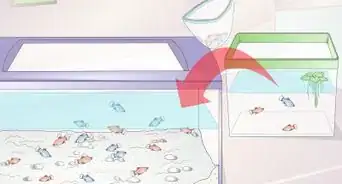
3Have three total tanks. Once your female has had her babies, she will need to be removed.[5] Similarly, once the babies hatch, you'll need to take the male out. That means you need a tank each for the male, female, and the babies.[6]
- The other two tanks that are not for breeding can be 20 gallons each. You can house other fish in these aquariums. Fish that are approximately the same size work best.[7]
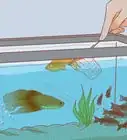
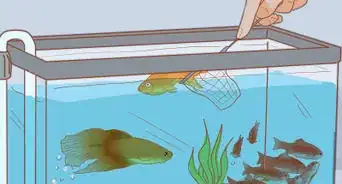
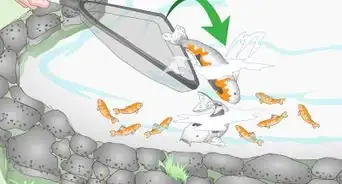
- To scoop up a fish, you can remove some of the plant life and lower the water in the tank to make it easier to catch the fish.[8]
- To acclimate the fish to the new tank, you can treat it like bringing a new fish home. That is, place it in a smaller container or plastic bag with some of the old tank water. Add a cup of the new water and let it sit for 10 minutes before adding just the fish to the new tank.[9]


Part 2
Part 2 of 3:Triggering Breeding
-
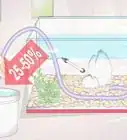
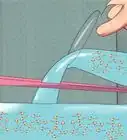
1Make the water shallower. Gouramis respond to a change in the depth of the water. When it becomes less deep, they are more likely to breed than when it is deeper. Remove some of the water from the tank to make the depth shallower to encourage breeding.[10]
- The tank can be as low as 6 inches for breeding.[11]
-
2Add floating plants. Male gouramis build a bubble nest for their young. To do so, they need plant leaves at the surface. Therefore, you need to add plants to the aquarium to allow them to breed.[12]
- Ricca is a common floating plant used with gouramis. However, you can also use fake floating plants designed for aquariums.[13]
-
3


Part 3
Part 3 of 3:Breeding the Fish
-
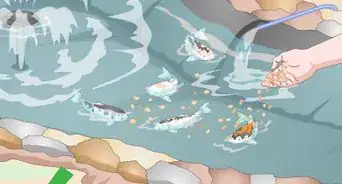
1Feed the breeding pair extra. Before you introduce the pair, you should be offering them live food or frozen food. You can offer this food a couple of times a day in small portions.[16]
-
2Introduce a male and female. Place a male gourami and a female gourami in the breeding tank you've prepared. You don't need to do anything special to introduce the pair except placing them in the same tank.[19]
- You should only have one breeding pair in the tank at a time.
-
3Look for the bubble nest. The male will build a bubble nest. It may be in a corner[20] or under a floating plant leaf.
- Usually, the nest will be at the surface. The male creates bubbles with his saliva that form a nest. He will often join it with the side of the tank or a leaf to help it hold together.[21]
-
4Wait for the female to lay eggs. Watch the nest to see when the female lays her eggs in it. Once she does, you will need to take her to another tank.[22] A female gourami can lay a large amount of eggs, up to 800.[23]
- The male of the species actually becomes the protector of the eggs. In fact, he becomes so protective that he will attack the female if she approaches. Therefore, she needs to be taken away so she isn't harmed and the male can be at peace. In fact, you may not be able to see the eggs due to the bubbles, but you should be able to notice the male staying close to the nest.
-
5Look for the hatching eggs. When the fry start swimming, you should remove the male to another tank (not the same one as the female). You need to remove him because he could start eating the fry once they start swimming.[24]
- The fry will hatch in a day, but they won't start swimming for four days. You need to remove the male before they start swimming.
-
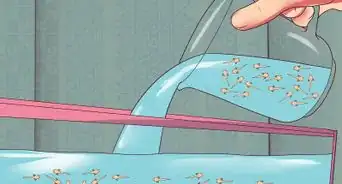
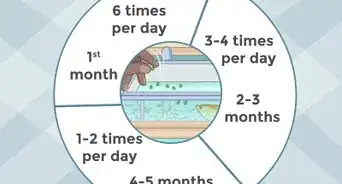
6Feed the babies. You have two main options for feeding the babies. You can either feed them infusoria, which are microworms you find at the local pet store, or liquid fry food, which you can also probably find at your pet store.[25]
- Once they get large enough, they can eat baby shrimp. Your fish should be able to eat these in about a week.[26]



References
- ↑ http://www.fishchannel.com/fish-species/freshwater-profiles/blue-gourami-2.aspx
- ↑ http://www.fishchannel.com/fish-species/freshwater-profiles/blue-gourami-2.aspx
- ↑ http://www.fishchannel.com/fish-species/freshwater-profiles/blue-gourami-2.aspx
- ↑ http://www.newyorktails.com/fishtank.htm
- ↑ http://www.fishchannel.com/fish-species/freshwater-profiles/blue-gourami-2.aspx
- ↑ http://animal-world.com/encyclo/fresh/anabantoids/bluegourami.php
- ↑ http://www.liveaquaria.com/product/prod_display.cfm?c=830+882+973&pcatid=973
- ↑ http://www.fishchannel.com/freshwater-aquariums/aquarium-care/netting-catching-aquarium-fish.aspx
- ↑ http://www.hartz.com/Fish/Habitat/How_to_Introduce_New_Fish_into_Your_Aquarium_Tank.aspx
- ↑ http://www.fishpondinfo.com/breed.htm
- ↑ http://animal-world.com/encyclo/fresh/anabantoids/bluegourami.php
- ↑ http://www.fishpondinfo.com/breed.htm
- ↑ http://www.fishpondinfo.com/breed.htm
- ↑ http://animal-world.com/encyclo/fresh/anabantoids/bluegourami.php
- ↑ http://animal-world.com/encyclo/fresh/anabantoids/bluegourami.php
- ↑ http://animal-world.com/encyclo/fresh/anabantoids/bluegourami.php
- ↑ http://www.petguide.com/breeds/fish/paradise-fish/
- ↑ https://www.aqua-fish.net/articles/types-aquarium-fish-food-answers
- ↑ http://animal-world.com/encyclo/fresh/anabantoids/bluegourami.php
- ↑ http://animal-world.com/encyclo/fresh/anabantoids/bluegourami.php
- ↑ http://www.fishpondinfo.com/breed.htm
- ↑ http://www.fishkeeping.co.uk/modules/caresheets/caresheet.php?caresheetID=196
- ↑ https://sta.uwi.edu/fst/lifesciences/documents/Trichopodus_trichopterus.pdf
- ↑ http://animal-world.com/encyclo/fresh/anabantoids/bluegourami.php
- ↑ http://animal-world.com/encyclo/fresh/anabantoids/bluegourami.php
- ↑ http://animal-world.com/encyclo/fresh/anabantoids/bluegourami.php
About This Article

To breed blue gouramis, start by setting up a shallow 30-gallon tank to breed your fish in. Then, add floating plants so your fish have somewhere to make a nest, and increase the temperature to 80 degrees Fahrenheit since gouramis prefer to breed in warm water. Next, place a male and female gourami in the tank, and wait for them to breed. Once the female lays eggs and the eggs hatch, remove the male and female, and place them in separate tanks. For more tips from our Veterinary co-author, like how to care for the baby fish, scroll down!