This article was co-authored by wikiHow Staff. Our trained team of editors and researchers validate articles for accuracy and comprehensiveness. wikiHow's Content Management Team carefully monitors the work from our editorial staff to ensure that each article is backed by trusted research and meets our high quality standards.
This article has been viewed 10,544 times.
Learn more...
Everyone wears watches. However, it's rare to come across someone who is a professional watchmaker. This is partly due to increased automation in the industry, resulting in fewer watchmakers entering the workforce. Yet, there is still a vibrant community that loves to see new watchmakers rise to their greatest potential, whether it be through an apprenticeship, or through a watchmaking school.
Steps
Method 1
Method 1 of 3:Learning the Anatomy of a Watch
-
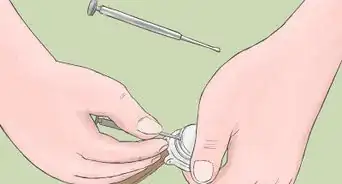
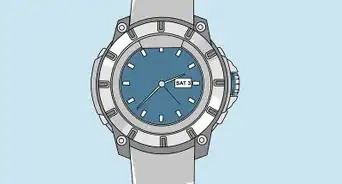
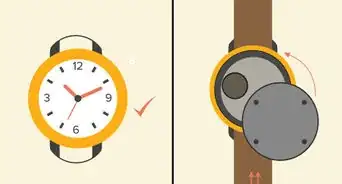
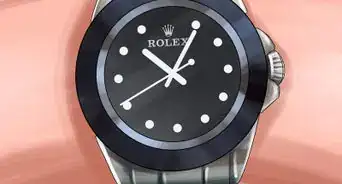
1Learn the basics from home. Before searching for apprenticeships, you should work on growing your knowledge of watchmaking. An expansive knowledge of watchmaking will make you more employable. Take apart a watch that you won't mind getting damaged. Then, try to put it together again. This will help you understand the anatomy of a watch.
- Take notes or draw diagrams that you can refer to once the watch is reassembled.
-
2Memorize different types of watch casings. Most watch faces are round. This shape is known as a watch casing. However, watch casings can take the shape of rectangles, ovals, or squares. These shapes are easy to learn, but you'll need to have an expansive knowledge of less common types of watch casings too.[1]
- Carriage watch casings look like a circle that has been squished inwards.
- Tonneau watch casings appear to have a straight top and bottom but curved sides.
- Carre watch casings have a curved top and bottom but straight sides.
-
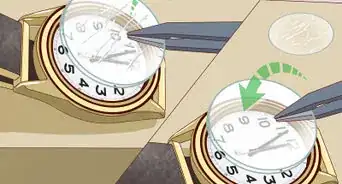
3Identify the crystal covering the face of the watch. All watches have a thin crystal layer covering the watch face. The most common types of watch casings are synthetic sapphire crystal, mineral crystal, and acrylic crystal.[2]
- Sapphire is a very hard material, bested only by diamond. Watchmakers use lab synthesized sapphire to utilise its natural hardiness. This crystal is expensive, but very tough.
- Mineral crystal is a form of glass. Mineral crystal is relatively inexpensive. However, the material scratches easily, and it cannot be buffed out. Mineral crystal needs to be replaced in order to appear new again.
- Acrylic crystal is the cheapest form of crystal covering. It is made out of plastic and can scratch easily. Acrylic crystal scratches can be buffed out. It is the weakest crystal of the 3.
-
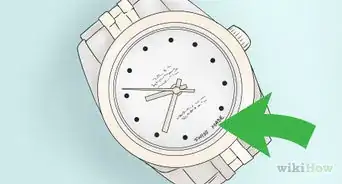
4Note the style of the dial on a watch. The 'dial' of a watch refers to how the numbers are notated on the outside. Some dials use numbers around the outside. This is the Arabic style. Others dials use roman numerals, which is known as the Roman style. Small straight lines instead of numbers indicates a Stick style.[3]
-
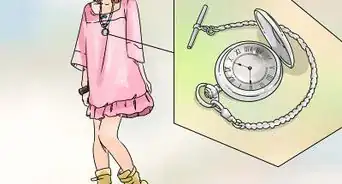
5Notice the style of strap on the watch. When you're making a watch you also need to consider the style of strap attached. Most watches use metal straps or leather straps. A metal strap uses buckled segments to form a strap around the wrist. This is a tough strap, but some find it uncomfortable. Some prefer a leather strap with a buckle to adjust tightness, but leather is less durable.[4]
-
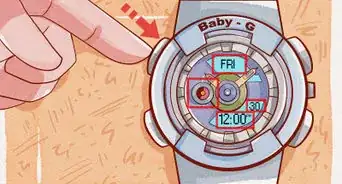
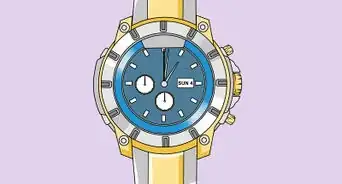
6Note the pushers and the crown. The 'crown' is the small knob which lies on the side of the watch. This large knob is surrounded by two smaller buttons known as 'pushers'. The pushers and crown are usually made of steel. The crown winds the clock to a certain time. The pushers control tertiary functions such as timers or stopwatches.
-
7Remember to consider smart watches as you learn. Smart watches are growing in popularity. Although there is still a sizeable market for a traditional watch, consider looking into the basic engineering behind a smart watch. Consider how to fit a larger battery into the chassis of the watch. Research wireless charging to understand how smart watches function.
- Hybrid watches use elements of smart watches, such as connectivity with smart phones, but they still retain the outer look of a classic watch.
- Continue learning the parts of a watch by looking at diagrams online.


Method 2
Method 2 of 3:Becoming an Apprentice Watchmaker
-
1Search for apprenticeship opportunities. If you live in a city, find local watchmakers and ask them if they are taking on apprenticeships. You may need to travel to a place with a watchmaker if you don't live near one. You can search online for watchmakers seeking apprentices, or large companies offering apprenticeships.[5]
- Try to meet watchmakers in person so that you can show your passion for learning the craft.
-
2Do your best to make a good impression on a watchmaker. Some watchmakers may be resistant to the idea of taking on an apprentice. Be respectful, kind, and considerate when talking with them. Demonstrating your watchmaking knowledge to the watchmaker will make you appear more employable.[6]
- Ask the watchmaker how you can help around the shop instead of asking them for a job.
- In an apprenticeship, you will be spending lots of your time learning from and being with the watchmaker. Chat with them face to face to figure out if you're a good match.
-
3Come to work eager to learn. If you're lucky enough to get taken on as an apprentice, show up to work eager and ready to learn from your new boss.[7] Demonstrate through daily dedication that you are a benefit to their business. Ask questions about the craft, take notes, and be helpful around the shop.
-
4Test your skills once you've learnt more. As you grow in knowledge and responsibility you will be given new opportunities to test your skills. The watchmaker may give you a watch to repair yourself. Use the knowledge you've gathered so far to rise to the task.
-
5Strike out on your own or stay with your employer. If you've gathered enough experience as an apprentice, ask yourself whether you are ready to move on. If the answer is yes, you should consider striking out on your own or asking to become a full-time employee at your employer's shop.
- Starting a watchmaking shop is tough due to the general lack of demand. Starting your own business will give you the most independence, but it will be financially risky.
- Try to apply to a large watch manufacturer for a job. These jobs are generally quite rare, so you'll be lucky if you can get one.
- You can further your watchmaking skills by attending watchmaking school.


Method 3
Method 3 of 3:Going to Watchmaking School
-
1Gather experience before applying for a school. Most countries only have 1 or 2 watchmaking schools. To become a successful applicant you will need to stand out. Read as many watchmaking books as you can, immerse yourself in the culture by reading about the latest models, or embark on an apprenticeship. The more experience you have under your belt, the more employable you'll look.
- The British School of Watchmaking only accept 8 students annually. This is typical for a watchmaking school, so you need to stand out.[8]
- Watchmaking is learnt by doing. Get some hands on experience repairing, modifying, and constructing watch mechanisms.
-
2Pass the entrance exams. Watchmaking schools will accept lots of applications, but they'll only accept the highest scorers into the school. Each school's exams will differ, but generally they will test your knowledge of a watches's anatomy and basic watchmaking skills.
- Get in contact with alumni of your chosen school. The community for watchmaking is small. Use any contacts you have to talk to those who've taken the entrance exams before.
-
3Come to school ready and eager to learn. Watchmaking schools hold full-time intensive skills courses that run for 30-40 hours a week. Dedication is key to getting the most out of the course. Get plenty of sleep every night and show up to class on time to make a good impression on your teachers.
-
4Pass the final exams. After your course concludes you'll need to tackle final exams. These examinations will cover practical and knowledge based skills. Revise every night for a month before the exams to refresh your memory on everything that you've learnt.
- Revision is key to passing an exam. Without putting the work in you may waste not just money, but time.[9]
-
5Apply for a job at a large-scale watch manufacturer. At watchmaking school you will make many contacts within the industry. Keep your ear to the ground for any opportunities at international watchmaking companies. Once they have an opening, send in your application. Your application will look much more appealing now that you have a qualification in watchmaking.
- Watches made by Omega, Hamilton or Calvin Klein are all made by the Swatch Group. You can search their open jobs here: http://www.swatchgroup.com/en/human_resources/job_offers
-
6Search for an apprenticeship if you want to grow your skill set. If you want to learn more about watches, search for an apprenticeship at a watchmaking shop. With academic qualifications, you are a much more attractive candidate for a professional watchmaker to take on as an apprentice. Look for the best watchmakers in your country and talk to them face to face.
- The IWC Foundation has opportunities for apprentice watchmakers, polymechanics, and designers: https://www.iwc.com/en/company/careers/apprenticeships.html
- The Institute for Apprenticeships in the UK works with several businesses to find positions for budding watchmakers: https://www.instituteforapprenticeships.org/apprenticeship-standards/watchmaker/
- The Swatch Group, a large multi-national organization, also offers apprenticeships: http://www.swatchgroup.com/human_resources/apprenticeships2




References
- ↑ http://www.tourneau.com/watch-education/watch-anatomy.html
- ↑ http://www.tourneau.com/watch-education/watch-anatomy.html
- ↑ http://www.tourneau.com/watch-education/watch-anatomy.html
- ↑ http://www.tourneau.com/watch-education/watch-anatomy.html
- ↑ https://www.smithsonianmag.com/smart-news/swiss-watchmaker-teaching-apprentices-for-free-180956891/
- ↑ https://www.allaboutschoolleavers.co.uk/articles/article/38/how-to-sell-yourself
- ↑ https://gothinkbig.co.uk/features/how-to-be-a-good-apprentice
- ↑ http://www.britishschoolofwatchmaking.co.uk/about/
- ↑ https://www.genietutors.co.uk/the-importance-of-revision/
About This Article