This article was co-authored by Better Business Bureau and by wikiHow staff writer, Hannah Madden. The Better Business Bureau, also known as the BBB, is a private, nonprofit organization focused on advancing marketplace trust. Founded in 1912, the BBB is a collection of 106 independently incorporated local BBB organizations in the United States and Canada coordinated under the International Association of Better Business Bureaus (IABBB) in Arlington, Virginia. The BBB provides direct services such as information about a company before you do business with it and with helping resolve a complaint you might have against a firm. The BBB also provides indirect services such as monitoring selling practices and alerting consumers to bad business and advertising practices. The BBB also provides accreditation to businesses, increasing their visibility and standards of integrity and excellence.
There are 7 references cited in this article, which can be found at the bottom of the page.
This article has been viewed 1,232 times.
Looking for a new job is stressful enough, but sifting through fake employers and postings can be equally exhausting. Giving out your personal info to a scammer can put your money and your identity at risk, so it’s important to be careful. We’ve compiled a list of a few ways you can avoid employment scams to look for a new job while keeping your information safe.
Steps
Method 1
Method 1 of 11:Look for jobs on reputable websites.
-
1Most employment websites vet their job postings. Sites like Indeed, Glassdoor, LinkedIn, Monster, CareerBuilder, Google for Jobs, and SimplyHired are great places to start your job search. The jobs listings are almost always legitimate, so you don’t have to worry as much about them.[1]
- Finding jobs on sites like Craigslist or Facebook Marketplace is fine, but you should always double check that they aren’t scams before you apply. Check out the company website or find the listing somewhere else to make sure the post is legit.

Method 2
Method 2 of 11:Stay away from jobs with catchy titles.
-
1Vague yet catchy titles are usually scams. Phrases like “Work at Home,” “No Experience Necessary,” “Make $1000 a Week,” and “Work Just One Hour a Week” are used by scammers a lot. If the listing has any of these phrases, it might not be legitimate.[2]
- This is especially true if it’s hard to figure out what the job actually is. If you can’t tell exactly what you’d be doing from the job posting, use caution when you apply.

Method 3
Method 3 of 11:Avoid clicking links in emails.
-
1A company will almost never send you a job offer directly. If you get an email from a company claiming to be legitimate, don’t click any links. Instead, head to the website directly and search through their jobs there.[3]
- An email from a free domain site like yahoo.com, gmail.com, or hotmail.com may also indicate that the job offer is a scam.

Method 4
Method 4 of 11:Don’t apply for jobs that seem too good to be true.
-
1Your gut is probably telling you that something’s wrong. If a job offers a huge salary for a very easy task, or it claims that you can make thousands of dollars only working a few hours per week, it’s probably fake. Anything that doesn’t seem like a real job offer is a warning sign.[4]
- Job postings that focus solely on the money to be made instead of the actual job duties are suspicious, and probably aren’t legitimate.
- Work from home jobs are more likely to be scams than any other jobs.[5]

Method 5
Method 5 of 11:Look up the name of the company.
-
1If you can’t find a website, proceed with caution. Some scammers will even set up websites for fake companies, so you can search the name plus “scam” or “fraud” to see if anyone has posted about them online. If you’re finding suspect information about them, it’s most likely a scam offer.[6]
- You can also search the Better Business Bureau to see if the company has any complaints lodged against them. Search their website by visiting https://bbblasv.org.

Method 6
Method 6 of 11:Don’t accept checks from potential employers.
-
1Employers will never send you a check and ask you to cash it for them. Scammers will often send people checks and ask people to pay them back with cash or gift cards. After that, the check will bounce, and you’ll be left without your money.[7]
- Scammers will also sometimes overpay you for a job and ask you to wire the excess money elsewhere. This is another scam that will cost you money, and it can be very difficult to get your money back.

Method 7
-
1Keep your info to yourself until you've thoroughly checked it out. Look at the company website, talk to the employer on the phone, and get a job offer in writing before you give them anything. Your name, address, ID, social security number, and bank account information can be used to steal your identity.[8]
- Legitimate jobs will need this information from you eventually, but only after you’ve gone through the application and interview process.

Method 8
Method 8 of 11:Don’t accept a job offer without an interview.
-
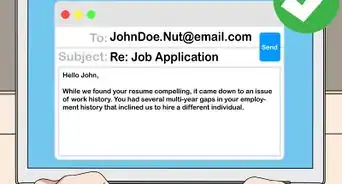
1Employers usually have you go through an interview process. If someone hires you based on your resumé alone, it’s a bad sign. While you may have an impressive job history, legitimate companies will still want to talk to you first before hiring you.[9]
- Even during peak seasons, most companies will still want to chat over the phone or via video call.

Method 9
Method 9 of 11:Get a contract and details in writing.
-
1If they can’t provide you with that, it’s probably a scam. Make sure you get documentation of what your job entails, how much you’ll be paid, and when your start date is. If you haven’t signed anything don’t do any work for the company.[10]
- If a potential employer is hesitant to send over a document, that’s a huge red flag. Do some more investigation of the company to see if it's legit or not.

Method 10
Method 10 of 11:Never pay to get a job.
-
1Legitimate job offers won’t require you to pay for them. If a job asks you for a deposit or insists you need to purchase a package or a training, it’s not real. A legitimate job will never ask you to pay to apply, either.[11]
- Some scams, like multi level marketing schemes, even ask you to purchase products that you can sell for a profit. These jobs are also not legitimate, and there is a high likelihood that you won’t be able to make your money back.

Method 11
Method 11 of 11:Don’t start working until you’re officially hired.
-
1If you haven’t signed a contract, don’t do any labor. Jobs that promise to pay you “later” or after you’ve completed a task are definitely scams. Only start working once you’ve received a job offer and signed a contract.[12]
- Even jobs that require training will have you sign a contract first.










-Step-7.webp)
References
- ↑ https://money.usnews.com/money/blogs/outside-voices-careers/articles/best-job-search-sites
- ↑ https://www.framingham.edu/the-fsu-difference/career-services/how-to-avoid-job-scams/
- ↑ https://www.framingham.edu/the-fsu-difference/career-services/how-to-avoid-job-scams/
- ↑ https://www.career.arizona.edu/jobs/avoiding-employment-scams
- ↑ https://www.forbes.com/sites/vanessamcgrady/2018/03/07/jobscam/?sh=3c4735c04df4
- ↑ https://www.consumer.ftc.gov/articles/job-scams
- ↑ https://www.consumer.ftc.gov/articles/job-scams
- ↑ https://www.framingham.edu/the-fsu-difference/career-services/how-to-avoid-job-scams/
- ↑ https://www.bbb.org/article/tips/14438-bbb-tips-for-avoiding-job-scams-this-holiday-season
About This Article