The Archdruid Report discusses some early applications of solar energy by Augustin Mouchot (late 1800s) and Frank Schuman (early 1900s). An overview of historical experiments and applications of solar energy can be found here and here.
Harnessing the Sun: the History of Solar Energy
Three Thousand Pages of 19th Century Technology
The “Dictionary of arts, manufactures, and mines containing a clear exposition of their principles and practice” by Andrew Ure (and many others) is a 3,000 page illustrated encyclopedia packed with useful technical and statistical
information relating to industrial development in the nineteenth
century.
The paper version can be yours for a mere € 1,248 (or $ 1,760, including a discount), but the Internet Archive has made the entire seventh edition (published in 1875) available for free: Volume 1 (A-C), Volume 2 (D-I), Volume 3 (J-Z). Some volumes of earlier editions can be found at Google Books.
Illustration on the left: the manufacturing of money (see “Mint”).
Related: The wonders of industry (1873-1877).
Floating Citadels, Powered by Wind and Water Mills
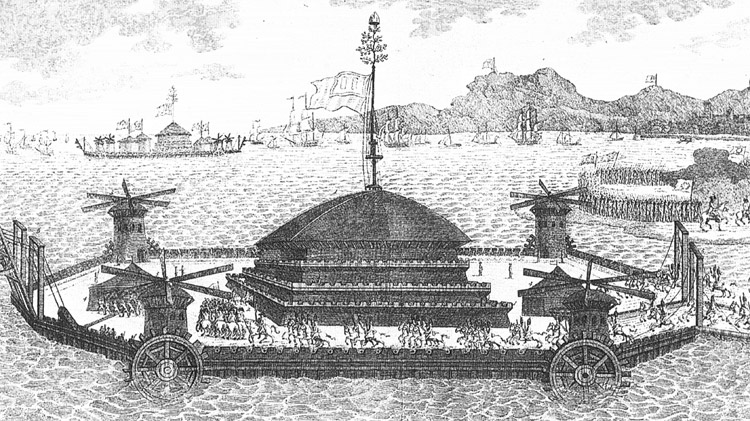
This engraving, published in 1798, shows the gigantic St. Malo raft, designed in 1791 during the French Revolution. The engraving informs us that this extraordinary structure was 600 feet long by 300 broad, mounts 500 pieces of cannon, 36 and 48-pounders, and is to convey 15,000 troops for the invasion of England. In the midst is a bomb-proof, metal-sheathed citadel.
The Panorama of Professions and Trades (1837)
What do you want to be when you grow up? In the 19th century, this question was easier to answer than it is today. There were 87 possibilities, according to Edward Hazen, author of “The Panorama of Professions and Trades” (1837). The book was also published as “Popular Technology; Professions and Trades” in 1870, Part 1 and Part 2 – these are better scans. Every profession is explained and illustrated. Find the table of contents below. Via Doug Berch, musician and dulcimer maker.
Optical telegraph in the Netherlands
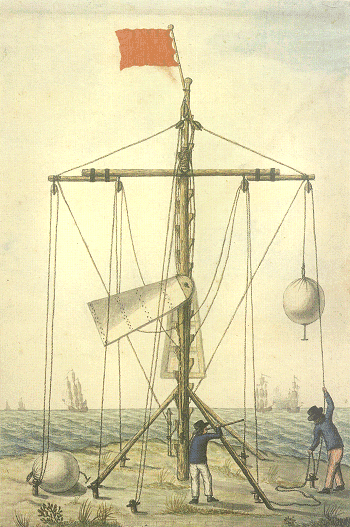
The communications device was located on the beach of Scheveningen in the 1700s. More on the optical telegraph: Email in the 18th century. Source: geschiedenis van de techniek in Nederland.
How Far Back?
On the appeal of steampunk:
“Compared with an earlier and more thoroughly handcrafted era, a return to the late 1800s or early 1900s does not mean having to give up all the most basic modern conveniences. Most of these, including indoor plumbing, electric lighting and even air conditioning, had been invented and put into use by this time—in the main by the privileged, but then it is their lives (and not those of common men and women) that are the stuff of historical fantasy. Travel no longer meant riding in cramped stagecoaches over dirt roads or wind-and wave-tossed sailing vessels, but in luxurious automobiles
and handsomely appointed cabins aboard trains and steamships.”
Via Clockworker.