Rain Water Purification and Storage
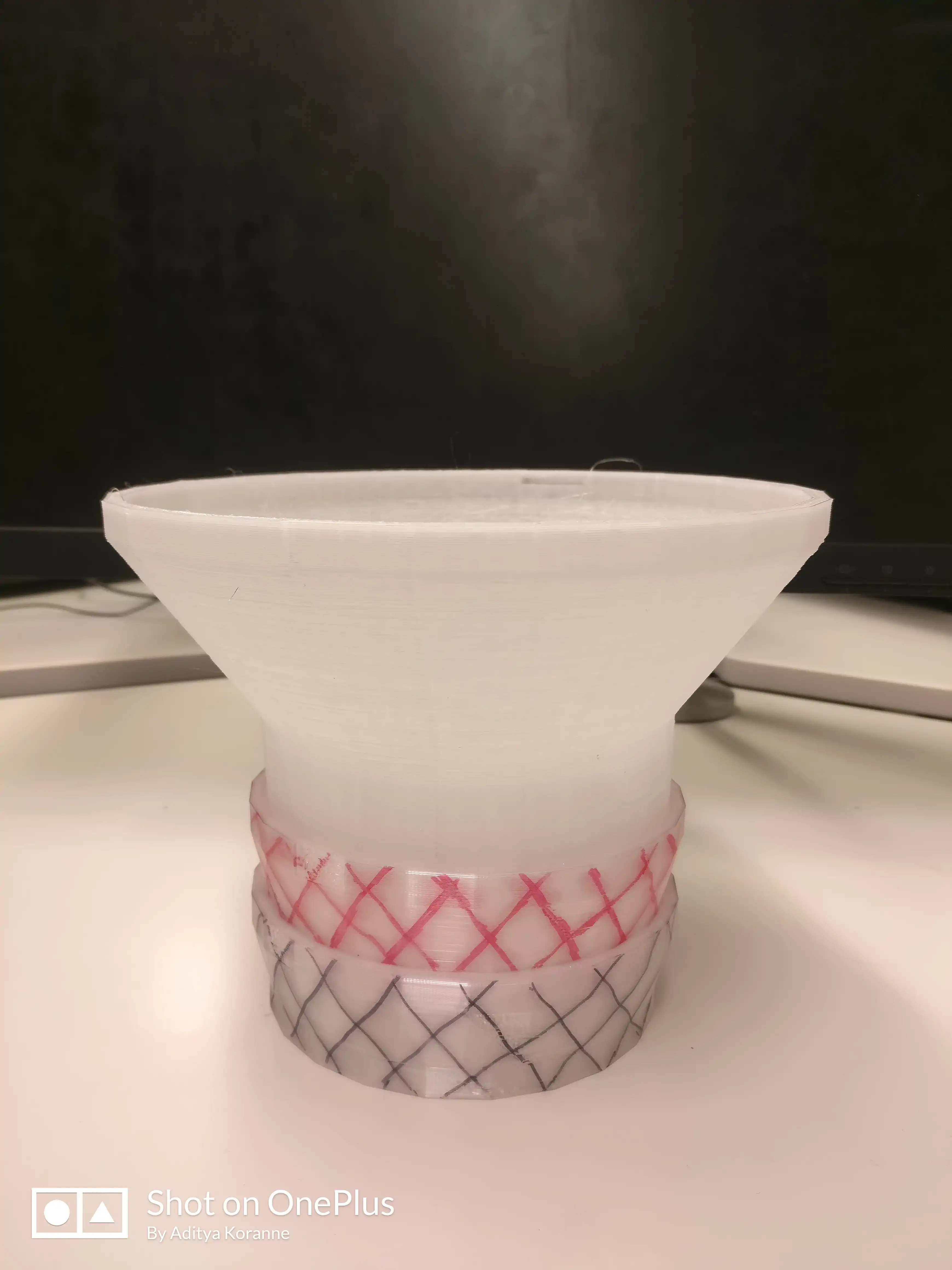
| Keywords | 3D printing, rain water harvesting, storage |
|---|---|
| Uses | development |
| Authors | Abhijeet |
| Status | prototype |
| Made? | Yes |
| Replicated? | No |
| Designed in | United States |
| SDGs | SDG06 Clean water and sanitation |
| Instructions data | |
| Manufacturing files | https://www.youmagine.com/designs/rain-water-purifier |
| Documentation data | |
| Language | English |
| Manifest data | |
| Language | English |
| Updated | 2020-06-04 |
| Author | Kathy Nativi |
| Author affiliation | Appropedia |
| Author email | info@appropedia.org |
Project Title
Project developed by [Abhijeet Patil]
 |
This Open Source Appropriate Technology has been designed but not yet tested — use at your own risk. |
|
This Open Source Appropriate Technology has been prototyped. |
Rain Water Purification and Storage
Abstract
Rainwater harvesting is one of the efficient ways of utilizing rain water for household purposes. Many of the underdeveloped and developing nations in Africa and South Asia rely majorly on these harvests since many years. While many of the rain water harvesting systems are designed for non-potable purposes, the water can be purified by use of local resources like charcoal, ceramic/clay pots and cotton sleeves. These simple water purification materials are scientifically proven to provide safe drinking water. Now all it needs is a simple, robust and affordable filter unit that can serve this purpose. Our OSAT project aims to provide such water purification technique in most affordable way.
Bill of Materials
- Link to all source files using open source CAD
- 1.75mm PLA 3D Printer Filament (2kg), $15 USD
- charcoal (1 kg max), $2 USD, free of cost at local site
- ceramic/clay pieces, free of cost at local site
- cotton sleeve, $0.2 USD, mostly free of cost at local site
Tools needed for fabrication of the OSAT
- MOST Delta RepRap or similar RepRap 3-D printer
- PLA and PETG Filament
Skills and Knowledge Necessary to Make the OSAT
- If you used special skill – link to relevant Wikipedia or Wikiversity articles/courses
Patience
Technical Specifications and Assembly Instructions
- Provide directions for print/assembly - be detailed enough in your “how to” to ensure that someone could construct the device from your description. Consider the elegance of IKEA like instructions.
- Include print time estimate
- Include assembly time estimate
- Including drawings or pictures of the device at stage of assembly at minimum. (Upload)
- Consider video if appropriate
| Example video summary of textbook |
|---|
Common Problems and Solutions
- Include common mistakes/problems to avoid in building your OSAT and how to overcome them
'Ultimaker Cura;' 3D printing software was used to print all the parts. Following are the print details:
FUNNEL LOWER BODY Nozzle: 0.8mm Material: PLA Profile: Fast
Approximate time to print: 3hrs 30 mins Approximate spool length required: 6.5 meter Approximate spool weight: 51 grams
FUNNEL UPPER BODY Nozzle: 0.8mm Material: PLA Profile: Fast
Approximate time to print: 8hrs Approximate spool length required: 14.45 meter Approximate spool weight: 114 grams
POT Nozzle: 0.8mm Material: PLA Profile: Fast
Approximate time to print: 12hrs Approximate spool length required: 18 meter Approximate spool weight: 130 grams
PIN Nozzle: 0.8mm Material: PLA Profile: Fast
Approximate time to print: 10min Approximate spool length required: 5 meter Approximate spool weight: 20 grams
ASSEMBLY TIME ESTIMATE: 5 mins
Cost savings
- If your solution is not a low cost one then it is not really appropriate.
- Estimate your costs
- Find a commercial equivalent, cite it and put the [url in square brackets]
- Calculate $ savings and % savings
My cost $20 commercial cost-$180 $ saving-160 % savings-85%
Benefited Internet Communities
- Name and add links to at least 5 using single brackets around [url name]
References
- The sources of information (e.g. engineering handbooks, journal articles, government documents, webpages, books, magazine articles etc.). References should use the <ref> </ref> and <references/> tags and can be in any format but should include all the information necessary for someone else to find the same information you did. For example: [1]
- ↑ web page: Department of Energy (DOE) Landscaping and Energy Efficiency, DOE/GO-10095 (1995) Available: http://www.eren.doe.gov/erec/factsheets/landscape.html
Based on the developmental needs addressed (e.g. food, heat, electricity, clean water, health care, etc.) be sure to label your device in the proper categories e.g. use [[Category:Water]]. Be sure to categorize your device so that it will be easy to find – for example “Low voltage connection basics” is categorized in [[Category:How tos]] [[Category:Electricity]] [[Category:Electric lighting]].