Concrete trowel
About this device

| Keywords | 3D printing, concrete trowel, construction |
|---|---|
| Uses | development, industry |
| Authors | Ethan Marshall |
| Status | prototype |
| Made? | Yes |
| Replicated? | No |
| Designed in | United States |
| Affiliations |
MTU MOST |
| Materials | Plastic |
| Cost | USD $ 1.12 |
| SDGs |
SDG10 Reduced inequalities SDG11 Sustainable cities and communities |
| Instructions data | |
| Manufacturing files | https://www.thingiverse.com/thing:1179953 |
| Manifest data | |
| Language | English |
| Updated | 2020-06-04 |
| Author | Kathy Nativi |
| Author affiliation | Appropedia |
| Author email | info@appropedia.org |
Concrete Trowel
Project developed by Ethan Marshall
 |
This Open Source Appropriate Technology has been designed but not yet tested — use at your own risk. |
|
This Open Source Appropriate Technology has been modeled. |
|
This Open Source Appropriate Technology has been prototyped. |
Abstract
According to Construction in Africa, investors are looking to invest $100 billion dollars in the infrastructure of Africa per year starting in 2013 in the next decade [1]. A way to put this money to use in the developing continent and to save money in the building of infrastructure, 3D printers could be used to make tools more available and cheaper. One tool is the concrete trowel which could be 3D printed as a cheaper method for smoothing out concrete walls and plaster on walls for the building of infrastructure in developing countries. This trowel would help fulfill the needs of affordable tools for concrete and interior work on houses and buildings in developing countries. Also the light weight of a 3D printed trowel would ease the strain on the wrists of construction laborers. Lastly customizable handles could be made based on a construction worker's grip which would make it easier on workers.
Bill of Materials
CAD files of parts FreeCAD files found here
STL
Purchased materials
- JB weld
Tools needed for fabrication of the OSAT
Skills and Knowledge Necessary to Make the OSAT
- N/A
Technical Specifications and Assembly Instructions
-Overall tool base dimensions Length and Width are 8 in by 4.25 in
- The masonry tool base slicer settings were
- Layer Height: 0.25 mm
- Top/Bottom layer thickness: 0.75 mm
- Shell Thickness: 1.4
- Fill Density: 100%
- Printer Speed: 30 mm/s
- Travel Speed: 50 mm/s
- The masonry handle slicer settings
- Layer Height: 0.25 mm
- Top/Bottom layer thickness: 0.75 mm
- Shell Thickness: 1.4
- Fill Density: 60%
- Printer Speed: 60 mm/s
- Travel Speed: 50 mm/s
- Print times: 2 hr 46 min for the tool base and 59 min for the handle- total time: 3 hr 45 min
-Assembly
- JB weld was placed on the short end of the handle and the handle was placed in the middle of the tool base (2 1/16 in from the long side and 4 in from the short side of the tool base)
Common Problems and Solutions
- When taking off the handle and toolbase carefully peel them off or may run the risk of plastic sticking to print platform
Cost savings
- 70 g of PLA filament were used which was a total cost of $1.12 at $16 for 1 kg of PLA filament
- The JB weld cost $3.00 for 2 oz of JB weld but only about .5 oz was used in assembly which cost about $0.33
- Adding up both costs the total cost is $1.45
- Trowels can range in price from $3.00 to $50
- The cost savings would be $1.55 to $48.55
- The cost savings in percent would be 51% to 97.1%
Gallery
- Concrete trowel
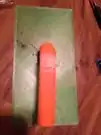 Trowel View 1
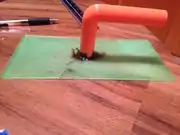 Trowel View 2
 Trowel View 3
References
- ↑ Construction in Africa, KPMG (2014) Available: https://www.kpmg.com/Africa/.../Construction%20in%20Africa.pdf
This article is issued from Appropedia. The text is licensed under Creative Commons - Attribution - Sharealike. Additional terms may apply for the media files.