3D printed carpet knife
About this device
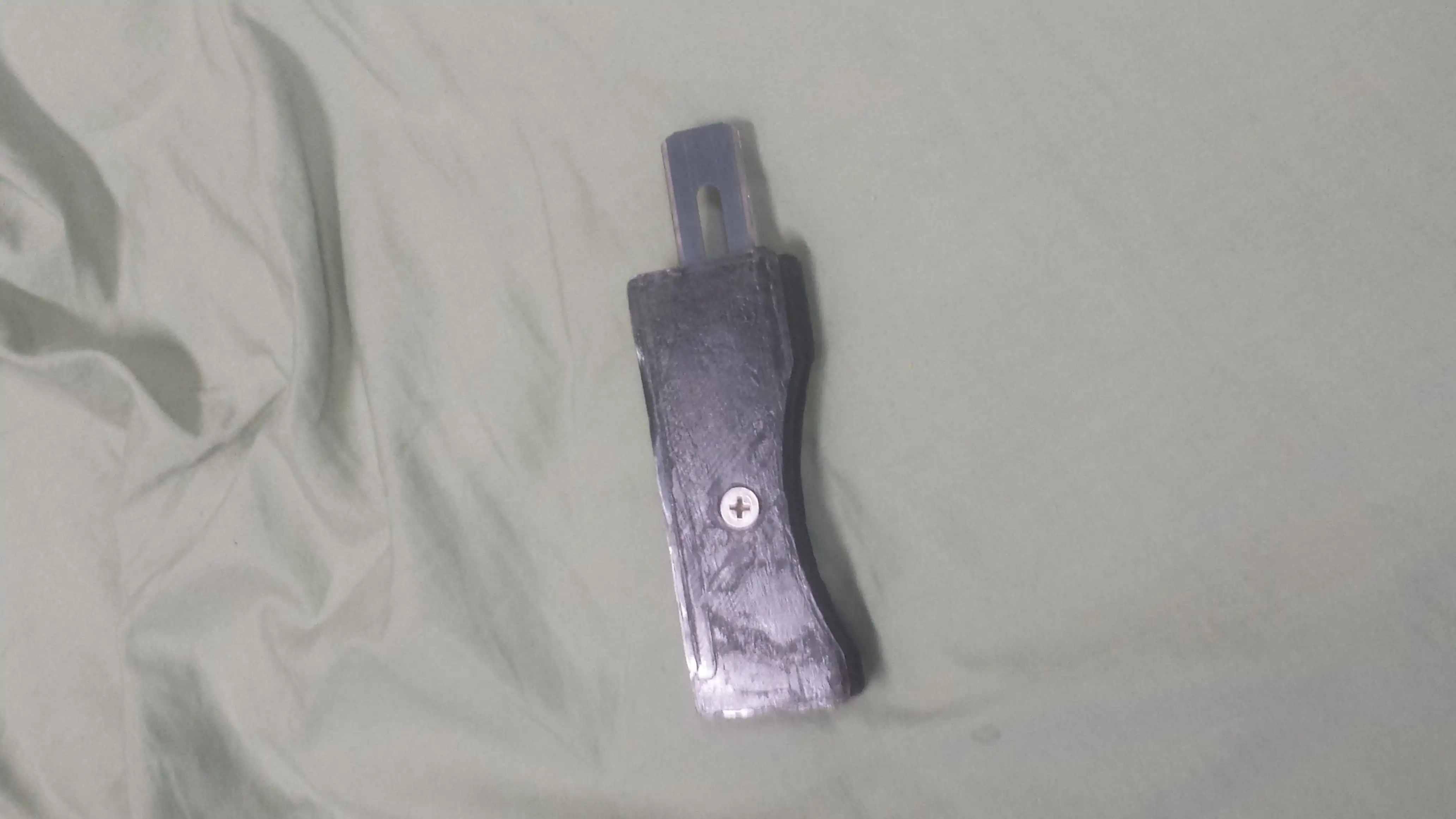
| Keywords | 3D printing, carpentry, knife |
|---|---|
| Uses | development, industry, individual use |
| Authors | Anthony Sharp |
| Status | Prototype |
| Made? | Yes |
| Replicated? | No |
| Designed in | United States |
| Affiliations |
MTU MOST |
| Materials |
Metal Plastic |
| Cost | USD $ 1.02 |
| SDGs | SDG09 Industry innovation and infrastructure |
| Manifest data | |
| Language | English |
| Updated | 2020-06-04 |
| Author | Kathy Nativi |
| Author affiliation | Appropedia |
| Author email | info@appropedia.org |
 |
This Open Source Appropriate Technology has been designed but not yet tested — use at your own risk. |
|
This Open Source Appropriate Technology has been prototyped. |
3D Printed Carpet Knife
Project developed by [Sharp]
Abstract
- Paragraph description of the OSAT - why is it Appropriate? What need does it fulfil? Are there case studies you have found of a technology being used successfully?
Bill of Materials
| Name | File | Price |
|---|---|---|
| Slot-Half | [[Media:[]]] | Printed |
| Bolt-Half | [[Media:[]]] | Printed |
| Slot-Half STL | ||
| Bolt-Half STL | ||
| Bolt | $0.53 | |
| Nut | $0.49 |
Tools needed for fabrication of the OSAT
- MOST Delta RepRap or similar RepRap 3-D printer
- Screw Driver
- Wrench
Technical Specifications and Assembly Instructions
- Provide directions for print/assembly - be detailed enough in your “how to” to ensure that someone could construct the device from your description. Consider the elegance of IKEA like instructions.
- Include print time estimate
- Include assembly time estimate
- Including drawings or pictures of the device at stage of assembly at minimum. (Upload)
- Consider video if appropriate
| Example video summary of textbook |
|---|
Common Problems and Solutions
- Include common mistakes/problems to avoid in building your OSAT and how to overcome them
Cost savings
- If your solution is not a low cost one then it is not really appropriate.
- Estimate your costs
- Find a commercial equivalent
- Calculate $ savings and % savings
References
- The sources of information (e.g. engineering handbooks, journal articles, government documents, webpages, books, magazine articles etc.). References should use the <ref> </ref> and <references/> tags and can be in any format but should include all the information necessary for someone else to find the same information you did. For example: [1]
- ↑ web page: Department of Energy (DOE) Landscaping and Energy Efficiency, DOE/GO-10095 (1995) Available: http://www.eren.doe.gov/erec/factsheets/landscape.html
This article is issued from Appropedia. The text is licensed under Creative Commons - Attribution - Sharealike. Additional terms may apply for the media files.