Fiberglass dust filter experiments

 The fancy furnace filter I use in my air cleaner
is quite expensive, so I had been thinking of other materials that might
work as a filter. An ideal filter material is more like felt than fabric,
with a consistent density of fibers throughout.
The fancy furnace filter I use in my air cleaner
is quite expensive, so I had been thinking of other materials that might
work as a filter. An ideal filter material is more like felt than fabric,
with a consistent density of fibers throughout.
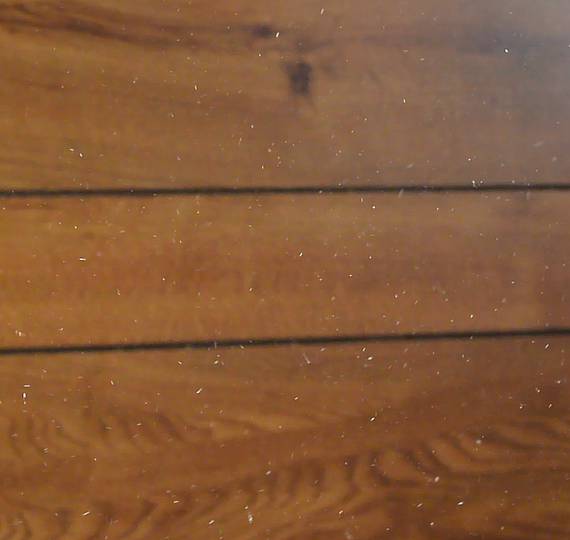
I figured, fiberglass insulation might work, even though fiberglass itself is actually quite dusty when you work with it. At right, airborne fiberglass particles in the sun, after shaking a piece of insulation.
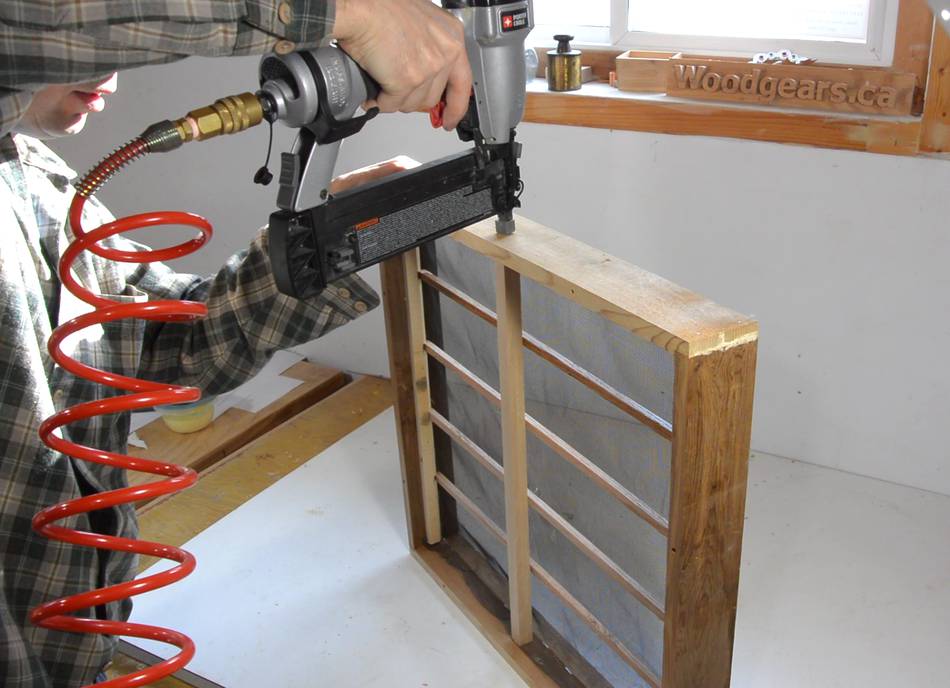
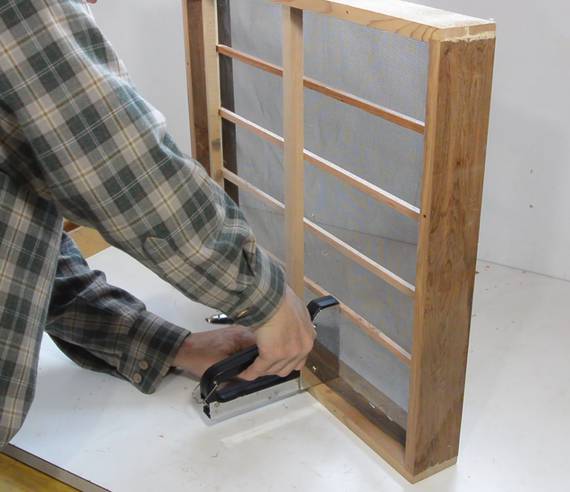 I figured the blower that I built recently would
be good for forcing air through some fiberglass. So I built a frame
with a screen in it to hold some insulation in front of the blower inlet.
I just nailed this one together quickly, the whole thing was an experiment.
I figured the blower that I built recently would
be good for forcing air through some fiberglass. So I built a frame
with a screen in it to hold some insulation in front of the blower inlet.
I just nailed this one together quickly, the whole thing was an experiment.
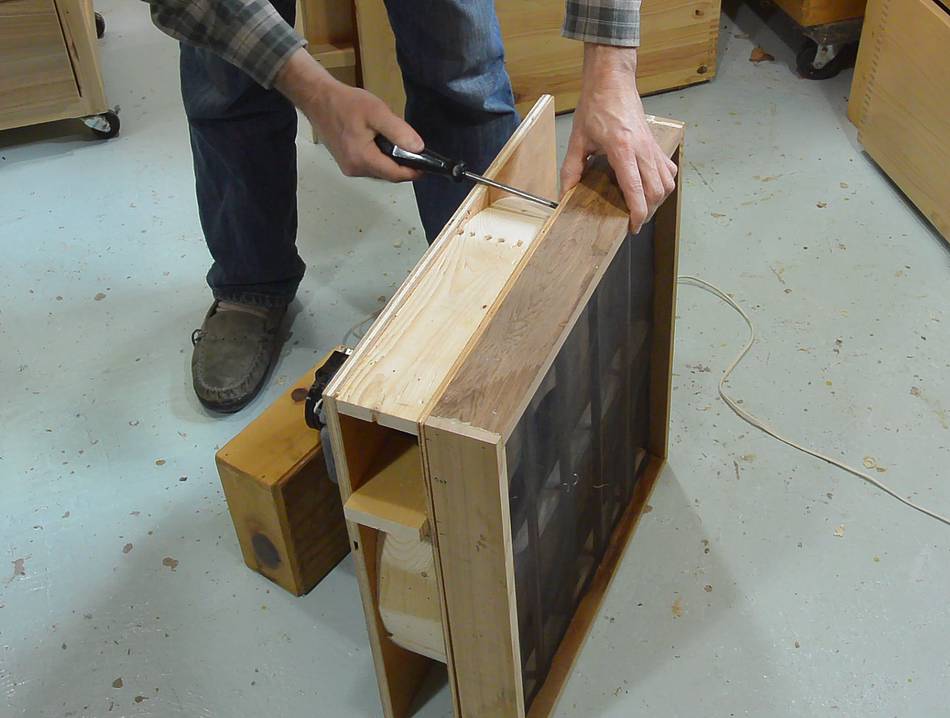 The frame screws to the inlet side of the blower.
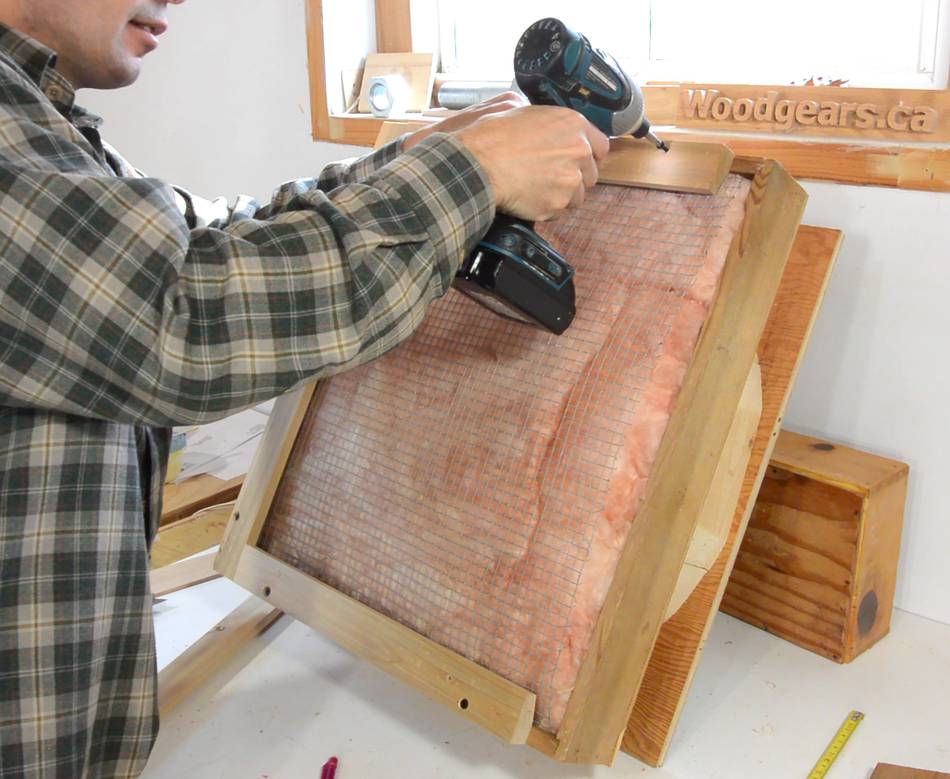 Some "hardware cloth" (a coarse metal screen) holds the insulation in place.
I'm using just under half the thickness of an R12 batt, for about 4 cm
thickness of batting.
Some "hardware cloth" (a coarse metal screen) holds the insulation in place.
I'm using just under half the thickness of an R12 batt, for about 4 cm
thickness of batting.
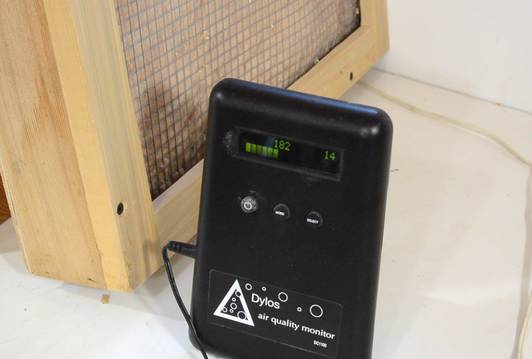
The first time I started the fan with the insulation in place
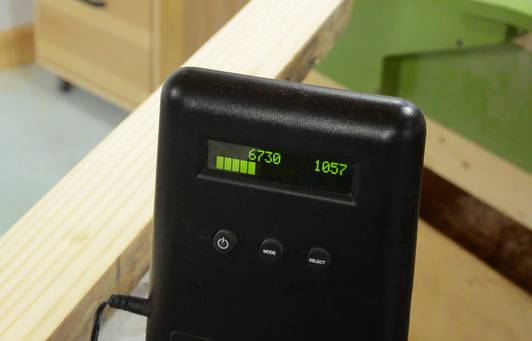
the particle count readings on my Dylos meter
went way up. The fiberglass is dusty to handle, after all.
But after running the blower for just a few minutes, as the air circulated
through the filter, the particle count values came right back down. In fact,
just having it running did a decent job of cleaning the air.
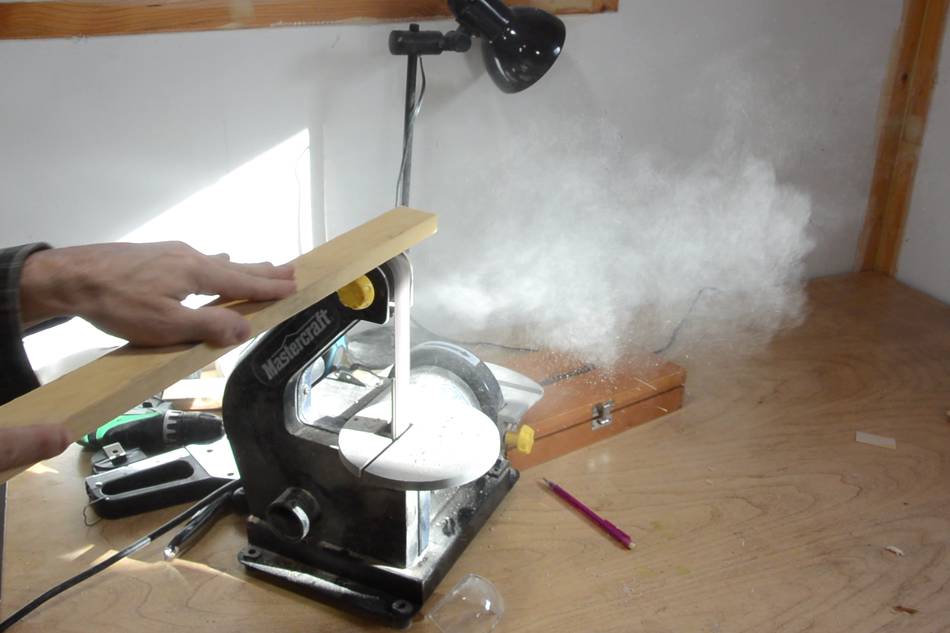 My next test was to see how quickly this unit could clear woodworking dust
from the air. So I made a whole lot of dust with my strip sander,
using it in a way that deliberately shot the dust into the air.
My next test was to see how quickly this unit could clear woodworking dust
from the air. So I made a whole lot of dust with my strip sander,
using it in a way that deliberately shot the dust into the air.
 I then left the room, with the blower and fiberglass filter running.
The Dylos meter recorded the dust values every minute.
I then left the room, with the blower and fiberglass filter running.
The Dylos meter recorded the dust values every minute.
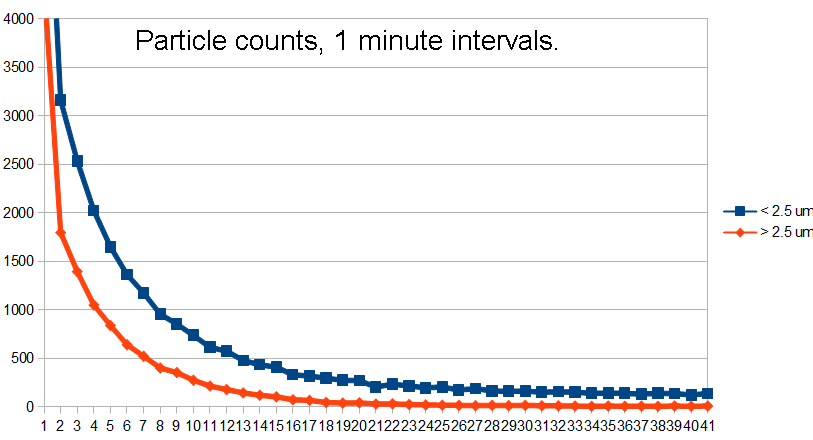
Graphing these over time, the particle counts decayed exponentially over time, though the coarse counts (orange line) decayed faster and much further down.
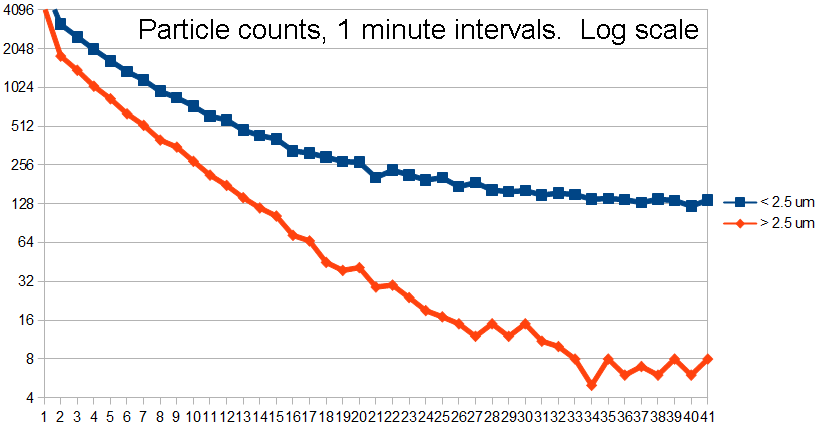 The same graph again, but with a log scale on the vertical. Each division
down means half the particle count. The larger than 2.5 micron particles
(orange line) consistently drop in half every three minutes until the
count drops below 16.
The same graph again, but with a log scale on the vertical. Each division
down means half the particle count. The larger than 2.5 micron particles
(orange line) consistently drop in half every three minutes until the
count drops below 16.
The slope for the fine particles is a bit lower. I suspect the fiberglass only catches a certain fraction of the finest particles on the way through, so the decay time constant for these is a bit longer.
Overall, this unit is slightly more effective at cleaning the air than my furnace filter based air cleaner, but it's also much louder and uses more power.
 With the fiberglass batt fairly effective at cleaning the air, I wanted to see
how well it would work if it's used as a dust collector.
With the fiberglass batt fairly effective at cleaning the air, I wanted to see
how well it would work if it's used as a dust collector.
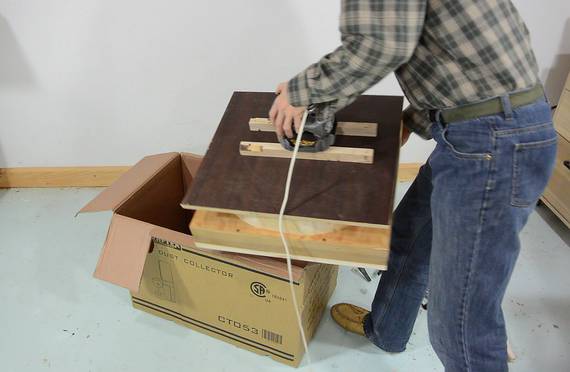
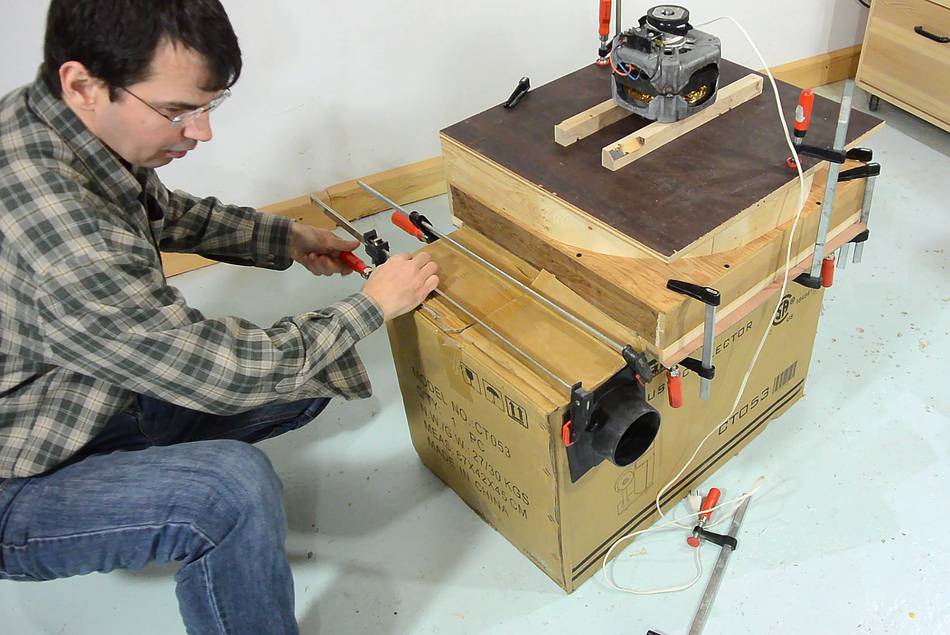
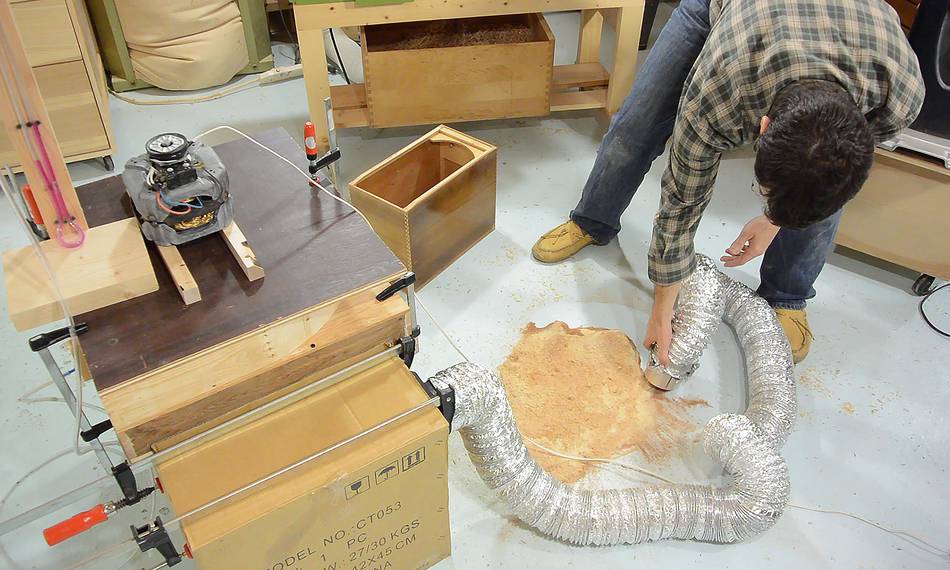
The blower only provides about half as much suction as would be needed for a proper dust collector, but I figured, no harm in trying. So I mounted the blower over a cardboard box. That box, ironically, is from another dust collector
It's all a very temporary experiment. I borrowed the hose flange from my other dust collector to make a hose hookup.
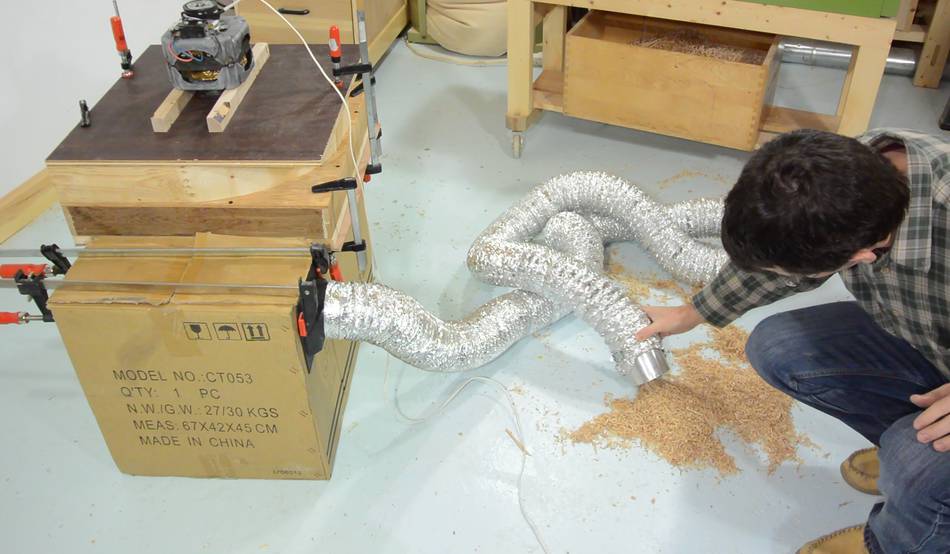 I used some dryer hose for the tubing. That hose is a bit longer than ideal,
but, surprisingly, there was no problem sucking planer shavings through it.
I used some dryer hose for the tubing. That hose is a bit longer than ideal,
but, surprisingly, there was no problem sucking planer shavings through it.
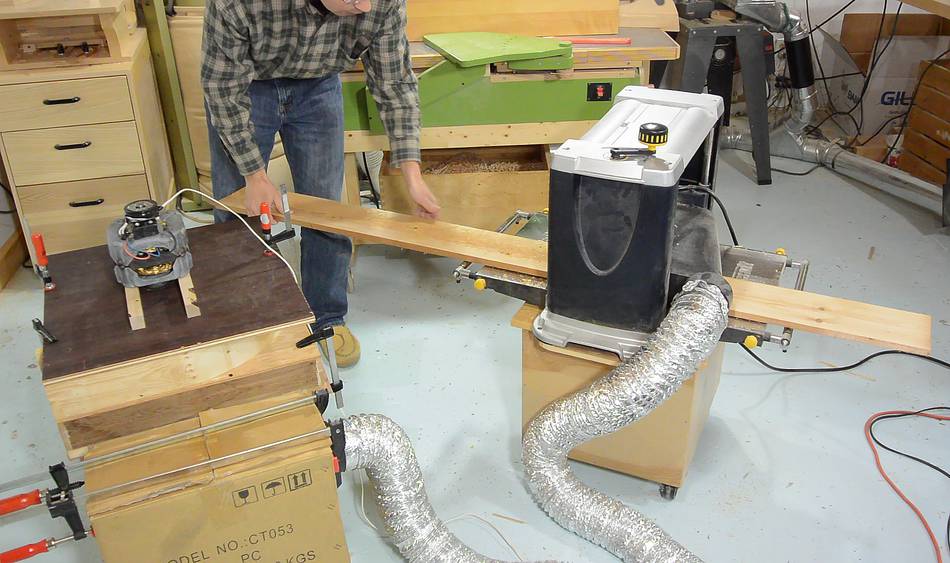
 Next test: Trying it with my thickness planer. The suction was barely
enough. The manifold slightly plugged with shavings once or twice, but it always
cleared on its own.
Next test: Trying it with my thickness planer. The suction was barely
enough. The manifold slightly plugged with shavings once or twice, but it always
cleared on its own.
But particle counts in my workshop went up considerably as I was planing wood. Thickness planers mostly make large shavings, but they also make their share of fine airborne dust. And I think some of that dust made it through the fiberglass filter.
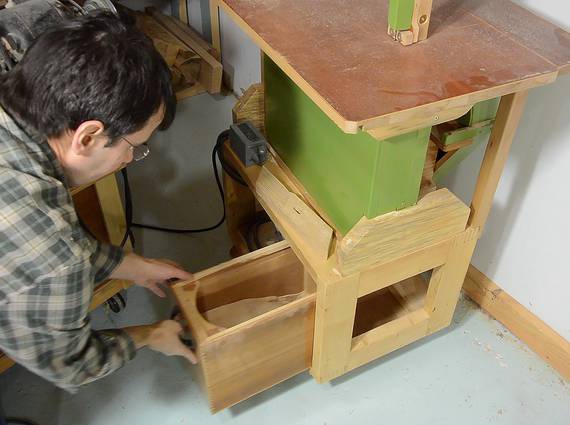
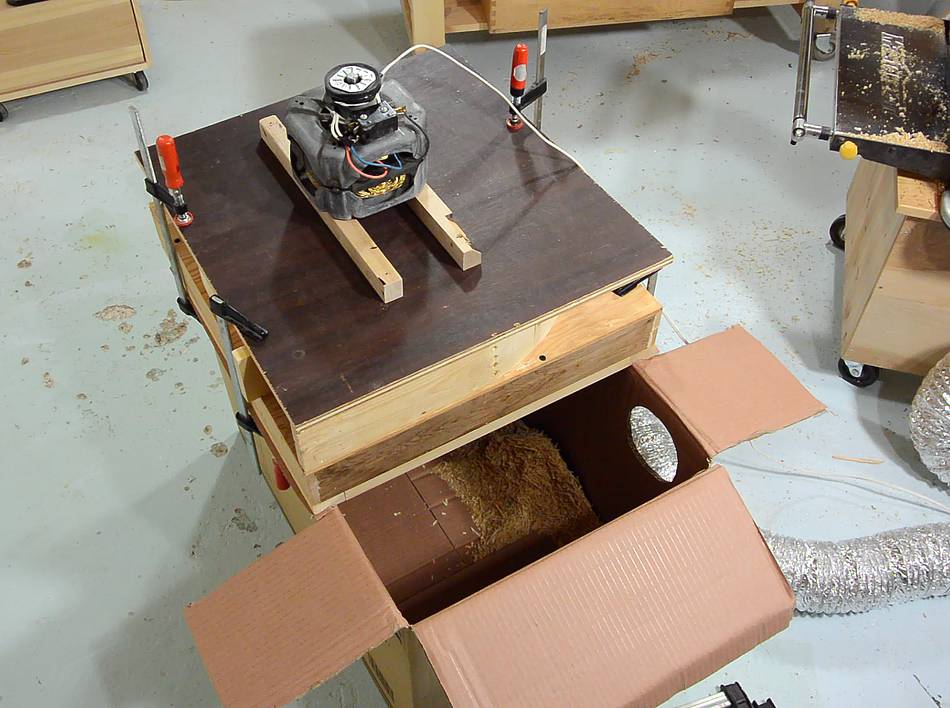 The box wasn't an ideal setup either. I could hear the planer shavings swirling
around inside the box...
The box wasn't an ideal setup either. I could hear the planer shavings swirling
around inside the box...
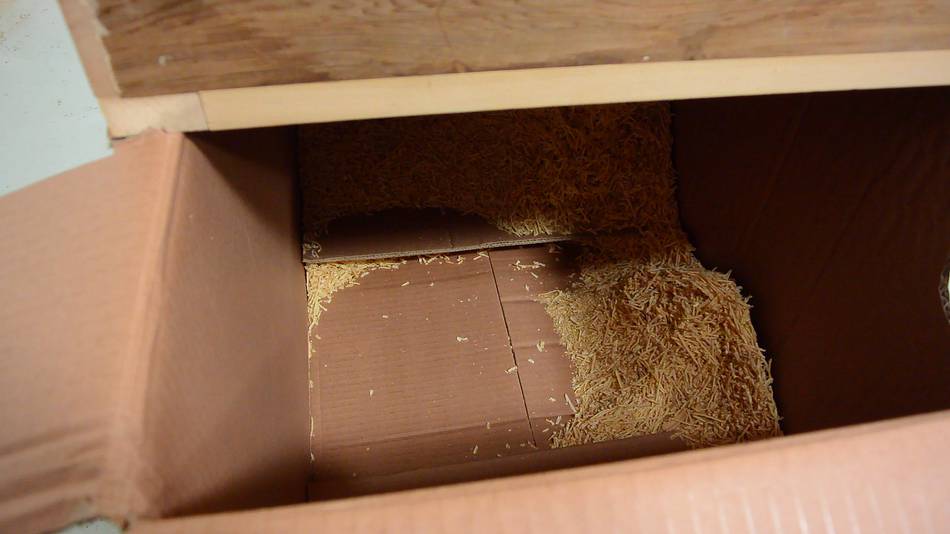 ... even though the box was not very full of shavings.
A box more vertically oriented, so that the shavings can drop further from the inlet and fan would probably be better.
 This experiment really wasn't meant to be "successful" as a dust collector, so
I was surprised it worked as well as it had so far.
This experiment really wasn't meant to be "successful" as a dust collector, so
I was surprised it worked as well as it had so far.
For the next test, I emptied the sawdust drawer from my big bandsaw.
Bandsaw sawdust is quite fine and dusty. The unit was able to suck
this into the hose, but it was slow going and seemed to get slower as I went along.
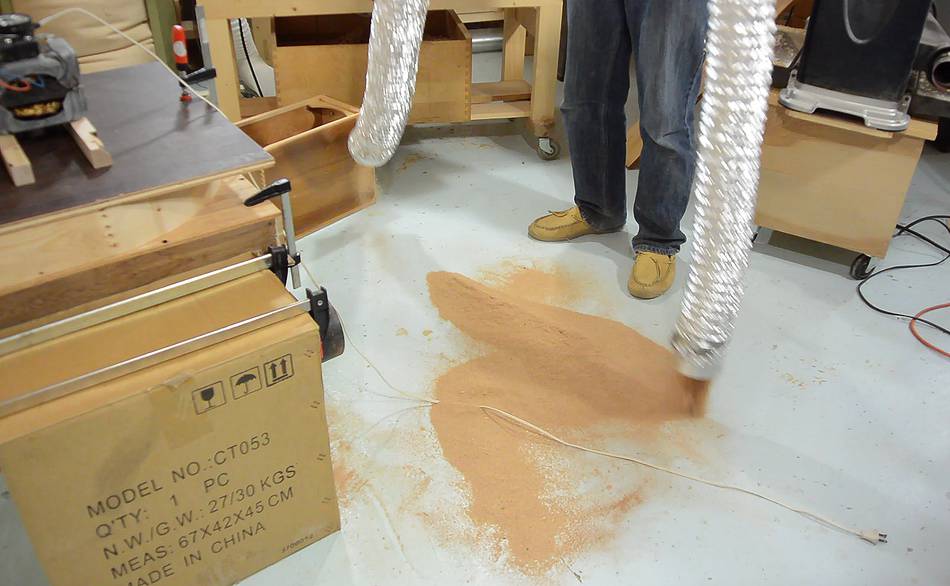
 After sucking in all the dust, I disconnected the hose and shook it out. Sure enough,
there was a lot of sawdust still in the hose. So the airflow wasn't
enough to reliably pull the bandsaw dust through the hose.
After sucking in all the dust, I disconnected the hose and shook it out. Sure enough,
there was a lot of sawdust still in the hose. So the airflow wasn't
enough to reliably pull the bandsaw dust through the hose.
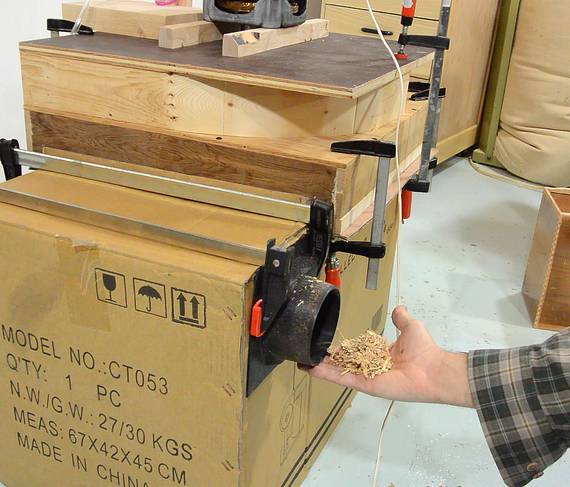
Even with the hose disconnected, airflow was by now much reduced. At right, I'm holding planer shavings in my hand, and I was able to get this close before they got sucked into the inlet.
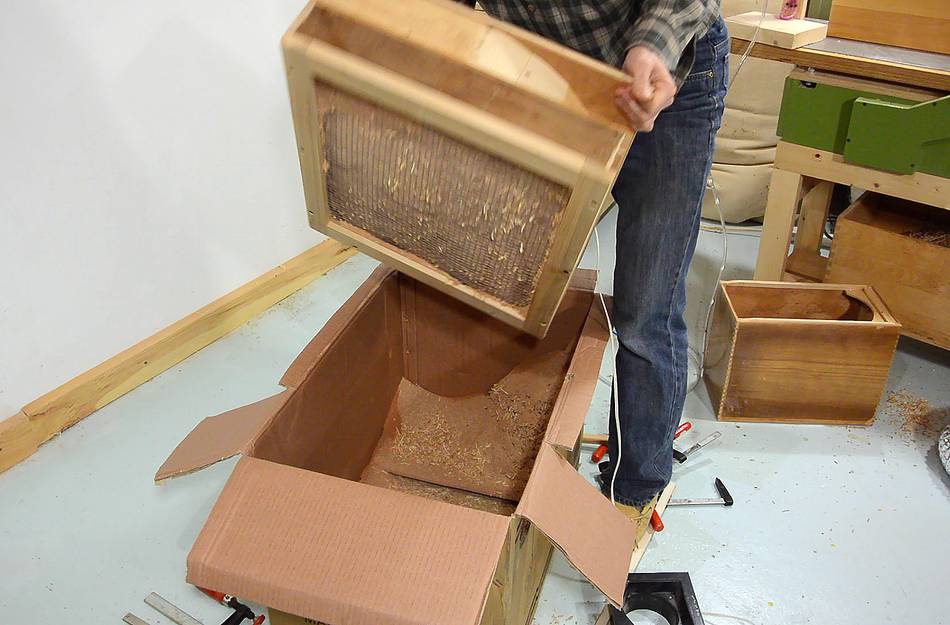 With all the fine dust I sucked into the unit, a lot of it was trapped inside
my filter. Dust trapped in a filter makes it more effective at filtering out
small particles, but also increases air resistance by a lot.
With all the fine dust I sucked into the unit, a lot of it was trapped inside
my filter. Dust trapped in a filter makes it more effective at filtering out
small particles, but also increases air resistance by a lot.
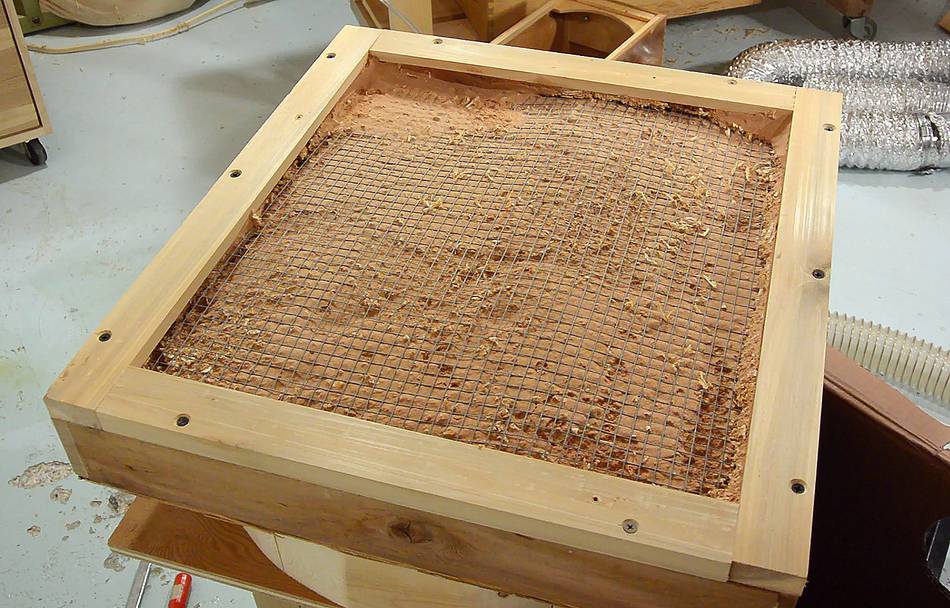
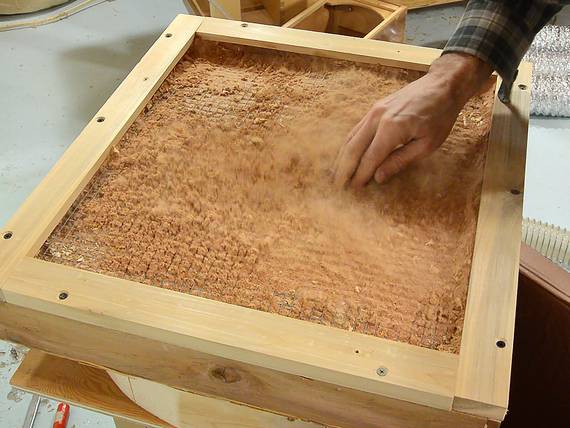 The filter was completely caked in fine dust, though it
was on there relatively loosely.
The filter was completely caked in fine dust, though it
was on there relatively loosely.
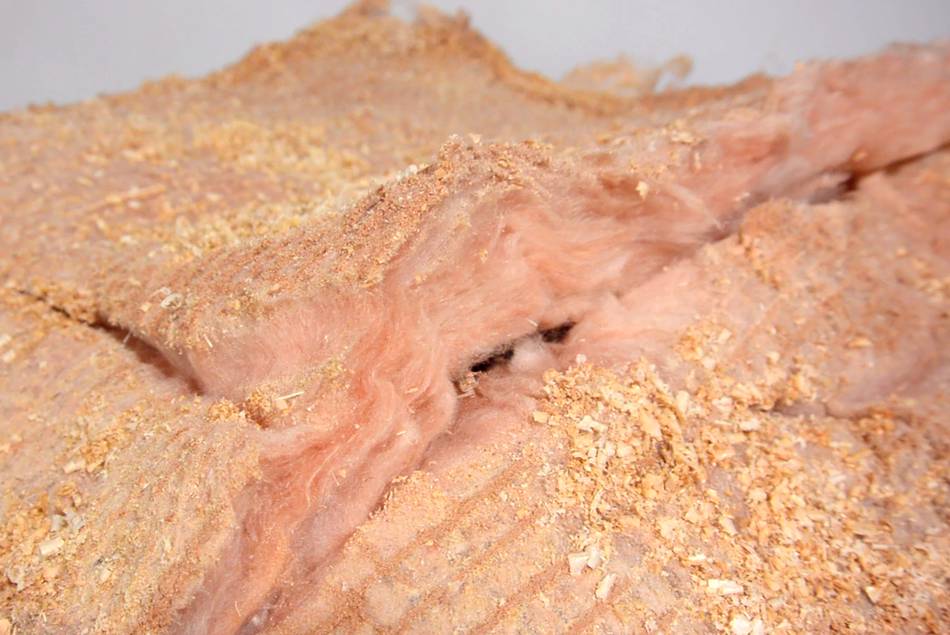 Examining the fiberglass after these experiments, I could only see dust near
the surface. So, at least for visible dust, it really didn't penetrate into
the batts very much. Though with some of the fine particles probably making
it through the filter, I would guess some of these would be deposited much deeper.
Examining the fiberglass after these experiments, I could only see dust near
the surface. So, at least for visible dust, it really didn't penetrate into
the batts very much. Though with some of the fine particles probably making
it through the filter, I would guess some of these would be deposited much deeper.
For an air cleaner, the fiberglass has potential, as the setup worked quite well for that. If an air cleaner lets, say, 20% of particles through, it will just take 20% longer to catch the particles in the air. But if a dust collector filter lets 20% through, that's a lot of airborne dust that could have stayed in the dust collector.
For a dust collector, I think the fiberglass, at least initially, lets too many of the fine particles through. That said, the felt filter in my small dust collector initially let through far too much of the fine particles, but improved considerably once the filter became caked in dust. But with the fiberglass, caked as it became, my airflow became far too low. Without any pleating, I think the area I had for my filter was just too small. So I think fiberglass batts might still have potential in a homemade dust collector, given maybe 4x as much fitler area, and a blower that can produce twice as much pressure.
It seems this article has triggered some criticism.
I guess it violates another safety mantra that people repeat blindly.
Yes, fiberglass is not good for you. That's why I rely on a particle counter. But no, fiberglass is not as bad as asbestos. Your body can break it down over time, so as long as your exposure is limited, your body can deal with it. Manipulating fiberglass releases dust. Pulling air through it will initially release dust, but once the loose fibers are blown out, it's quite low in dust. So please inform yourself before blindly repeating another mantra. Safety doesn't have to be exempt from analysis. You might want to do some reading on it. A quick google search revealed this:
The comparative Safety of Rockwool, Fiberglass, and Organic Fibers (a review)
Michael Sullivan comments about fiberglass dust:
One of the things that most people miss is how differently these
materials react to flexing. Asbestos splits along the grain like
stringy wood. Man made fibers crack across the fiber like MDF. This
means the asbestos gets smaller and smaller and can get deep into the
lungs and actually penetrate into the lung lining. The man made fibers
are, generally, so much larger in diameter, that even broken, they
remain incapable of deep lung penetration. Does not mean there is no
hazard but it orders of magnitude less than that posed by a comparable
amount of asbestos.
That said, is prudent to avoid unnecessary excessive long exposure. Even rudimentary precautions are capable of this.
See also:
 Blower design experiment
 Air cleaner from a
 Homemade pleated filter air cleaner
 Dylos air quality monitor
 Building a small dust collector (version 1)
 Small dust collector
(version 2)
 Homemade box fan
More about dust collection on my woodworking website.
