Zane Middle School permeable concrete 3
| Keywords | permeable concrete pathway, sustainable design, drainage |
|---|---|
| Uses | education, development |
| Authors | Jps19 |
| Status | Deployed |
| Made? | Yes |
| Replicated? | No |
| Designed in | United States |
| Affiliations |
Engr215 Introduction to Design Humboldt State University Zane Middle School |
| Materials |
Gravel Cement |
| Cost | USD $ 197.25 |
| SDGs |
SDG04 Quality education SDG11 Sustainable cities and communities SDG15 Life on land |
| Documentation data | |
| Language | English |
| Manifest data | |
| Language | English |
| Updated | 2020-06-04 |
| Author | Kathy Nativi |
| Author affiliation | Appropedia |
| Author email | info@appropedia.org |
Abstract
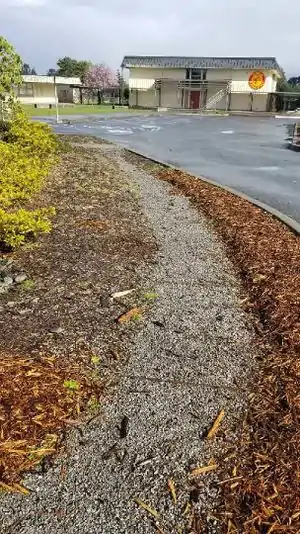
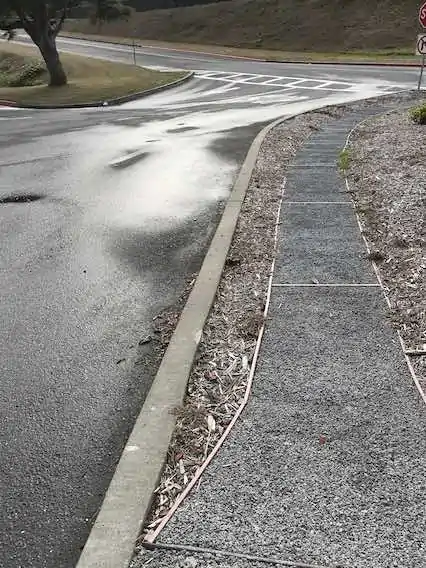
The purpose of the project was to replace a failing permeable pathway (Fig 1) at Catherine Zane Middle School in Eureka, CA with a functioning permeable pathway. The previously installed pathway was uneven, impermeable and produced undesirable loose gravel. The new path was successfully implemented and the middle school now has a solid, level, and permeable concrete pathway in the Peace Garden.
Background
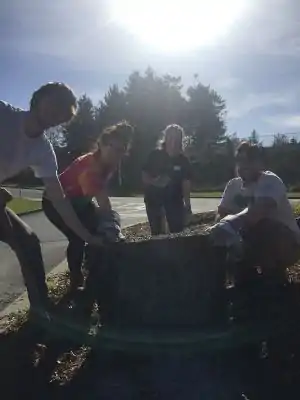
The project was being design and installed by Team^2 (Fig 2) whose members were Ailynn Andersen, Jesse Bobrow, Catherine Carbajal and Julian Sicaud. Team^2 was a team in HSU's Engineering 215: Intro to Design course taken in Spring 2018 and taught by Lonny Grafman. The client of the project was Catherine Zane Middle School, a Science Technology Engineering and Math (STEAM) school which has had a relationship with facilitation projects on their campus for ENGR 215 courses. Team^2's client representative was Trevor Hammons, a school administrator. A previous engineering team had incorrectly installed a permeable concrete pathway in the Peace Garden . We hypothesized that there was too much water in their mix, causing the concrete to sink to the bottom of their installation and harden into an impermeable layer. There was not enough concrete left at the top layer to properly set aggregate. Aggregate erosion resulted in loose gravel, which pedestrians tracked across campus.
Problem statement and criteria
The Peace Garden had a failing pathway that was uneven, sunken, impermeable and produced too much loose gravel. The criteria established by the client, Catherine Zane Middle School, was based on correcting the conditions of the failed permeable pathway to meet the client expectations.
| Criteria | Weight (1-10) |
|---|---|
| Durability | 10 |
| Permeability | 10 |
| Functionality | 8 |
| Maintenance | 7 |
| Cost | 6 |
| Educational Value | 5 |
Description of final project
The final product should be a permeable concrete pathway that seamlessly merges with the surrounding pathways and curbs. The path should be level and smooth ensuring an effortless user experience. The pathway material should also be porous to allow water to permeate through the pathway into the surrounding garden beds.
Prototyping
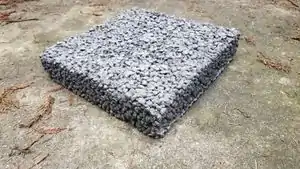
Permeable Concrete is made from a mix of round aggregates of equal size and Portland cement. Typical mixtures usually consist of a 3:1 ratio of three parts 3/8" pea gravel aggregate to one part Portland cement. We decided to test both permeability and viability as product of this ratio by testing it against both a 4:1 and 2:1 ratio of aggregate to cement. We poured samples (fig 3) of each ratio into one square foot molds to a depth of three inches.
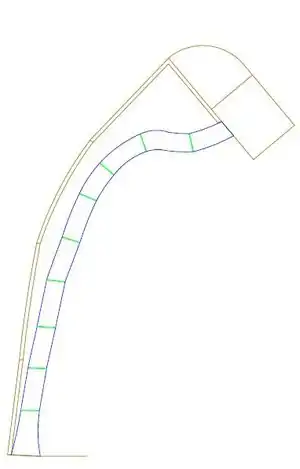
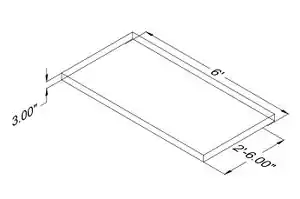
The team took site measurements of the old path installed in the Peace Garden. We made measurements of each section's dimensions, which we then entered into AutoCAD and rendered into a viable blueprint plan (Fig 5) for the pathway. We also rendered a 3D example of a typical path section block of porous concrete (Fig 6). The pathway in the garden is approximately 62 feet long and is composed of ten sections that are approximately six feet long, by two and a half feet wide, by three inches tall. We calculated that the overall volume of concrete needed to pour was a little under forty cubic feet, or just over a cubic yard.
Testing Results
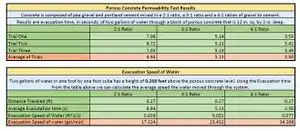
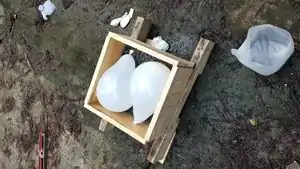
We ran three tests on each prototype ratio concrete sample to determine the rate of permeability or the speed at which water drained through the material. The tests for the prototype slabs were completed by building a box of wood around each block and adding silicone to seal the inside seams and corners. We leveled the boxes and placed two water balloons filled with approximately 2 gallons of water in each (Fig 4). We then popped both of the balloons at the same time and measured the time it took for the volume of water to permeate through the each sample.
Figure 4 contains the results of our tests. With each ratio (4:1, 3:1, and 2:1) of aggregate to cement, we found that they all produced a strong and highly permeable concrete sample. This told us that mixing a precise ratio of aggregate to cement was not as crucial in producing a viable concrete as other concerns, such as adding the correct moisture level or properly curing the mix after installation.
Costs
Our project would never have come to fruition without generous donations. The project budget was $400 but our expected costs rose to over $1000! Because of our donations and community help we spent less than $200.
| Materials | Source | Quantity | Unit | Retail Price per unit ($) | Total Retail ($) | Expenses ($) |
|---|---|---|---|---|---|---|
| 3/8" Washed Pea Gravel | Mercer-Fraser | 2 | Cubic Yard | 60.00 | 120.00 | Donated |
| 3/8" Washed Pea Gravel | Hensell Materials | 2 | 5 gallon bucket | 4.00 | 4.50 | Donated |
| Weed Cloth | Zane Middle School | 1.2 | 100 feet | 68.99 | 68.99 | Donated |
| Mixing Wheelbarrow | Larry Nichols/Zane | 2 | 150.00 | 300.00 | Donated | |
| 5 Gal. Bucket | Julian Sicaud | 4 | 4.99 | 4.99 | Donated | |
| 1 Foot Wooden Stakes | Zane Middle School | 1 | 100 Stakes | 17.50 | 17.50 | Donated |
| Bender Board | Zane Middle School | 6 | 20 Feet | 19.99 | 120.00 | Donated |
| Fill Dirt | Zane Middle School | 2 | Cubic Yard | 7.99 | 15.99 | Donated |
| Portland Cement | Piersons Hardware | 5 | 97 lb bag | 16.99 | 84.95 | Donated |
| Tarp | Julian Sicaud | 2 | 15.99 | 31.98 | Donated | |
| Shovel | Julian Sicaud | 2 | 23.86 | 23.86 | Donated | |
| Portland Cement | Hensell Materials | 1 | 47 lb bag | 6.07 | 6.77 | 6.77 |
| Portland Cement | Shafer's Hardware | 1 | 47 lb bag | 9.99 | 10.84 | 10.84 |
| Line Level | Piersons Hardware | 1 | 3.69 | 4.00 | 4.00 | |
| Shovel | Piersons Hardware | 1 | 21.99 | 23.86 | 23.86 | |
| Garden Hoe | Shafers Hardware | 2 | 16.99 | 16.99 | 16.99 | |
| Hose Valve Key | Shafers Hardware | 1 | 1.79 | 1.79 | 1.79 | |
| #9 x 2-1/2" Deck Screws | Hensel's Hardware | 1 | 50 screws | 9.78 | 9.78 | 9.78 |
| Wood | Almquist | 14 | Feet | 1.09 | 16.44 | 16.44 |
| 1" x 4" pine | Piersons Hardware | 30 | Feet | 0.69 | 20.42 | 20.42 |
| Wheel barrow Tube | Miller Farms | 2 | 9.64 | 19.28 | 19.28 | |
| Caulking Gun | Harbor Freight Tools | 1 | 2.99 | 2.99 | 2.99 | |
| Silicone caulk | Harbor Freight Tools | 2 | Tube | 3.99 | 7.98 | 7.98 |
| Balloons | Dollar Tree | 5 | Bag of 25 | 1.00 | 5.43 | 5.43 |
| Caution Tape | Shafers Hardware | 1 | Roll | 7.59 | 7.59 | 7.59 |
| Gloves | Harbor Freight Tools | 5 | pair | 7.99 | 7.99 | 7.99 |
| Push Broom | Shafers Hardware | 1 | 7.99 | 7.99 | 7.99 | |
| Plastic Sheeting | Piersons Hardware | 1 | 9 x 400 Feet | 24.99 | 27.11 | 27.11 |
| TOTAL | 990.01 | 197.25 |
Design Hours
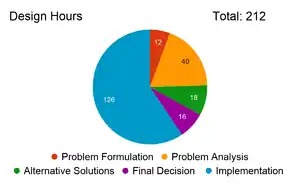
The team spent the most time testing materials and on implementation which required time top acquire tools and materials before installation and the curing time after installation.
Final Product
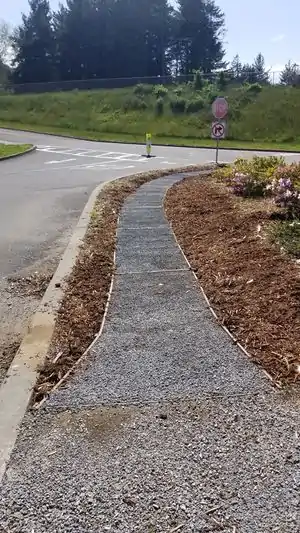
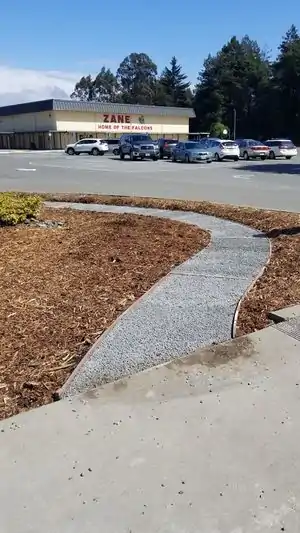
The final product is a beautiful, durable and permeable concrete pathway in the Peace Garden. See Figure 8 and 9.
Video
How to Build
How to Install a Permeable Concrete Pathway:
- If needed, remove undesired path or trail, or dig to depth of concrete layer.
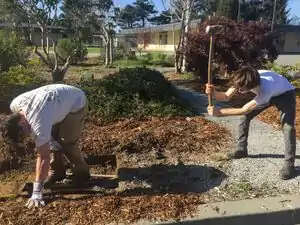 Sledging the old path.
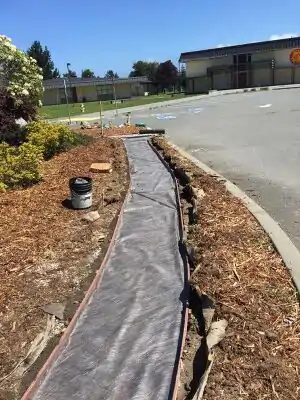
 - Prepare sub-grade by leveling and compacting dirt to the depth of porous concrete level. Define concrete blocks with benderboard and 1x4 wood dividers. cover dirt with weed cloth.
 Prepared Subgrade
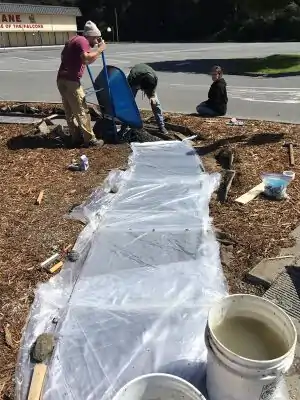
 - Mix Porous concrete in wheelbarrow or mixer then pour into path sections, level and immediately cover with plastic to cure for a week.
 Pour and Cover
Maintenance
Recommended maintenance of the pathway consists of powerwashing twice a year. This ensures that small objects will not clog the holes in the path way.
Update September 2018
The walkway appears to be in good looking condition. When walked on, gravel does not come loose and the walkway feels softer to walk on than the parking lot concrete. When kicked harshly, the gravel does come loose. To compare the walkways I poured 2/3 cup of water on the 2015 walkway and 2/3 of water on the 2018 walkway. The 2015 walkway seemed to be more permeable as the water permeated almost immediately leaving little water marks on the walkway. The 2018 walkway took a couple minutes to permeate completely while leaving a water mark for a couple minutes before permeating completely. Overall seems to be a successful project and is still in use at Zane Middle School.
Update September 2019
The permeable concrete pathway seems fully functional and is very lightly worn. When we visited the site, it had just rained 10-15 minutes prior. The permeable concrete was already dry versus the asphalt road which was still wet and formed puddles from the rain. We reached out to the school’s counseling services director who told us the paths are not creating any issues. Maintenance seems low to none. Overall, permeable concrete path seems effective and successful and still in use.
References
Paths for All. (2014). “Permeable Material (Surface).” <http://web.archive.org/web/20171022190944/http://www.pathsforall.org.uk:80/pfa/glossary-of-path-construction-terminology/permeable-material-surface.html> (Feb. 18, 2018).
How Cement is Made. (n.d.). Retrieved February 21, 2018, from http://www.cement.org/cement- (Links to an external site.)Links to an external site. concrete-applications/how-cement-is-made
Previous Concrete. (n.d.). Retrieved February 21, 2018, from http://www.washingtonconcrete.org/pervious-concrete
GreenBlue Urban. (2017). “Permeable Pavement: The Pros and Cons You Need to Know.” <https://www.greenblue.com/na/permeable-pavement-the-pros-and-cons-you-need-to-know/ (Links to an external site.)Links to an external site.> (Feb. 18, 2018).
Pervious Pavements. (2011). “Pervious Concrete Pavement an Overview.” <http://www.perviouspavement.org/> (Feb. 17, 2018).