Smart Phone Adaptive Otoscope
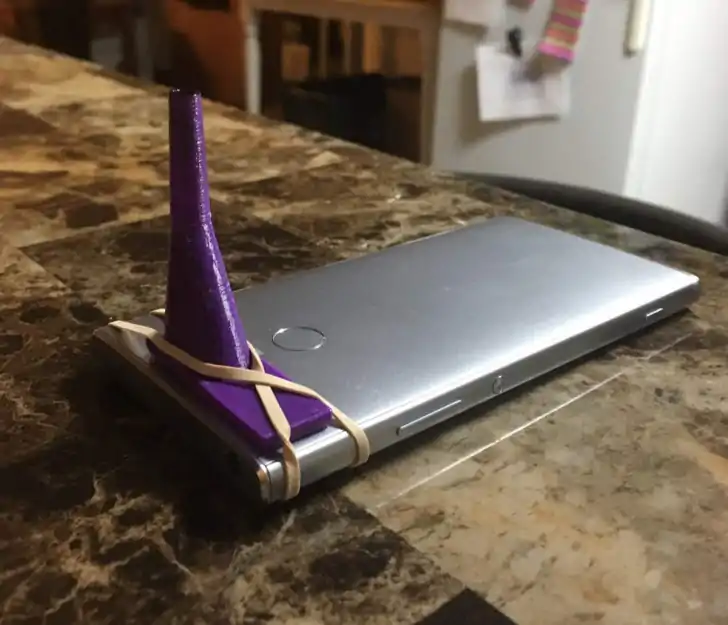
| Keywords | 3D printing, otoscope, ear infections |
|---|---|
| Uses | medical, development |
| Authors | Emily |
| Status | Prototype |
| Made? | Yes |
| Replicated? | No |
| Designed in | United States |
| Affiliations |
MTU MOST |
| Materials | Plastic |
| Cost | USD $ 0.08 |
| SDGs |
SDG03 Good health and well-being SDG10 Reduced inequalities |
| Instructions data | |
| Manufacturing files | https://www.youmagine.com/designs/smart-phone-adaptive-otoscope |
| Documentation data | |
| Language | English |
| Manifest data | |
| Language | English |
| Updated | 2020-06-04 |
| Author | Kathy Nativi |
| Author affiliation | Appropedia |
| Author email | info@appropedia.org |
Smart Phone Adaptive Otoscope
Project developed by Ejweiden NOTE: This is NOT a regulated diagnostic tool, only medical professionals can make a diagnosis.
 |
This Open Source Appropriate Technology has been designed but not yet tested — use at your own risk. |
|
This Open Source Appropriate Technology has been prototyped. |
Abstract
Device Definition
An otoscope is a medical instrument or device used to examine of the eardrum and the passage of the outer ear, which can be dificult to see to the naked eye. From an otoscope a medical professional or health care provider can diagnose or recognize ear infections, fluid in the ears, tearing of the eardrum and more.
The OSAT Need
If ear symptoms go continuously on treated, they can lead to hearing loss. Millions of people in across the globe suffer from hearing loss . The first step to avoiding hearing loss is primary prevention such as diagnosing ear simple ear infections. "Experts say at least half of all hearing loss cases are avoidable through primary prevention" , care like this can be costly and hard to come by in developing countries. And because otoscopes, a very basic and necessary medical device, can be expensive, an simple, cheap, adaptive, otoscope could be a useful solution for those who are lacking primary preventative care.
Bill of Materials
Printing Material:
- Black (or dark, opaque, non translucent) PLA (or plastic printing material)
Printed Parts:
- Otoscope
Other Materials
- A rubber band
- Black paint/nail polish (only needed if a dark printing material is not used)
Files:
- OpenSCAD File:
- STL File:
File:OSAT Otoscope.stl - Thingiverse Page
- Youmagine OpenSCAD and STL Link
Tools needed for fabrication of the OSAT
- MOST Delta RepRap or similar RepRap 3-D printer
- Smart phone/cell phone with rear-facing camera AND flash
Skills and Knowledge Necessary to Make the OSAT
- Basic knowledge of 3D printing
Technical Specifications and Assembly Instructions
Printer Settings
- Material: 1.75mm PLA
- Rafts: Doesn't matter
- Support: None
- Layer Height: 0.2mm
- Shell Thickness: 1 mm
- Fill Density: 100%
- Print Speed: 75 mm/s
- Printing Temperature: 220 C
Estimated Print Time: 31 minutes when printed at these settings
Estimated Assembly Time: < 5 minutes to attach printed part with a rubber band to the phone
Assembly
- Line up the large opening of the otoscope with the camera and flash on the phone being used.
- Wrap a rubber band around the top portion of the phone so that the otoscope is being held in place securely
- Turn on the phone's camera
- Adjust positioning of the rubber band to ensure the small opening of the otoscope is centered around the camera
Common Problems and Solutions
If when using the flash, the image on the phone is unclear use paint or a darker printing material to keep the light from escaping the otoscope If when using the camera or another app the image is blurry or unclear the otoscope needs to be at a greater distance
Cost savings
This device cost $0.08 to in material to print
- A high end commercial equivalent cost $299.99
- A median commercial equivalent cost $49.99 (Amazon.com)
- A low end commercial equivalent cost $9.95 (Amazon.com)
- A non cellphone attached otoscope can cost on average $30 to $70
Savings: $299.91 to $9.87 (99.9% to 99.2% cost redcution)