Pocket Wrench
About this device
| Keywords | 3D printing, wrench, hand tool |
|---|---|
| Uses | development |
| Authors | Austin Ballou |
| Status | Open design |
| Made? | No |
| Replicated? | No |
| Designed in | United States |
| Affiliations |
MTU MOST |
| Materials | Plastic |
| Cost | USD $ 1.50 |
| SDGs | SDG09 Industry innovation and infrastructure |
| Instructions data | |
| Manufacturing files | https://www.youmagine.com/designs/pocket-wrench-set |
| Documentation data | |
| Language | English |
| Manifest data | |
| Language | English |
| Updated | 2020-06-04 |
| Author | Kathy Nativi |
| Author affiliation | Appropedia |
| Author email | info@appropedia.org |
Pocket Wrench
Project developed by Atballou (talk) 23:44, 3 December 2019 (UTC)
 |
This Open Source Appropriate Technology has been designed but not yet tested — use at your own risk. |
Abstract
- The pocket wrench is an excellent example of OSAT. Wrenches are a universal necessity, especially in third world countries where buying something new, rather than repairing something, is seldom an option. In addition to this, this wrench is small and cheap to make.
Bill of Materials
Tools needed for fabrication of the OSAT
- MOST Delta RepRap or similar RepRap 3-D printer
Skills and Knowledge Necessary to Make the OSAT
- No special skills were used to produce this wrench, other than basic 3D printing knowledge.
Technical Specifications and Assembly Instructions
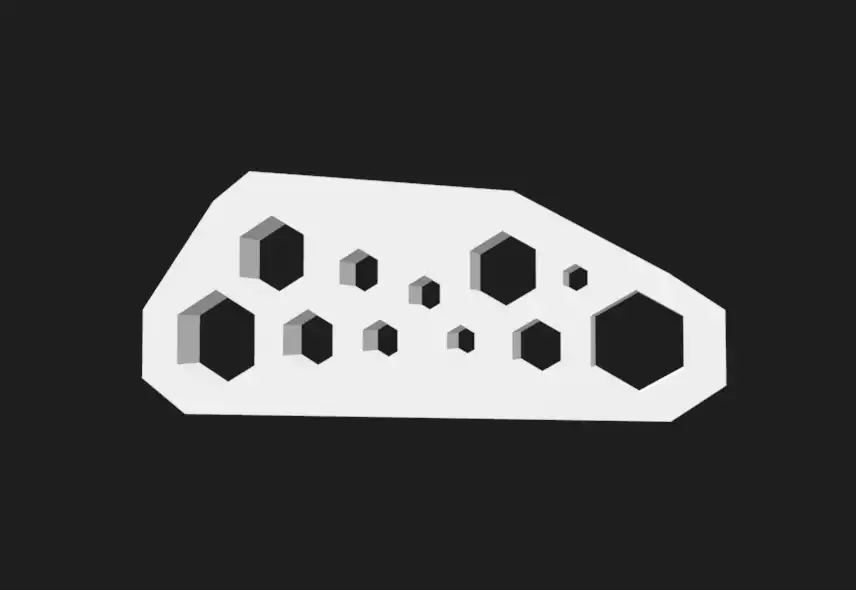
- My print was made by extruding the PLA at 240C. I used this high of a temperature because my 3D printer is located in a room that is not heated, and as such, higher extrusion temperatures are needed to allow the filament to extrude properly. The print was made using a 60% hexagonal infill, this allows for the structure to maintain its rigidity, and be used for the application. There is no assembly process, as the design is one simple printed part.
- The print time on a delta printer was around 2 hours, using 37g of filament.
- There is no necessary assembly involved in the finished product.
- A picture of the CAD Drawing is located to the right.
Common Problems and Solutions
The only foreseeable problem with this print is the accuracy of the smaller mm bolt holes. The best way to overcome these issues is to heat the correct bolt up to an extremely high temperature and forcing it through the corresponding wrench holes. This will allow the wrench to take a form fitting shape to the required bolt size. If the print is accurate enough there will be no further post processing necessary to finish the design.
Cost savings
Benefited Internet Communities
This article is issued from Appropedia. The text is licensed under Creative Commons - Attribution - Sharealike. Additional terms may apply for the media files.