OSAT 3D Printed Hand Pump
About this device
| Keywords | 3D printing, pump, hand tool, liquid transport |
|---|---|
| Uses | development, industry |
| Authors | Jdkizer |
| Made? | No |
| Replicated? | Yes |
| Designed in | United States |
| Cost | USD $ 5.00 |
| SDGs | SDG08 Decent work and economic growth |
| Documentation data | |
| Language | English |
| Manifest data | |
| Language | English |
| Updated | 2020-06-04 |
| Author | Kathy Nativi |
| Author affiliation | Appropedia |
| Author email | info@appropedia.org |
- screw thread bottom so it doesnt come off, same with handle
- 3d print gasket - fit tighter to doesnt come off
- threads for outlet so you can attach it to hose
- print valves in flexible filament or gasket for better seals
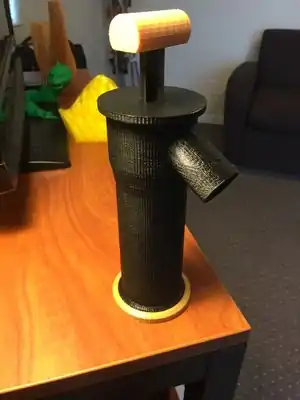
3D Printed Hand Pump
Project developed by Yanibeeker (talk) 11:58, 4 December 2016 (PST)
 |
This Open Source Appropriate Technology has been designed but not yet tested — use at your own risk. |
|
This Open Source Appropriate Technology has been prototyped. |
Abstract
The 3-D Printed Hand Pump is an OSAT that allows liquid to be pumped from a reservoir to a container. Hand pumps are needed in across the globe for the distribution of water, oil, and other liquids. Assembly of this device takes less than one minute with little effort. This design is most effective when used for pumping liquids from a bucket/barrel into a smaller container. However modifications and more components can be added to the design to make the pump applicable to more situations.
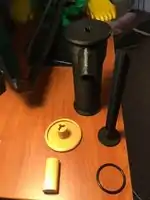 Pump Components
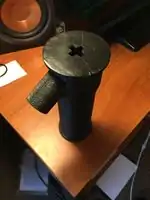 Pump Body
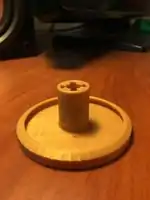 Bottom Valve
 Piston with o-ring
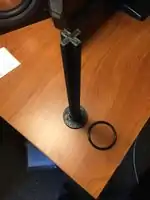
 Pump Handle
Bill of Materials
- PLA 1.75mm filament
- Glue stick to aid in bed adhesion
- O-ring (42mmID, 48mmOD, 3mm thickness)
Link to files: https://www.youmagine.com/designs/osat-3d-printable-hand-pump
Tools needed for fabrication of the OSAT
- MOST Delta RepRap or similar RepRap 3-D printer
Technical Specifications and Assembly Instructions
- Print the files in the orientation shown in the photograph below (20% infill). The layer height for the check valve components should be 0.1mm(may be increased to decrease printing time but performance will decrease). Other components may be printed with higher layer heights (0.2mm). PLA will suffice but swelling will occur over time. Use PP of PETG for minimal degradation.
- The once the parts are removed from the bed, twist the check valve cones to free them from any stringing that may have occurred during printing.
- Seat the o-ring on the piston as shown in the photograph below
- Feed the piston shaft though the top of the pump body.
- Press on the bottom check valve
- Press on the handle to the top of the piston shaft.
- To pump, submerge the bottom of pump body in liquid and begin to pump (~10 pumps may be necessary to fill the chamber)
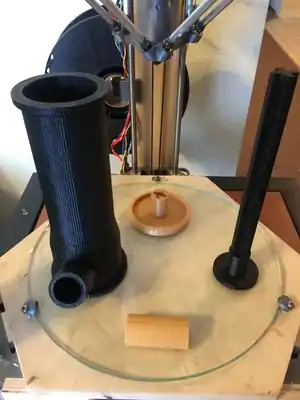 Correct printing orientation
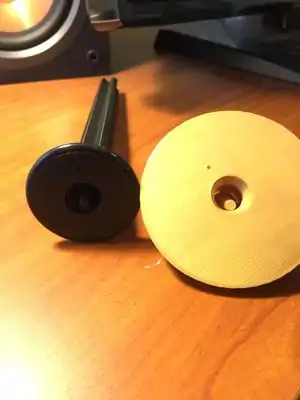 Check valve cones after being twisted free
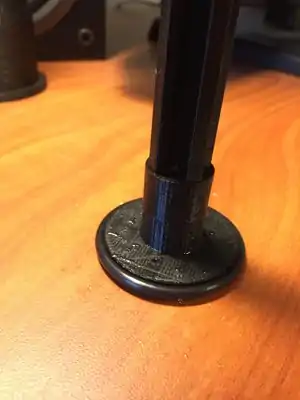 O-ring fitted on piston
Time Estimates
- Total Print Time: ~16 hrs
- Total Assembly Time: ~1min
Common Problems and Solutions
- Piston won't slide: Lubricate the pump body with water before attempting to slide piston in body. If this doesn't fix the issue sand some plastic off of the piston to decrease the total diameter.
- O-ring slides off piston while pumping: Decrease the pumping speed and ensure that the force pumping is directed vertically.
Cost savings
- Filament:~$4.00
- O-ring: $0.48
- Commercial equivalent hand pumps typically range from $20-$200
- Assuming a commercial hand pump costs ~$60.00(rough median) the cost savings would be $55.52 or about 92%
References
This article is issued from Appropedia. The text is licensed under Creative Commons - Attribution - Sharealike. Additional terms may apply for the media files.